

416
HETEROCYCLES
11.4.3 Tautomerism: pyridones
The pyridine ring system may carry substituents, just
as we have seen with benzene rings. We have encountered a number of such derivatives in the previous
section. Hydroxy or amino heterocycles, however,
may sometimes exist in tautomeric forms. We have
met the concept of tautomerism primarily with carbonyl compounds, and have seen the isomerization of
keto and enol tautomers (see Section 10.1). In certain
cases, e.g. 1,3-dicarbonyl compounds, the enol form
is a major component of the equilibrium mixture.
In the example shown, liquid acetylacetone contains
about 76% of the enol tautomer.
O
O
OH O
keto form
enol form
acetylacetone
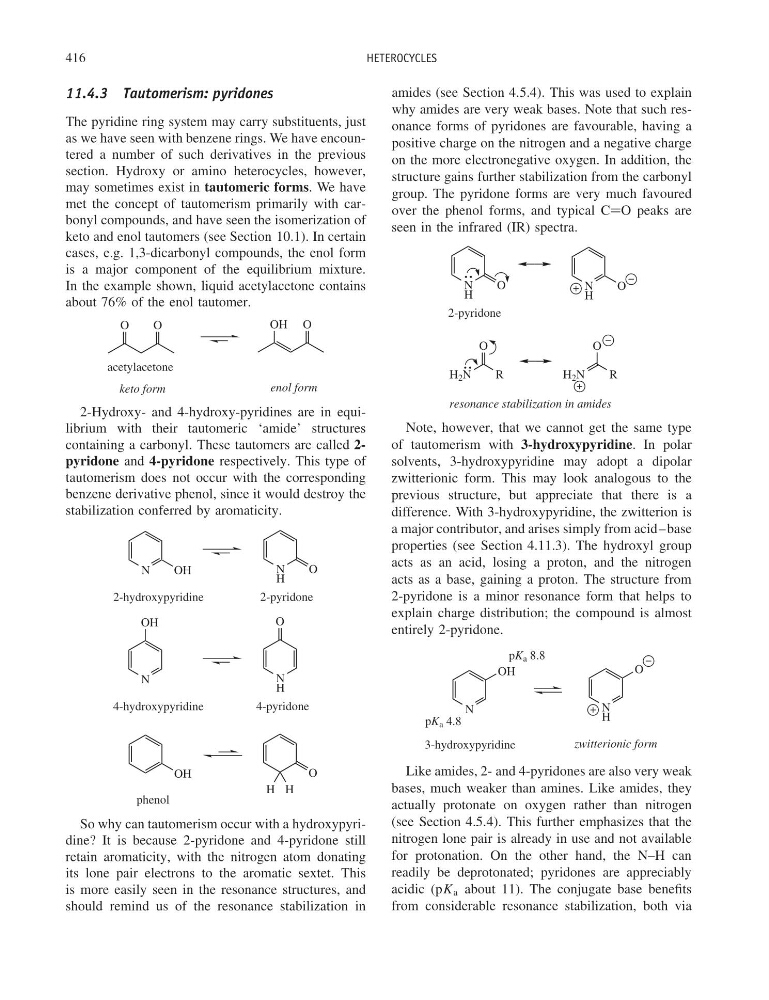
2-Hydroxy- and 4-hydroxy-pyridines are in equilibrium with their tautomeric ‘amide’ structures
containing a carbonyl. These tautomers are called 2pyridone and 4-pyridone respectively. This type of
tautomerism does not occur with the corresponding
benzene derivative phenol, since it would destroy the
stabilization conferred by aromaticity.
N
OH
N
H
O
N
OH
N
H
O
2-pyridone
4-pyridone
OH
O
phenol
2-hydroxypyridine
4-hydroxypyridine
H H
So why can tautomerism occur with a hydroxypyridine? It is because 2-pyridone and 4-pyridone still
retain aromaticity, with the nitrogen atom donating
its lone pair electrons to the aromatic sextet. This
is more easily seen in the resonance structures, and
should remind us of the resonance stabilization in
amides (see Section 4.5.4). This was used to explain
why amides are very weak bases. Note that such resonance forms of pyridones are favourable, having a
positive charge on the nitrogen and a negative charge
on the more electronegative oxygen. In addition, the
structure gains further stabilization from the carbonyl
group. The pyridone forms are very much favoured
over the phenol forms, and typical C=O peaks are
seen in the infrared (IR) spectra.
N
H
O
2-pyridone
N
H
O
O
R
H 2 N
O
R
H 2 N
resonance stabilization in amides
Note, however, that we cannot get the same type
of tautomerism with 3-hydroxypyridine. In polar
solvents, 3-hydroxypyridine may adopt a dipolar
zwitterionic form. This may look analogous to the
previous structure, but appreciate that there is a
difference. With 3-hydroxypyridine, the zwitterion is
a major contributor, and arises simply from acid–base
properties (see Section 4.11.3). The hydroxyl group
acts as an acid, losing a proton, and the nitrogen
acts as a base, gaining a proton. The structure from
2-pyridone is a minor resonance form that helps to
explain charge distribution; the compound is almost
entirely 2-pyridone.
N
OH
3-hydroxypyridine
N
H
O
zwitterionic form
pK a 4.8
pK a 8.8
Like amides, 2- and 4-pyridones are also very weak
bases, much weaker than amines. Like amides, they
actually protonate on oxygen rather than nitrogen
(see Section 4.5.4). This further emphasizes that the
nitrogen lone pair is already in use and not available
for protonation. On the other hand, the N–H can
readily be deprotonated; pyridones are appreciably
acidic (pK a about 11). The conjugate base benefits
from considerable resonance stabilization, both via
HETEROCYCLES
11.4.3 Tautomerism: pyridones
The pyridine ring system may carry substituents, just
as we have seen with benzene rings. We have encountered a number of such derivatives in the previous
section. Hydroxy or amino heterocycles, however,
may sometimes exist in tautomeric forms. We have
met the concept of tautomerism primarily with carbonyl compounds, and have seen the isomerization of
keto and enol tautomers (see Section 10.1). In certain
cases, e.g. 1,3-dicarbonyl compounds, the enol form
is a major component of the equilibrium mixture.
In the example shown, liquid acetylacetone contains
about 76% of the enol tautomer.
O
O
OH O
keto form
enol form
acetylacetone
2-Hydroxy- and 4-hydroxy-pyridines are in equilibrium with their tautomeric ‘amide’ structures
containing a carbonyl. These tautomers are called 2pyridone and 4-pyridone respectively. This type of
tautomerism does not occur with the corresponding
benzene derivative phenol, since it would destroy the
stabilization conferred by aromaticity.
N
OH
N
H
O
N
OH
N
H
O
2-pyridone
4-pyridone
OH
O
phenol
2-hydroxypyridine
4-hydroxypyridine
H H
So why can tautomerism occur with a hydroxypyridine? It is because 2-pyridone and 4-pyridone still
retain aromaticity, with the nitrogen atom donating
its lone pair electrons to the aromatic sextet. This
is more easily seen in the resonance structures, and
should remind us of the resonance stabilization in
amides (see Section 4.5.4). This was used to explain
why amides are very weak bases. Note that such resonance forms of pyridones are favourable, having a
positive charge on the nitrogen and a negative charge
on the more electronegative oxygen. In addition, the
structure gains further stabilization from the carbonyl
group. The pyridone forms are very much favoured
over the phenol forms, and typical C=O peaks are
seen in the infrared (IR) spectra.
N
H
O
2-pyridone
N
H
O
O
R
H 2 N
O
R
H 2 N
resonance stabilization in amides
Note, however, that we cannot get the same type
of tautomerism with 3-hydroxypyridine. In polar
solvents, 3-hydroxypyridine may adopt a dipolar
zwitterionic form. This may look analogous to the
previous structure, but appreciate that there is a
difference. With 3-hydroxypyridine, the zwitterion is
a major contributor, and arises simply from acid–base
properties (see Section 4.11.3). The hydroxyl group
acts as an acid, losing a proton, and the nitrogen
acts as a base, gaining a proton. The structure from
2-pyridone is a minor resonance form that helps to
explain charge distribution; the compound is almost
entirely 2-pyridone.
N
OH
3-hydroxypyridine
N
H
O
zwitterionic form
pK a 4.8
pK a 8.8
Like amides, 2- and 4-pyridones are also very weak
bases, much weaker than amines. Like amides, they
actually protonate on oxygen rather than nitrogen
(see Section 4.5.4). This further emphasizes that the
nitrogen lone pair is already in use and not available
for protonation. On the other hand, the N–H can
readily be deprotonated; pyridones are appreciably
acidic (pK a about 11). The conjugate base benefits
from considerable resonance stabilization, both via