

SIX-MEMBERED AROMATIC HETEROCYCLES
415
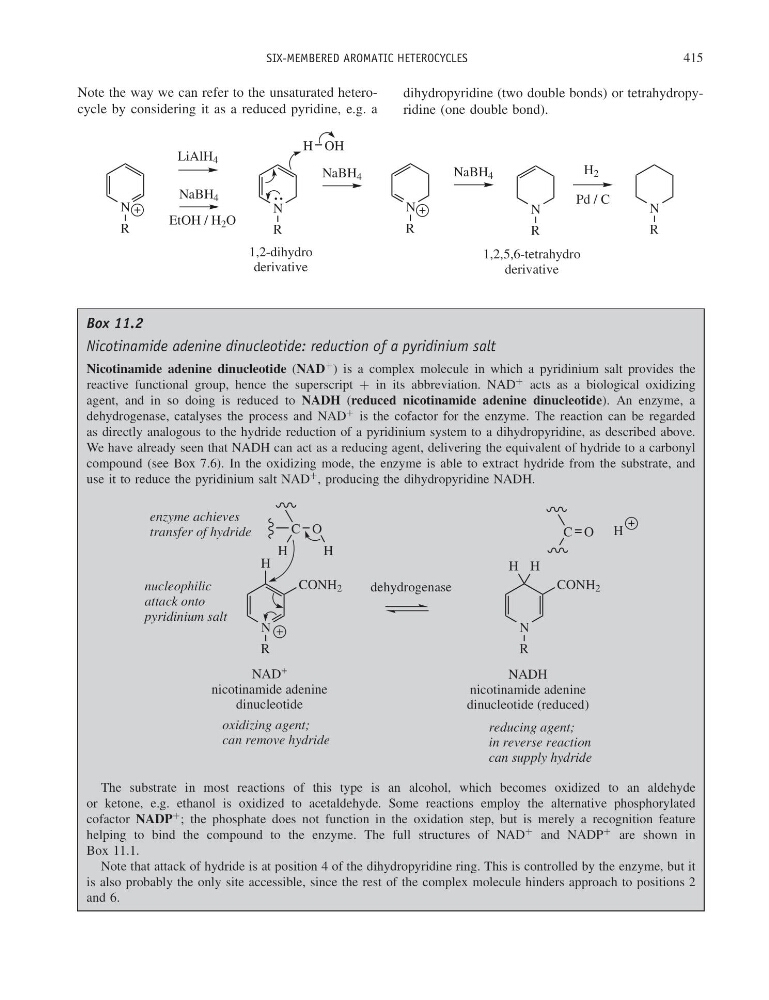
Note the way we can refer to the unsaturated heterocycle by considering it as a reduced pyridine, e.g. a
dihydropyridine (two double bonds) or tetrahydropyridine (one double bond).
N
R
LiAlH 4
N
R
1,2-dihydro
derivative
NaBH 4
NaBH 4
H OH
EtOH / H 2 O
N
R
NaBH 4
N
R
H 2
Pd / C
N
R
1,2,5,6-tetrahydro
derivative
Box 11.2
Nicotinamide adenine dinucleotide: reduction of a pyridinium salt
Nicotinamide adenine dinucleotide (NAD
+ ) is a complex molecule in which a pyridinium salt provides the
reactive functional group, hence the superscript + in its abbreviation. NAD
+ acts as a biological oxidizing
agent, and in so doing is reduced to NADH (reduced nicotinamide adenine dinucleotide). An enzyme, a
dehydrogenase, catalyses the process and NAD
+ is the cofactor for the enzyme. The reaction can be regarded
as directly analogous to the hydride reduction of a pyridinium system to a dihydropyridine, as described above.
We have already seen that NADH can act as a reducing agent, delivering the equivalent of hydride to a carbonyl
compound (see Box 7.6). In the oxidizing mode, the enzyme is able to extract hydride from the substrate, and
use it to reduce the pyridinium salt NAD
+ , producing the dihydropyridine NADH.
N
R
CONH 2
H
H
C O
N
R
CONH 2
C
H
H
NADH
nicotinamide adenine
dinucleotide (reduced)
dehydrogenase
NAD
+
nicotinamide adenine
dinucleotide
reducing agent;
in reverse reaction
can supply hydride
oxidizing agent;
can remove hydride
O
H
enzyme achieves
transfer of hydride
nucleophilic
attack onto
pyridinium salt
H
The substrate in most reactions of this type is an alcohol, which becomes oxidized to an aldehyde
or ketone, e.g. ethanol is oxidized to acetaldehyde. Some reactions employ the alternative phosphorylated
cofactor NADP
+ ; the phosphate does not function in the oxidation step, but is merely a recognition feature
helping to bind the compound to the enzyme. The full structures of NAD
+ and NADP
+ are shown in
Box 11.1.
Note that attack of hydride is at position 4 of the dihydropyridine ring. This is controlled by the enzyme, but it
is also probably the only site accessible, since the rest of the complex molecule hinders approach to positions 2
and 6.
415
Note the way we can refer to the unsaturated heterocycle by considering it as a reduced pyridine, e.g. a
dihydropyridine (two double bonds) or tetrahydropyridine (one double bond).
N
R
LiAlH 4
N
R
1,2-dihydro
derivative
NaBH 4
NaBH 4
H OH
EtOH / H 2 O
N
R
NaBH 4
N
R
H 2
Pd / C
N
R
1,2,5,6-tetrahydro
derivative
Box 11.2
Nicotinamide adenine dinucleotide: reduction of a pyridinium salt
Nicotinamide adenine dinucleotide (NAD
+ ) is a complex molecule in which a pyridinium salt provides the
reactive functional group, hence the superscript + in its abbreviation. NAD
+ acts as a biological oxidizing
agent, and in so doing is reduced to NADH (reduced nicotinamide adenine dinucleotide). An enzyme, a
dehydrogenase, catalyses the process and NAD
+ is the cofactor for the enzyme. The reaction can be regarded
as directly analogous to the hydride reduction of a pyridinium system to a dihydropyridine, as described above.
We have already seen that NADH can act as a reducing agent, delivering the equivalent of hydride to a carbonyl
compound (see Box 7.6). In the oxidizing mode, the enzyme is able to extract hydride from the substrate, and
use it to reduce the pyridinium salt NAD
+ , producing the dihydropyridine NADH.
N
R
CONH 2
H
H
C O
N
R
CONH 2
C
H
H
NADH
nicotinamide adenine
dinucleotide (reduced)
dehydrogenase
NAD
+
nicotinamide adenine
dinucleotide
reducing agent;
in reverse reaction
can supply hydride
oxidizing agent;
can remove hydride
O
H
enzyme achieves
transfer of hydride
nucleophilic
attack onto
pyridinium salt
H
The substrate in most reactions of this type is an alcohol, which becomes oxidized to an aldehyde
or ketone, e.g. ethanol is oxidized to acetaldehyde. Some reactions employ the alternative phosphorylated
cofactor NADP
+ ; the phosphate does not function in the oxidation step, but is merely a recognition feature
helping to bind the compound to the enzyme. The full structures of NAD
+ and NADP
+ are shown in
Box 11.1.
Note that attack of hydride is at position 4 of the dihydropyridine ring. This is controlled by the enzyme, but it
is also probably the only site accessible, since the rest of the complex molecule hinders approach to positions 2
and 6.