

SIX-MEMBERED AROMATIC HETEROCYCLES
417
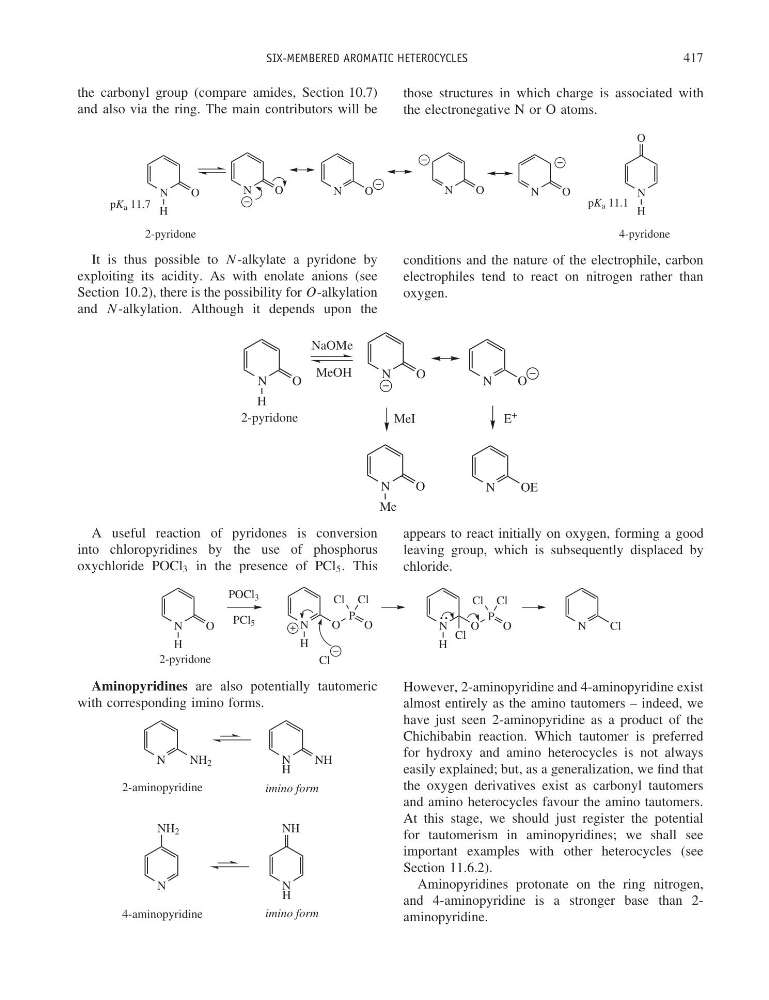
the carbonyl group (compare amides, Section 10.7)
and also via the ring. The main contributors will be
those structures in which charge is associated with
the electronegative N or O atoms.
N
O
N
O
N
O
2-pyridone
H
N
O
N
O
pK a 11.7
N
O
4-pyridone
pK a 11.1
H
It is thus possible to N -alkylate a pyridone by
exploiting its acidity. As with enolate anions (see
Section 10.2), there is the possibility for O-alkylation
and N -alkylation. Although it depends upon the
conditions and the nature of the electrophile, carbon
electrophiles tend to react on nitrogen rather than
oxygen.
N
O
N
O
2-pyridone
H
N
O
NaOMe
MeOH
MeI
N
O
N
OE
Me
E
+
A useful reaction of pyridones is conversion
into chloropyridines by the use of phosphorus
oxychloride POCl 3 in the presence of PCl 5 . This
appears to react initially on oxygen, forming a good
leaving group, which is subsequently displaced by
chloride.
N
O
2-pyridone
H
POCl 3
N
O
H
P
O
Cl
Cl
Cl
N
O
H
P
O
Cl
Cl
Cl
N
Cl
PCl 5
Aminopyridines are also potentially tautomeric
with corresponding imino forms.
N
NH 2
N
H
NH
N
NH 2
N
H
NH
imino form
imino form
2-aminopyridine
4-aminopyridine
However, 2-aminopyridine and 4-aminopyridine exist
almost entirely as the amino tautomers – indeed, we
have just seen 2-aminopyridine as a product of the
Chichibabin reaction. Which tautomer is preferred
for hydroxy and amino heterocycles is not always
easily explained; but, as a generalization, we find that
the oxygen derivatives exist as carbonyl tautomers
and amino heterocycles favour the amino tautomers.
At this stage, we should just register the potential
for tautomerism in aminopyridines; we shall see
important examples with other heterocycles (see
Section 11.6.2).
Aminopyridines protonate on the ring nitrogen,
and 4-aminopyridine is a stronger base than 2aminopyridine.
417
the carbonyl group (compare amides, Section 10.7)
and also via the ring. The main contributors will be
those structures in which charge is associated with
the electronegative N or O atoms.
N
O
N
O
N
O
2-pyridone
H
N
O
N
O
pK a 11.7
N
O
4-pyridone
pK a 11.1
H
It is thus possible to N -alkylate a pyridone by
exploiting its acidity. As with enolate anions (see
Section 10.2), there is the possibility for O-alkylation
and N -alkylation. Although it depends upon the
conditions and the nature of the electrophile, carbon
electrophiles tend to react on nitrogen rather than
oxygen.
N
O
N
O
2-pyridone
H
N
O
NaOMe
MeOH
MeI
N
O
N
OE
Me
E
+
A useful reaction of pyridones is conversion
into chloropyridines by the use of phosphorus
oxychloride POCl 3 in the presence of PCl 5 . This
appears to react initially on oxygen, forming a good
leaving group, which is subsequently displaced by
chloride.
N
O
2-pyridone
H
POCl 3
N
O
H
P
O
Cl
Cl
Cl
N
O
H
P
O
Cl
Cl
Cl
N
Cl
PCl 5
Aminopyridines are also potentially tautomeric
with corresponding imino forms.
N
NH 2
N
H
NH
N
NH 2
N
H
NH
imino form
imino form
2-aminopyridine
4-aminopyridine
However, 2-aminopyridine and 4-aminopyridine exist
almost entirely as the amino tautomers – indeed, we
have just seen 2-aminopyridine as a product of the
Chichibabin reaction. Which tautomer is preferred
for hydroxy and amino heterocycles is not always
easily explained; but, as a generalization, we find that
the oxygen derivatives exist as carbonyl tautomers
and amino heterocycles favour the amino tautomers.
At this stage, we should just register the potential
for tautomerism in aminopyridines; we shall see
important examples with other heterocycles (see
Section 11.6.2).
Aminopyridines protonate on the ring nitrogen,
and 4-aminopyridine is a stronger base than 2aminopyridine.