

410
HETEROCYCLES
C-2 or C-4 will be unfavourable, in that one of
the resonance forms features an unstable electrondeficient nitrogen cation. Attack at C-3 is the more
likely, simply based on an inspection of resonance
structures for the addition cation. However, electrophilic attack still tends to be unfavourable, because
many electrophilic reagents, e.g. HNO 3 –H 2 SO 4 , are
strongly acidic, and the first effect is protonation on nitrogen. Attack of E
+ on to a positively
charged pyridinium cation is even less favourable.
Under acidic conditions, we require attack on free
pyridine, the concentration of which will be very
small. Thus, under equivalent conditions, pyridine
undergoes electrophilic substitution very much more
slowly than benzene, by a factor of about 10
6 . Even
Friedel–Crafts acylations are inhibited, because the
nitrogen complexes with the Lewis acid, again leading to a cationic nitrogen.
N
N
H
HNO 3
H 2 SO 4
HNO 3
H 2 SO 4
no reaction
N
N
AlCl 3
RCOCl
AlCl 3
no reaction
RCOCl
AlCl 3
A striking demonstration of the reduced activity
towards electrophiles for the pyridine ring compared
with the benzene ring will be seen later when
we consider the fused heterocycles quinoline and
isoquinoline (see Section 11.8.1). These contain a
benzene ring fused to a pyridine ring; electrophilic
substitution occurs exclusively in the benzene ring.
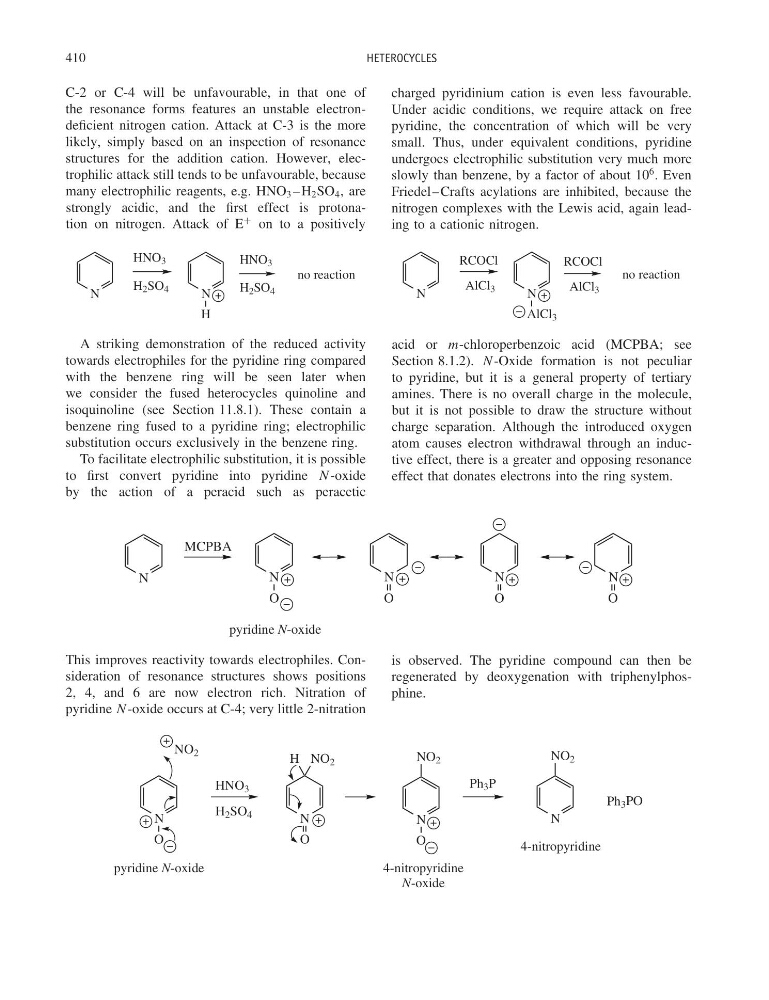
To facilitate electrophilic substitution, it is possible
to first convert pyridine into pyridine N -oxide
by the action of a peracid such as peracetic
acid or m-chloroperbenzoic acid (MCPBA; see
Section 8.1.2). N -Oxide formation is not peculiar
to pyridine, but it is a general property of tertiary
amines. There is no overall charge in the molecule,
but it is not possible to draw the structure without
charge separation. Although the introduced oxygen
atom causes electron withdrawal through an inductive effect, there is a greater and opposing resonance
effect that donates electrons into the ring system.
N
MCPBA
N
O
pyridine N-oxide
N
O
N
O
N
O
This improves reactivity towards electrophiles. Consideration of resonance structures shows positions
2, 4, and 6 are now electron rich. Nitration of
pyridine N -oxide occurs at C-4; very little 2-nitration
is observed. The pyridine compound can then be
regenerated by deoxygenation with triphenylphosphine.
N
O
pyridine N-oxide
NO 2
HNO 3
H 2 SO 4
N
O
NO 2
H
N
O
NO 2
4-nitropyridine
N-oxide
Ph 3 P
N
NO 2
4-nitropyridine
Ph 3 PO
HETEROCYCLES
C-2 or C-4 will be unfavourable, in that one of
the resonance forms features an unstable electrondeficient nitrogen cation. Attack at C-3 is the more
likely, simply based on an inspection of resonance
structures for the addition cation. However, electrophilic attack still tends to be unfavourable, because
many electrophilic reagents, e.g. HNO 3 –H 2 SO 4 , are
strongly acidic, and the first effect is protonation on nitrogen. Attack of E
+ on to a positively
charged pyridinium cation is even less favourable.
Under acidic conditions, we require attack on free
pyridine, the concentration of which will be very
small. Thus, under equivalent conditions, pyridine
undergoes electrophilic substitution very much more
slowly than benzene, by a factor of about 10
6 . Even
Friedel–Crafts acylations are inhibited, because the
nitrogen complexes with the Lewis acid, again leading to a cationic nitrogen.
N
N
H
HNO 3
H 2 SO 4
HNO 3
H 2 SO 4
no reaction
N
N
AlCl 3
RCOCl
AlCl 3
no reaction
RCOCl
AlCl 3
A striking demonstration of the reduced activity
towards electrophiles for the pyridine ring compared
with the benzene ring will be seen later when
we consider the fused heterocycles quinoline and
isoquinoline (see Section 11.8.1). These contain a
benzene ring fused to a pyridine ring; electrophilic
substitution occurs exclusively in the benzene ring.
To facilitate electrophilic substitution, it is possible
to first convert pyridine into pyridine N -oxide
by the action of a peracid such as peracetic
acid or m-chloroperbenzoic acid (MCPBA; see
Section 8.1.2). N -Oxide formation is not peculiar
to pyridine, but it is a general property of tertiary
amines. There is no overall charge in the molecule,
but it is not possible to draw the structure without
charge separation. Although the introduced oxygen
atom causes electron withdrawal through an inductive effect, there is a greater and opposing resonance
effect that donates electrons into the ring system.
N
MCPBA
N
O
pyridine N-oxide
N
O
N
O
N
O
This improves reactivity towards electrophiles. Consideration of resonance structures shows positions
2, 4, and 6 are now electron rich. Nitration of
pyridine N -oxide occurs at C-4; very little 2-nitration
is observed. The pyridine compound can then be
regenerated by deoxygenation with triphenylphosphine.
N
O
pyridine N-oxide
NO 2
HNO 3
H 2 SO 4
N
O
NO 2
H
N
O
NO 2
4-nitropyridine
N-oxide
Ph 3 P
N
NO 2
4-nitropyridine
Ph 3 PO