

SIX-MEMBERED AROMATIC HETEROCYCLES
411
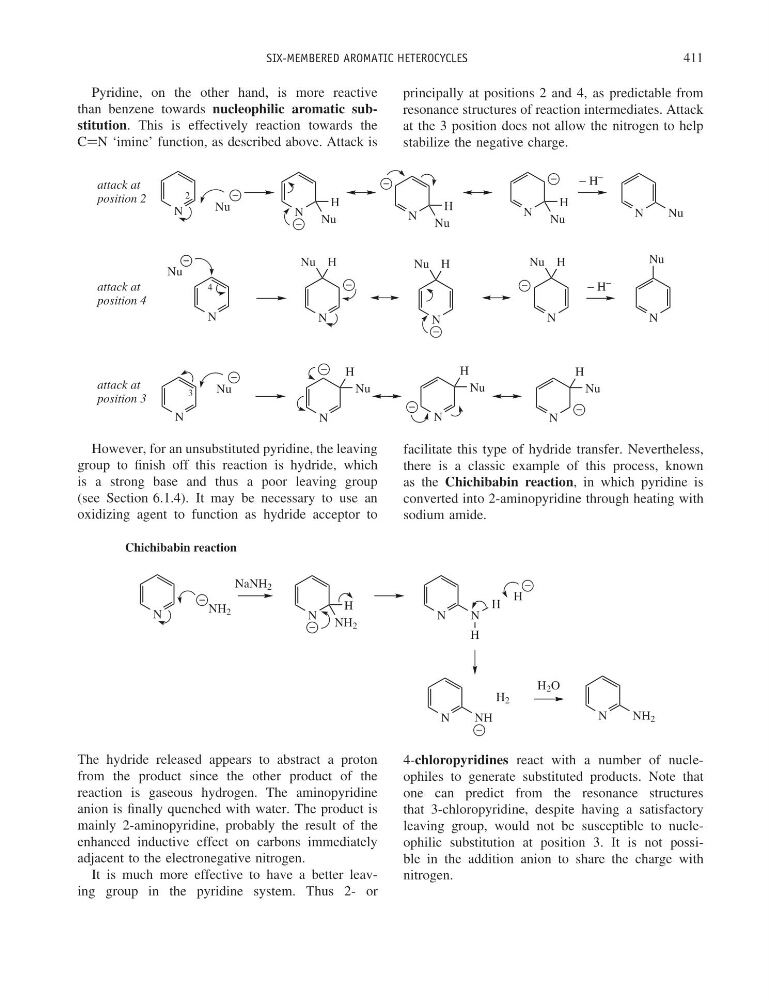
Pyridine, on the other hand, is more reactive
than benzene towards nucleophilic aromatic substitution. This is effectively reaction towards the
C=N ‘imine’ function, as described above. Attack is
principally at positions 2 and 4, as predictable from
resonance structures of reaction intermediates. Attack
at the 3 position does not allow the nitrogen to help
stabilize the negative charge.
N
Nu
N
H
Nu
N
H
Nu
N
H
Nu
− H −
N
Nu
N
Nu
N
N
N
− H
−
N
H
Nu
H
Nu
H
Nu
Nu
N
Nu
N
Nu
H
N
Nu
H
N
Nu
H
2
3
4
attack at
position 2
attack at
position 4
attack at
position 3
However, for an unsubstituted pyridine, the leaving
group to finish off this reaction is hydride, which
is a strong base and thus a poor leaving group
(see Section 6.1.4). It may be necessary to use an
oxidizing agent to function as hydride acceptor to
facilitate this type of hydride transfer. Nevertheless,
there is a classic example of this process, known
as the Chichibabin reaction, in which pyridine is
converted into 2-aminopyridine through heating with
sodium amide.
N
N
H
NH 2
Chichibabin reaction
NH 2
NaNH 2
N
N
N
NH
H
H 2
H
N
NH 2
H 2 O
H
The hydride released appears to abstract a proton
from the product since the other product of the
reaction is gaseous hydrogen. The aminopyridine
anion is finally quenched with water. The product is
mainly 2-aminopyridine, probably the result of the
enhanced inductive effect on carbons immediately
adjacent to the electronegative nitrogen.
It is much more effective to have a better leaving group in the pyridine system. Thus 2- or
4-chloropyridines react with a number of nucleophiles to generate substituted products. Note that
one can predict from the resonance structures
that 3-chloropyridine, despite having a satisfactory
leaving group, would not be susceptible to nucleophilic substitution at position 3. It is not possible in the addition anion to share the charge with
nitrogen.
411
Pyridine, on the other hand, is more reactive
than benzene towards nucleophilic aromatic substitution. This is effectively reaction towards the
C=N ‘imine’ function, as described above. Attack is
principally at positions 2 and 4, as predictable from
resonance structures of reaction intermediates. Attack
at the 3 position does not allow the nitrogen to help
stabilize the negative charge.
N
Nu
N
H
Nu
N
H
Nu
N
H
Nu
− H −
N
Nu
N
Nu
N
N
N
− H
−
N
H
Nu
H
Nu
H
Nu
Nu
N
Nu
N
Nu
H
N
Nu
H
N
Nu
H
2
3
4
attack at
position 2
attack at
position 4
attack at
position 3
However, for an unsubstituted pyridine, the leaving
group to finish off this reaction is hydride, which
is a strong base and thus a poor leaving group
(see Section 6.1.4). It may be necessary to use an
oxidizing agent to function as hydride acceptor to
facilitate this type of hydride transfer. Nevertheless,
there is a classic example of this process, known
as the Chichibabin reaction, in which pyridine is
converted into 2-aminopyridine through heating with
sodium amide.
N
N
H
NH 2
Chichibabin reaction
NH 2
NaNH 2
N
N
N
NH
H
H 2
H
N
NH 2
H 2 O
H
The hydride released appears to abstract a proton
from the product since the other product of the
reaction is gaseous hydrogen. The aminopyridine
anion is finally quenched with water. The product is
mainly 2-aminopyridine, probably the result of the
enhanced inductive effect on carbons immediately
adjacent to the electronegative nitrogen.
It is much more effective to have a better leaving group in the pyridine system. Thus 2- or
4-chloropyridines react with a number of nucleophiles to generate substituted products. Note that
one can predict from the resonance structures
that 3-chloropyridine, despite having a satisfactory
leaving group, would not be susceptible to nucleophilic substitution at position 3. It is not possible in the addition anion to share the charge with
nitrogen.