

SIX-MEMBERED AROMATIC HETEROCYCLES
409
N
RCOCl
N
Cl
R
O
N-acylpyridinium chloride
N
Ac 2 O
N
AcO
H 3 C
O
N-acetylpyridinium acetate
ArOH
N
OAr
H 3 C
O
ester
R´OH
N
OR´
R
O
ester
HCl
HOAc
H 2 O
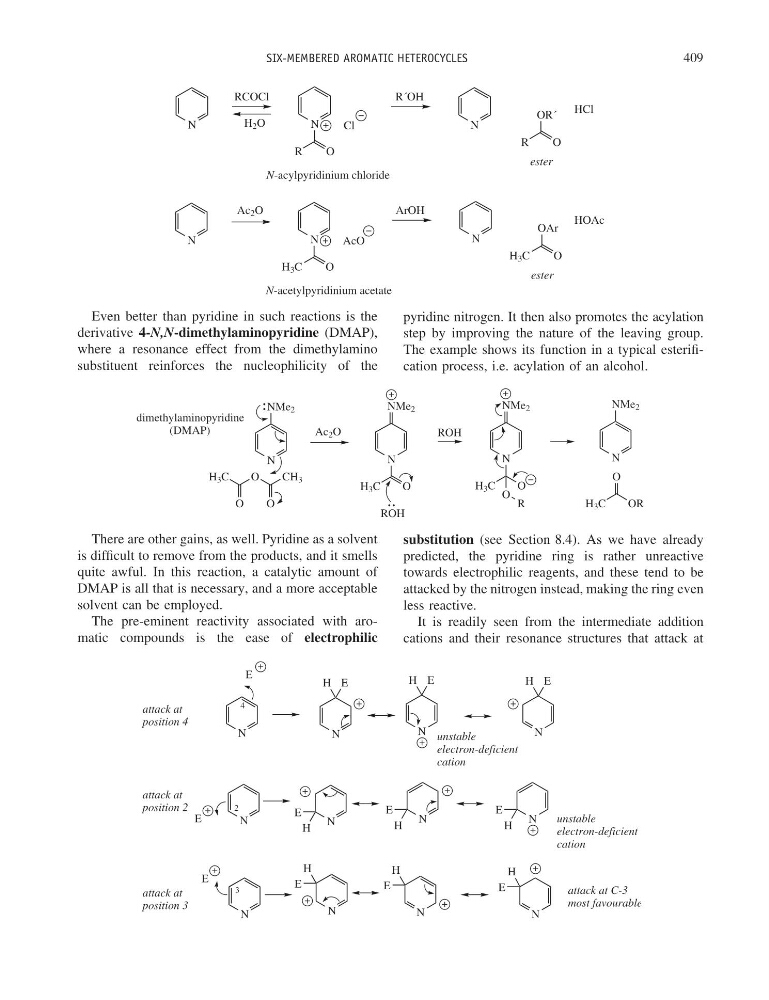
Even better than pyridine in such reactions is the
derivative 4-N,N-dimethylaminopyridine (DMAP),
where a resonance effect from the dimethylamino
substituent reinforces the nucleophilicity of the
pyridine nitrogen. It then also promotes the acylation
step by improving the nature of the leaving group.
The example shows its function in a typical esterification process, i.e. acylation of an alcohol.
N
Ac 2 O
N
H 3 C
O
NMe 2
dimethylaminopyridine
(DMAP)
H 3 C
O
CH 3
O
O
NMe 2
ROH
N
H 3 C
O
NMe 2
O
R
N
NMe 2
ROH
H 3 C
OR
O
There are other gains, as well. Pyridine as a solvent
is difficult to remove from the products, and it smells
quite awful. In this reaction, a catalytic amount of
DMAP is all that is necessary, and a more acceptable
solvent can be employed.
The pre-eminent reactivity associated with aromatic compounds is the ease of electrophilic
substitution (see Section 8.4). As we have already
predicted, the pyridine ring is rather unreactive
towards electrophilic reagents, and these tend to be
attacked by the nitrogen instead, making the ring even
less reactive.
It is readily seen from the intermediate addition
cations and their resonance structures that attack at
N
E
N
N
E
H
H E
unstable
electron-deficient
cation
N
E
N
E
H
N
N
E
N
N
E
H
E
H
4
3
2
E
H
N
H E
N
E
H
unstable
electron-deficient
cation
N
E
H
attack at C-3
most favourable
attack at
position 4
attack at
position 2
attack at
position 3
409
N
RCOCl
N
Cl
R
O
N-acylpyridinium chloride
N
Ac 2 O
N
AcO
H 3 C
O
N-acetylpyridinium acetate
ArOH
N
OAr
H 3 C
O
ester
R´OH
N
OR´
R
O
ester
HCl
HOAc
H 2 O
Even better than pyridine in such reactions is the
derivative 4-N,N-dimethylaminopyridine (DMAP),
where a resonance effect from the dimethylamino
substituent reinforces the nucleophilicity of the
pyridine nitrogen. It then also promotes the acylation
step by improving the nature of the leaving group.
The example shows its function in a typical esterification process, i.e. acylation of an alcohol.
N
Ac 2 O
N
H 3 C
O
NMe 2
dimethylaminopyridine
(DMAP)
H 3 C
O
CH 3
O
O
NMe 2
ROH
N
H 3 C
O
NMe 2
O
R
N
NMe 2
ROH
H 3 C
OR
O
There are other gains, as well. Pyridine as a solvent
is difficult to remove from the products, and it smells
quite awful. In this reaction, a catalytic amount of
DMAP is all that is necessary, and a more acceptable
solvent can be employed.
The pre-eminent reactivity associated with aromatic compounds is the ease of electrophilic
substitution (see Section 8.4). As we have already
predicted, the pyridine ring is rather unreactive
towards electrophilic reagents, and these tend to be
attacked by the nitrogen instead, making the ring even
less reactive.
It is readily seen from the intermediate addition
cations and their resonance structures that attack at
N
E
N
N
E
H
H E
unstable
electron-deficient
cation
N
E
N
E
H
N
N
E
N
N
E
H
E
H
4
3
2
E
H
N
H E
N
E
H
unstable
electron-deficient
cation
N
E
H
attack at C-3
most favourable
attack at
position 4
attack at
position 2
attack at
position 3