

408
HETEROCYCLES
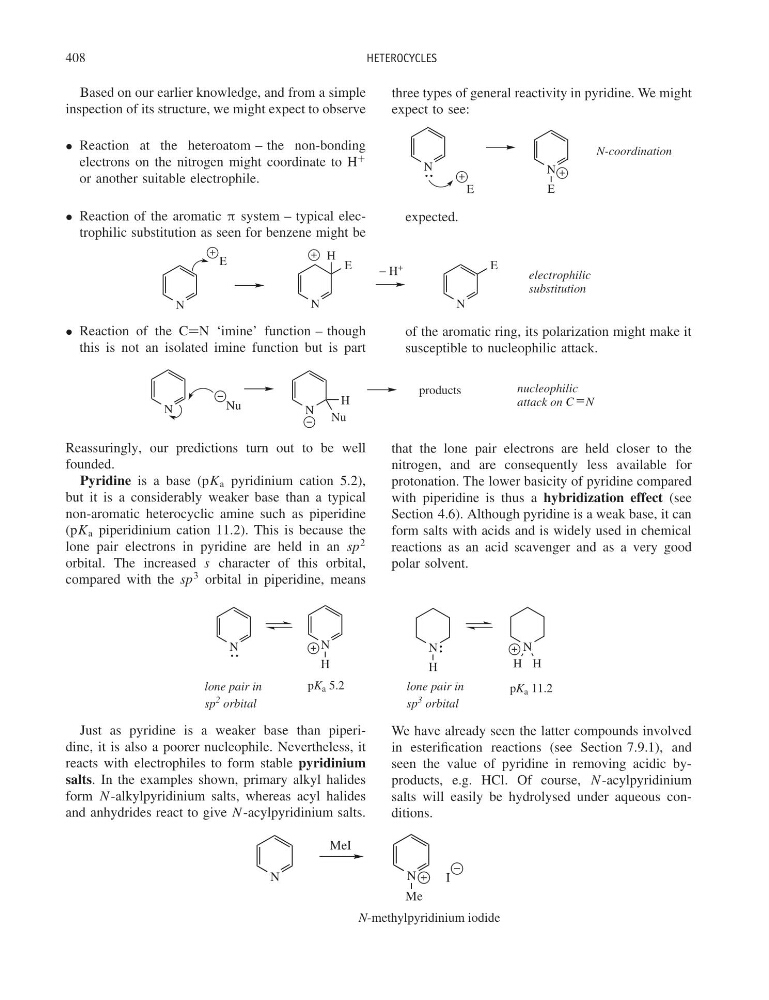
Based on our earlier knowledge, and from a simple
inspection of its structure, we might expect to observe
three types of general reactivity in pyridine. We might
expect to see:
• Reaction at the heteroatom – the non-bonding
electrons on the nitrogen might coordinate to H
+
or another suitable electrophile.
N
E
N
E
N-coordination
• Reaction of the aromatic π system – typical electrophilic substitution as seen for benzene might be
expected.
N
N
E
E
H
N
E
− H +
electrophilic
substitution
• Reaction of the C=N ‘imine’ function – though
this is not an isolated imine function but is part
of the aromatic ring, its polarization might make it
susceptible to nucleophilic attack.
N
Nu
N
H
Nu
nucleophilic
attack on
products
C N
Reassuringly, our predictions turn out to be well
founded.
Pyridine is a base (pK a pyridinium cation 5.2),
but it is a considerably weaker base than a typical
non-aromatic heterocyclic amine such as piperidine
(pK a piperidinium cation 11.2). This is because the
lone pair electrons in pyridine are held in an sp
2
orbital. The increased s character of this orbital,
compared with the sp
3 orbital in piperidine, means
that the lone pair electrons are held closer to the
nitrogen, and are consequently less available for
protonation. The lower basicity of pyridine compared
with piperidine is thus a hybridization effect (see
Section 4.6). Although pyridine is a weak base, it can
form salts with acids and is widely used in chemical
reactions as an acid scavenger and as a very good
polar solvent.
N
H
pK a 5.2
N
H
N
N
H
H
pK a 11.2
lone pair in
sp
2 orbital
lone pair in
sp 3 orbital
Just as pyridine is a weaker base than piperidine, it is also a poorer nucleophile. Nevertheless, it
reacts with electrophiles to form stable pyridinium
salts. In the examples shown, primary alkyl halides
form N -alkylpyridinium salts, whereas acyl halides
and anhydrides react to give N -acylpyridinium salts.
We have already seen the latter compounds involved
in esterification reactions (see Section 7.9.1), and
seen the value of pyridine in removing acidic byproducts, e.g. HCl. Of course, N -acylpyridinium
salts will easily be hydrolysed under aqueous conditions.
N
MeI
N
Me
I
N-methylpyridinium iodide
HETEROCYCLES
Based on our earlier knowledge, and from a simple
inspection of its structure, we might expect to observe
three types of general reactivity in pyridine. We might
expect to see:
• Reaction at the heteroatom – the non-bonding
electrons on the nitrogen might coordinate to H
+
or another suitable electrophile.
N
E
N
E
N-coordination
• Reaction of the aromatic π system – typical electrophilic substitution as seen for benzene might be
expected.
N
N
E
E
H
N
E
− H +
electrophilic
substitution
• Reaction of the C=N ‘imine’ function – though
this is not an isolated imine function but is part
of the aromatic ring, its polarization might make it
susceptible to nucleophilic attack.
N
Nu
N
H
Nu
nucleophilic
attack on
products
C N
Reassuringly, our predictions turn out to be well
founded.
Pyridine is a base (pK a pyridinium cation 5.2),
but it is a considerably weaker base than a typical
non-aromatic heterocyclic amine such as piperidine
(pK a piperidinium cation 11.2). This is because the
lone pair electrons in pyridine are held in an sp
2
orbital. The increased s character of this orbital,
compared with the sp
3 orbital in piperidine, means
that the lone pair electrons are held closer to the
nitrogen, and are consequently less available for
protonation. The lower basicity of pyridine compared
with piperidine is thus a hybridization effect (see
Section 4.6). Although pyridine is a weak base, it can
form salts with acids and is widely used in chemical
reactions as an acid scavenger and as a very good
polar solvent.
N
H
pK a 5.2
N
H
N
N
H
H
pK a 11.2
lone pair in
sp
2 orbital
lone pair in
sp 3 orbital
Just as pyridine is a weaker base than piperidine, it is also a poorer nucleophile. Nevertheless, it
reacts with electrophiles to form stable pyridinium
salts. In the examples shown, primary alkyl halides
form N -alkylpyridinium salts, whereas acyl halides
and anhydrides react to give N -acylpyridinium salts.
We have already seen the latter compounds involved
in esterification reactions (see Section 7.9.1), and
seen the value of pyridine in removing acidic byproducts, e.g. HCl. Of course, N -acylpyridinium
salts will easily be hydrolysed under aqueous conditions.
N
MeI
N
Me
I
N-methylpyridinium iodide