

406
HETEROCYCLES
N 1.34 Å
1.39 Å
1.40 Å
1.40 Å
bond lengths in benzene and pyridine
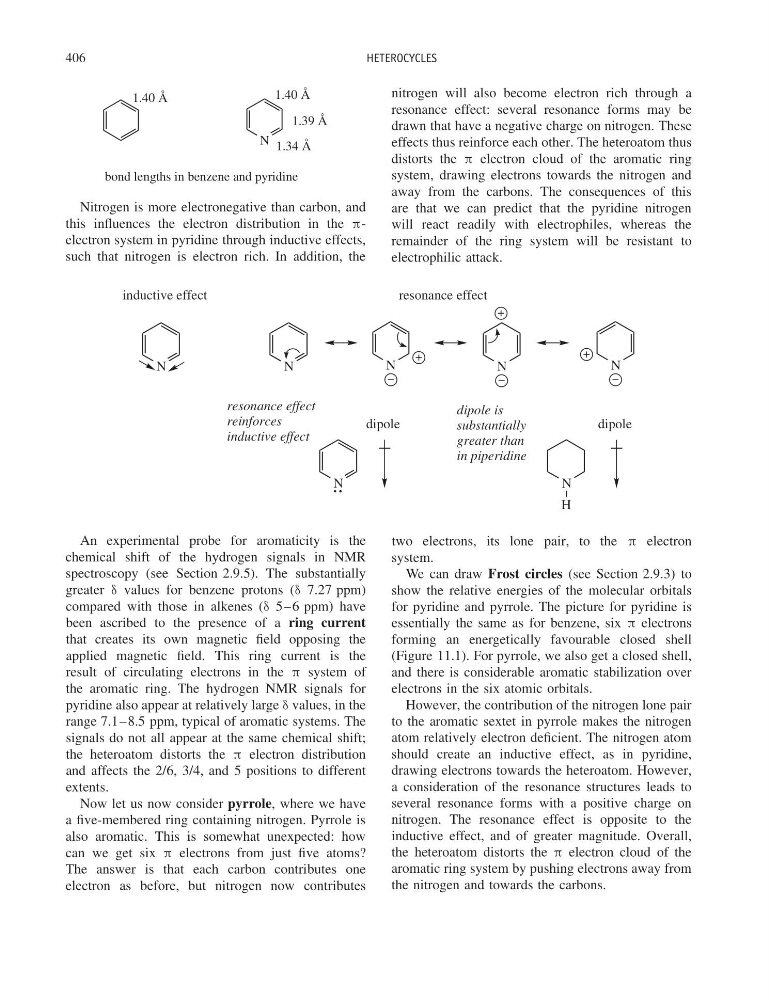
Nitrogen is more electronegative than carbon, and
this influences the electron distribution in the πelectron system in pyridine through inductive effects,
such that nitrogen is electron rich. In addition, the
nitrogen will also become electron rich through a
resonance effect: several resonance forms may be
drawn that have a negative charge on nitrogen. These
effects thus reinforce each other. The heteroatom thus
distorts the π electron cloud of the aromatic ring
system, drawing electrons towards the nitrogen and
away from the carbons. The consequences of this
are that we can predict that the pyridine nitrogen
will react readily with electrophiles, whereas the
remainder of the ring system will be resistant to
electrophilic attack.
N
N
N
N
N
dipole
N
inductive effect
resonance effect
resonance effect
reinforces
inductive effect
N
H
dipole
dipole is
substantially
greater than
in piperidine
An experimental probe for aromaticity is the
chemical shift of the hydrogen signals in NMR
spectroscopy (see Section 2.9.5). The substantially
greater δ values for benzene protons (δ 7.27 ppm)
compared with those in alkenes (δ 5–6 ppm) have
been ascribed to the presence of a ring current
that creates its own magnetic field opposing the
applied magnetic field. This ring current is the
result of circulating electrons in the π system of
the aromatic ring. The hydrogen NMR signals for
pyridine also appear at relatively large δ values, in the
range 7.1–8.5 ppm, typical of aromatic systems. The
signals do not all appear at the same chemical shift;
the heteroatom distorts the π electron distribution
and affects the 2/6, 3/4, and 5 positions to different
extents.
Now let us now consider pyrrole, where we have
a five-membered ring containing nitrogen. Pyrrole is
also aromatic. This is somewhat unexpected: how
can we get six π electrons from just five atoms?
The answer is that each carbon contributes one
electron as before, but nitrogen now contributes
two electrons, its lone pair, to the π electron
system.
We can draw Frost circles (see Section 2.9.3) to
show the relative energies of the molecular orbitals
for pyridine and pyrrole. The picture for pyridine is
essentially the same as for benzene, six π electrons
forming an energetically favourable closed shell
(Figure 11.1). For pyrrole, we also get a closed shell,
and there is considerable aromatic stabilization over
electrons in the six atomic orbitals.
However, the contribution of the nitrogen lone pair
to the aromatic sextet in pyrrole makes the nitrogen
atom relatively electron deficient. The nitrogen atom
should create an inductive effect, as in pyridine,
drawing electrons towards the heteroatom. However,
a consideration of the resonance structures leads to
several resonance forms with a positive charge on
nitrogen. The resonance effect is opposite to the
inductive effect, and of greater magnitude. Overall,
the heteroatom distorts the π electron cloud of the
aromatic ring system by pushing electrons away from
the nitrogen and towards the carbons.
HETEROCYCLES
N 1.34 Å
1.39 Å
1.40 Å
1.40 Å
bond lengths in benzene and pyridine
Nitrogen is more electronegative than carbon, and
this influences the electron distribution in the πelectron system in pyridine through inductive effects,
such that nitrogen is electron rich. In addition, the
nitrogen will also become electron rich through a
resonance effect: several resonance forms may be
drawn that have a negative charge on nitrogen. These
effects thus reinforce each other. The heteroatom thus
distorts the π electron cloud of the aromatic ring
system, drawing electrons towards the nitrogen and
away from the carbons. The consequences of this
are that we can predict that the pyridine nitrogen
will react readily with electrophiles, whereas the
remainder of the ring system will be resistant to
electrophilic attack.
N
N
N
N
N
dipole
N
inductive effect
resonance effect
resonance effect
reinforces
inductive effect
N
H
dipole
dipole is
substantially
greater than
in piperidine
An experimental probe for aromaticity is the
chemical shift of the hydrogen signals in NMR
spectroscopy (see Section 2.9.5). The substantially
greater δ values for benzene protons (δ 7.27 ppm)
compared with those in alkenes (δ 5–6 ppm) have
been ascribed to the presence of a ring current
that creates its own magnetic field opposing the
applied magnetic field. This ring current is the
result of circulating electrons in the π system of
the aromatic ring. The hydrogen NMR signals for
pyridine also appear at relatively large δ values, in the
range 7.1–8.5 ppm, typical of aromatic systems. The
signals do not all appear at the same chemical shift;
the heteroatom distorts the π electron distribution
and affects the 2/6, 3/4, and 5 positions to different
extents.
Now let us now consider pyrrole, where we have
a five-membered ring containing nitrogen. Pyrrole is
also aromatic. This is somewhat unexpected: how
can we get six π electrons from just five atoms?
The answer is that each carbon contributes one
electron as before, but nitrogen now contributes
two electrons, its lone pair, to the π electron
system.
We can draw Frost circles (see Section 2.9.3) to
show the relative energies of the molecular orbitals
for pyridine and pyrrole. The picture for pyridine is
essentially the same as for benzene, six π electrons
forming an energetically favourable closed shell
(Figure 11.1). For pyrrole, we also get a closed shell,
and there is considerable aromatic stabilization over
electrons in the six atomic orbitals.
However, the contribution of the nitrogen lone pair
to the aromatic sextet in pyrrole makes the nitrogen
atom relatively electron deficient. The nitrogen atom
should create an inductive effect, as in pyridine,
drawing electrons towards the heteroatom. However,
a consideration of the resonance structures leads to
several resonance forms with a positive charge on
nitrogen. The resonance effect is opposite to the
inductive effect, and of greater magnitude. Overall,
the heteroatom distorts the π electron cloud of the
aromatic ring system by pushing electrons away from
the nitrogen and towards the carbons.