

AROMATICITY AND HETEROAROMATICITY
405
N
H
N
H
N
H
O
N
H
pK a
(conjugate acid)
N
H
H
N
11.3
11.1
8.5
10.8
9.7, 5.3
pyrrolidine
piperidine
morpholine
diethylamine
piperazine
From the pK a values shown, there is relatively little
difference in basicities for diethylamine, pyrrolidine,
or piperidine. Note, however, that morpholine and
piperazine are weaker bases than piperidine. This is
the result of an electron-withdrawing inductive effect
from the second heteroatom, making the nitrogen
atom both less basic and also less nucleophilic.
This makes morpholine a useful base with basicity
between that of piperidine and pyridine (pK a 5.2) (see
Section 4.6). The second pK a value for the diamine
piperazine is substantially lower than the first, since
the inductive effect from the protonated amine will
withdraw electrons away from the unprotonated
amine (see Section 4.7).
11.3 Aromaticity and
heteroaromaticity
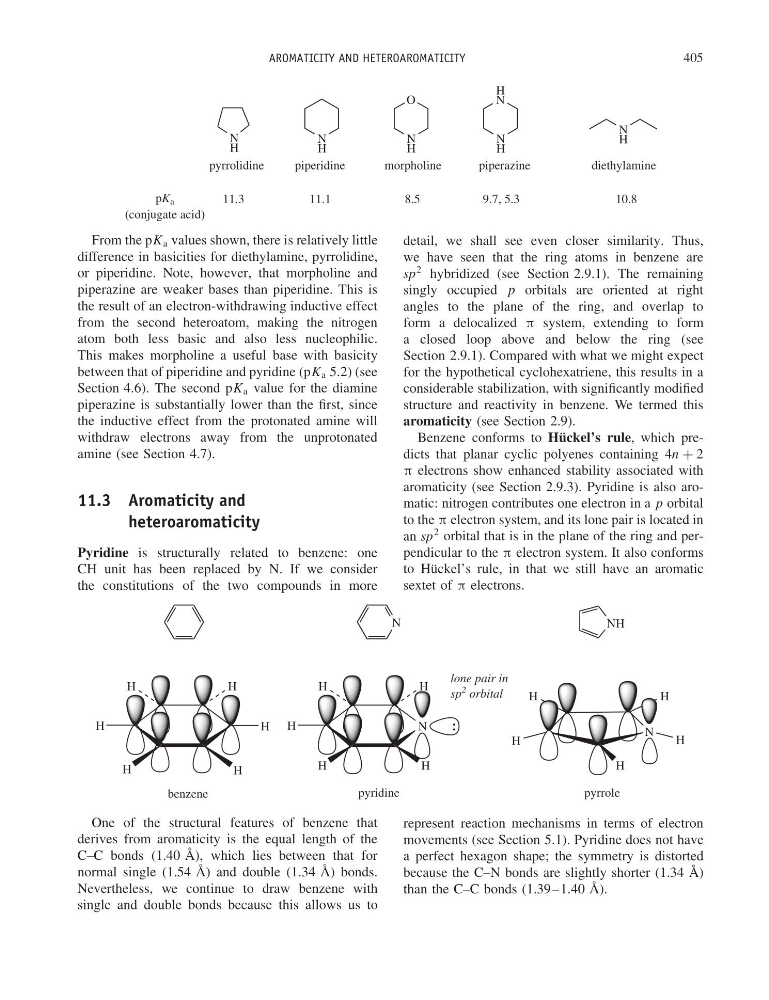
Pyridine is structurally related to benzene: one
CH unit has been replaced by N. If we consider
the constitutions of the two compounds in more
detail, we shall see even closer similarity. Thus,
we have seen that the ring atoms in benzene are
sp
2 hybridized (see Section 2.9.1). The remaining
singly occupied p orbitals are oriented at right
angles to the plane of the ring, and overlap to
form a delocalized π system, extending to form
a closed loop above and below the ring (see
Section 2.9.1). Compared with what we might expect
for the hypothetical cyclohexatriene, this results in a
considerable stabilization, with significantly modified
structure and reactivity in benzene. We termed this
aromaticity (see Section 2.9).
Benzene conforms to H ¨
uckel’s rule, which predicts that planar cyclic polyenes containing 4n + 2
π electrons show enhanced stability associated with
aromaticity (see Section 2.9.3). Pyridine is also aromatic: nitrogen contributes one electron in a p orbital
to the π electron system, and its lone pair is located in
an sp
2 orbital that is in the plane of the ring and perpendicular to the π electron system. It also conforms
to H¨ uckel’s rule, in that we still have an aromatic
sextet of π electrons.
H
H
H
H
H
H
N
H
H
H
H
H
N
H
H
H
H
H
pyrrole
benzene
pyridine
NH
lone pair in
sp
2 orbital
N
One of the structural features of benzene that
derives from aromaticity is the equal length of the
C–C bonds (1.40 ˚
A), which lies between that for
normal single (1.54 ˚
A) and double (1.34 ˚
A) bonds.
Nevertheless, we continue to draw benzene with
single and double bonds because this allows us to
represent reaction mechanisms in terms of electron
movements (see Section 5.1). Pyridine does not have
a perfect hexagon shape; the symmetry is distorted
because the C–N bonds are slightly shorter (1.34 ˚
A)
than the C–C bonds (1.39–1.40 ˚
A).
405
N
H
N
H
N
H
O
N
H
pK a
(conjugate acid)
N
H
H
N
11.3
11.1
8.5
10.8
9.7, 5.3
pyrrolidine
piperidine
morpholine
diethylamine
piperazine
From the pK a values shown, there is relatively little
difference in basicities for diethylamine, pyrrolidine,
or piperidine. Note, however, that morpholine and
piperazine are weaker bases than piperidine. This is
the result of an electron-withdrawing inductive effect
from the second heteroatom, making the nitrogen
atom both less basic and also less nucleophilic.
This makes morpholine a useful base with basicity
between that of piperidine and pyridine (pK a 5.2) (see
Section 4.6). The second pK a value for the diamine
piperazine is substantially lower than the first, since
the inductive effect from the protonated amine will
withdraw electrons away from the unprotonated
amine (see Section 4.7).
11.3 Aromaticity and
heteroaromaticity
Pyridine is structurally related to benzene: one
CH unit has been replaced by N. If we consider
the constitutions of the two compounds in more
detail, we shall see even closer similarity. Thus,
we have seen that the ring atoms in benzene are
sp
2 hybridized (see Section 2.9.1). The remaining
singly occupied p orbitals are oriented at right
angles to the plane of the ring, and overlap to
form a delocalized π system, extending to form
a closed loop above and below the ring (see
Section 2.9.1). Compared with what we might expect
for the hypothetical cyclohexatriene, this results in a
considerable stabilization, with significantly modified
structure and reactivity in benzene. We termed this
aromaticity (see Section 2.9).
Benzene conforms to H ¨
uckel’s rule, which predicts that planar cyclic polyenes containing 4n + 2
π electrons show enhanced stability associated with
aromaticity (see Section 2.9.3). Pyridine is also aromatic: nitrogen contributes one electron in a p orbital
to the π electron system, and its lone pair is located in
an sp
2 orbital that is in the plane of the ring and perpendicular to the π electron system. It also conforms
to H¨ uckel’s rule, in that we still have an aromatic
sextet of π electrons.
H
H
H
H
H
H
N
H
H
H
H
H
N
H
H
H
H
H
pyrrole
benzene
pyridine
NH
lone pair in
sp
2 orbital
N
One of the structural features of benzene that
derives from aromaticity is the equal length of the
C–C bonds (1.40 ˚
A), which lies between that for
normal single (1.54 ˚
A) and double (1.34 ˚
A) bonds.
Nevertheless, we continue to draw benzene with
single and double bonds because this allows us to
represent reaction mechanisms in terms of electron
movements (see Section 5.1). Pyridine does not have
a perfect hexagon shape; the symmetry is distorted
because the C–N bonds are slightly shorter (1.34 ˚
A)
than the C–C bonds (1.39–1.40 ˚
A).