

404
HETEROCYCLES
Note, however, that the most important of these
structures tend to have a trivial rather than systematic
name, a consequence of long-standing common
usage. Some of these, e.g. tetrahydrofuran and
tetrahydropyran, are derived from the name of the
corresponding aromatic heterocycle by the concept of
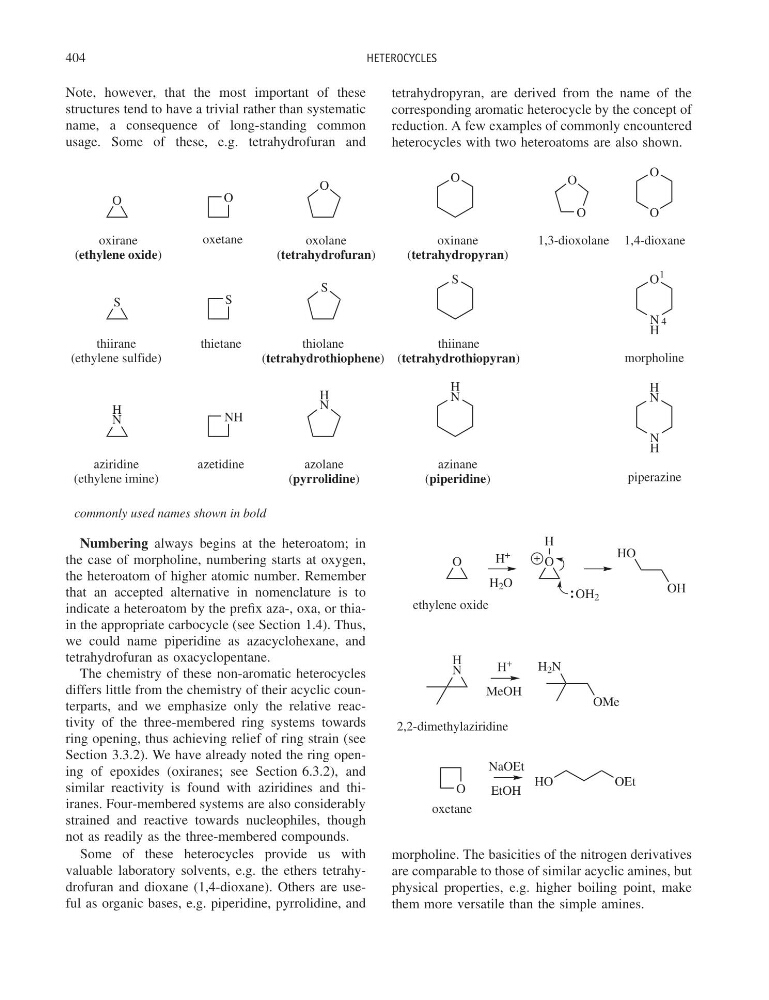
reduction. A few examples of commonly encountered
heterocycles with two heteroatoms are also shown.
O
S
H
N
O
O
O
S
S
S
NH
H
N
H
N
oxirane
(ethylene oxide)
thiirane
(ethylene sulfide)
aziridine
(ethylene imine)
oxetane
oxolane
(tetrahydrofuran)
oxinane
(tetrahydropyran)
thietane
thiolane
(tetrahydrothiophene)
thiinane
(tetrahydrothiopyran)
azetidine
azolane
(pyrrolidine)
azinane
(piperidine)
O
O
N
H
O
N
H
H
N
1,4-dioxane
morpholine
piperazine
O
O
1,3-dioxolane
1
4
commonly used names shown in bold
Numbering always begins at the heteroatom; in
the case of morpholine, numbering starts at oxygen,
the heteroatom of higher atomic number. Remember
that an accepted alternative in nomenclature is to
indicate a heteroatom by the prefix aza-, oxa, or thiain the appropriate carbocycle (see Section 1.4). Thus,
we could name piperidine as azacyclohexane, and
tetrahydrofuran as oxacyclopentane.
The chemistry of these non-aromatic heterocycles
differs little from the chemistry of their acyclic counterparts, and we emphasize only the relative reactivity of the three-membered ring systems towards
ring opening, thus achieving relief of ring strain (see
Section 3.3.2). We have already noted the ring opening of epoxides (oxiranes; see Section 6.3.2), and
similar reactivity is found with aziridines and thiiranes. Four-membered systems are also considerably
strained and reactive towards nucleophiles, though
not as readily as the three-membered compounds.
O
H
+
O
H
H 2 O
OH 2
OH
HO
ethylene oxide
H
N
H
+
MeOH
H 2 N
OMe
2,2-dimethylaziridine
O
NaOEt
EtOH
HO
OEt
oxetane
Some of these heterocycles provide us with
valuable laboratory solvents, e.g. the ethers tetrahydrofuran and dioxane (1,4-dioxane). Others are useful as organic bases, e.g. piperidine, pyrrolidine, and
morpholine. The basicities of the nitrogen derivatives
are comparable to those of similar acyclic amines, but
physical properties, e.g. higher boiling point, make
them more versatile than the simple amines.
HETEROCYCLES
Note, however, that the most important of these
structures tend to have a trivial rather than systematic
name, a consequence of long-standing common
usage. Some of these, e.g. tetrahydrofuran and
tetrahydropyran, are derived from the name of the
corresponding aromatic heterocycle by the concept of
reduction. A few examples of commonly encountered
heterocycles with two heteroatoms are also shown.
O
S
H
N
O
O
O
S
S
S
NH
H
N
H
N
oxirane
(ethylene oxide)
thiirane
(ethylene sulfide)
aziridine
(ethylene imine)
oxetane
oxolane
(tetrahydrofuran)
oxinane
(tetrahydropyran)
thietane
thiolane
(tetrahydrothiophene)
thiinane
(tetrahydrothiopyran)
azetidine
azolane
(pyrrolidine)
azinane
(piperidine)
O
O
N
H
O
N
H
H
N
1,4-dioxane
morpholine
piperazine
O
O
1,3-dioxolane
1
4
commonly used names shown in bold
Numbering always begins at the heteroatom; in
the case of morpholine, numbering starts at oxygen,
the heteroatom of higher atomic number. Remember
that an accepted alternative in nomenclature is to
indicate a heteroatom by the prefix aza-, oxa, or thiain the appropriate carbocycle (see Section 1.4). Thus,
we could name piperidine as azacyclohexane, and
tetrahydrofuran as oxacyclopentane.
The chemistry of these non-aromatic heterocycles
differs little from the chemistry of their acyclic counterparts, and we emphasize only the relative reactivity of the three-membered ring systems towards
ring opening, thus achieving relief of ring strain (see
Section 3.3.2). We have already noted the ring opening of epoxides (oxiranes; see Section 6.3.2), and
similar reactivity is found with aziridines and thiiranes. Four-membered systems are also considerably
strained and reactive towards nucleophiles, though
not as readily as the three-membered compounds.
O
H
+
O
H
H 2 O
OH 2
OH
HO
ethylene oxide
H
N
H
+
MeOH
H 2 N
OMe
2,2-dimethylaziridine
O
NaOEt
EtOH
HO
OEt
oxetane
Some of these heterocycles provide us with
valuable laboratory solvents, e.g. the ethers tetrahydrofuran and dioxane (1,4-dioxane). Others are useful as organic bases, e.g. piperidine, pyrrolidine, and
morpholine. The basicities of the nitrogen derivatives
are comparable to those of similar acyclic amines, but
physical properties, e.g. higher boiling point, make
them more versatile than the simple amines.