

11
Heterocycles
11.1 Heterocycles
Cyclic compounds in which one or more of the ring
atoms is not carbon are termed heterocycles; the noncarbon atoms are referred to as heteroatoms. We
shall limit our discussions to compounds in which
the heteroatoms are nitrogen, oxygen, or sulfur. For
the purposes of studying and understanding their
properties, heterocycles are conveniently grouped
into two classes, i.e. non-aromatic and aromatic.
11.2 Non-aromatic heterocycles
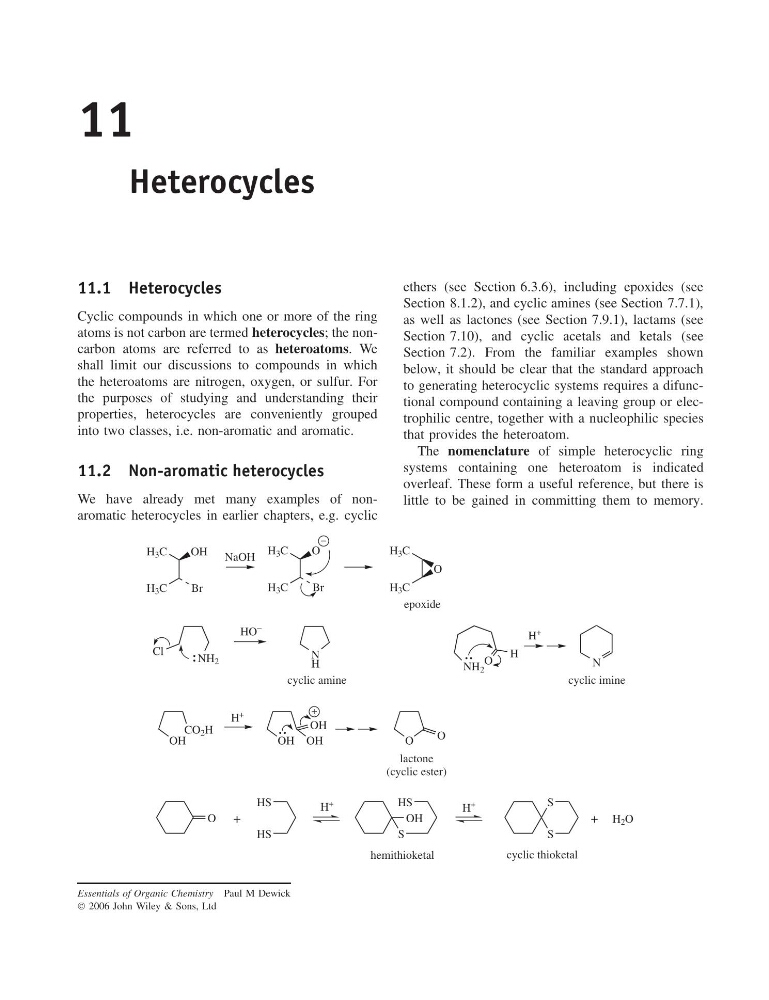
We have already met many examples of nonaromatic heterocycles in earlier chapters, e.g. cyclic
ethers (see Section 6.3.6), including epoxides (see
Section 8.1.2), and cyclic amines (see Section 7.7.1),
as well as lactones (see Section 7.9.1), lactams (see
Section 7.10), and cyclic acetals and ketals (see
Section 7.2). From the familiar examples shown
below, it should be clear that the standard approach
to generating heterocyclic systems requires a difunctional compound containing a leaving group or electrophilic centre, together with a nucleophilic species
that provides the heteroatom.
The nomenclature of simple heterocyclic ring
systems containing one heteroatom is indicated
overleaf. These form a useful reference, but there is
little to be gained in committing them to memory.
H 3 C
Br
OH
H 3 C
NaOH
H 3 C
Br
O
H 3 C
H 3 C
H 3 C
O
O
O
OH
CO 2 H
OH
OH
OH
H +
epoxide
lactone
(cyclic ester)
NH 2
Cl
N
H
HO
−
O
HS
HS
S
S
+
+
cyclic thioketal
H
+
cyclic amine
S
HS
OH
hemithioketal
H
+
N
NH 2
O
H
cyclic imine
H +
H 2 O
Essentials of Organic Chemistry Paul M Dewick
2006 John Wiley & Sons, Ltd
Heterocycles
11.1 Heterocycles
Cyclic compounds in which one or more of the ring
atoms is not carbon are termed heterocycles; the noncarbon atoms are referred to as heteroatoms. We
shall limit our discussions to compounds in which
the heteroatoms are nitrogen, oxygen, or sulfur. For
the purposes of studying and understanding their
properties, heterocycles are conveniently grouped
into two classes, i.e. non-aromatic and aromatic.
11.2 Non-aromatic heterocycles
We have already met many examples of nonaromatic heterocycles in earlier chapters, e.g. cyclic
ethers (see Section 6.3.6), including epoxides (see
Section 8.1.2), and cyclic amines (see Section 7.7.1),
as well as lactones (see Section 7.9.1), lactams (see
Section 7.10), and cyclic acetals and ketals (see
Section 7.2). From the familiar examples shown
below, it should be clear that the standard approach
to generating heterocyclic systems requires a difunctional compound containing a leaving group or electrophilic centre, together with a nucleophilic species
that provides the heteroatom.
The nomenclature of simple heterocyclic ring
systems containing one heteroatom is indicated
overleaf. These form a useful reference, but there is
little to be gained in committing them to memory.
H 3 C
Br
OH
H 3 C
NaOH
H 3 C
Br
O
H 3 C
H 3 C
H 3 C
O
O
O
OH
CO 2 H
OH
OH
OH
H +
epoxide
lactone
(cyclic ester)
NH 2
Cl
N
H
HO
−
O
HS
HS
S
S
+
+
cyclic thioketal
H
+
cyclic amine
S
HS
OH
hemithioketal
H
+
N
NH 2
O
H
cyclic imine
H +
H 2 O
Essentials of Organic Chemistry Paul M Dewick
2006 John Wiley & Sons, Ltd