

396
NUCLEOPHILIC REACTIONS INVOLVING ENOLATE ANIONS
O
CH 3 S
S
O
H 3 C
acrolein
methanethiol
CH 3 SH
NaOH
CH 3 S H
S
O
H 3 C
conjugate addition of
thiolate anion onto
a,b-unsaturated aldehyde
Strecker synthesis
(see Box 7.10)
S
CO 2 H
H 3 C
NH 2
methionine
H
+
HCN
NH 4 Cl
4-thiapentanal
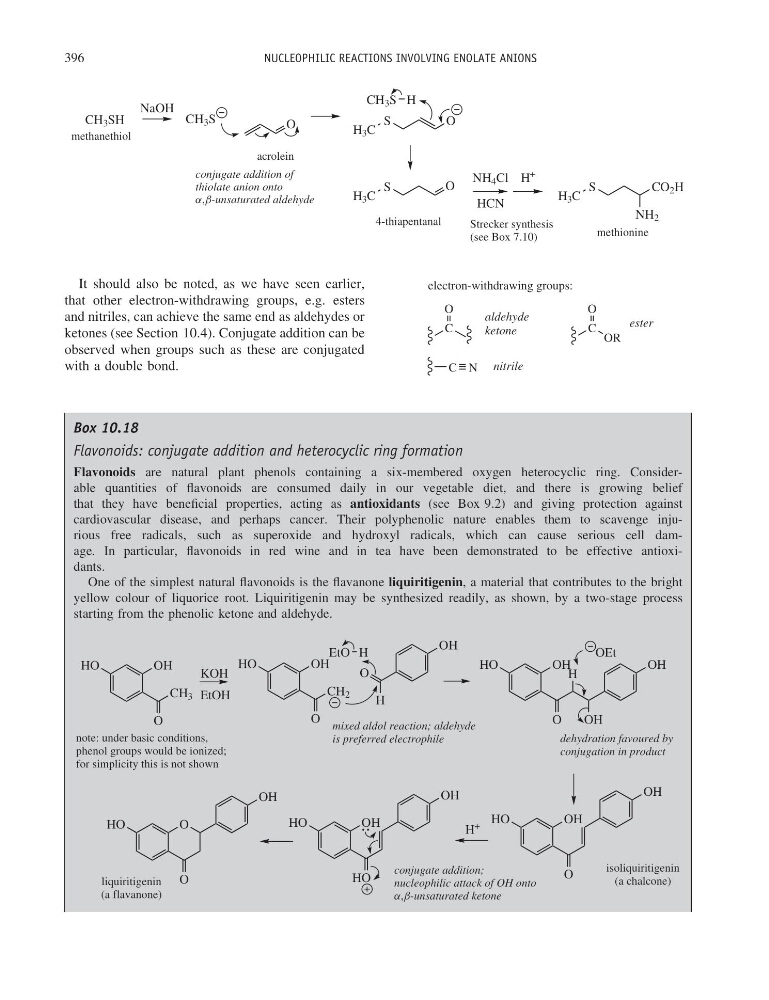
It should also be noted, as we have seen earlier,
that other electron-withdrawing groups, e.g. esters
and nitriles, can achieve the same end as aldehydes or
ketones (see Section 10.4). Conjugate addition can be
observed when groups such as these are conjugated
with a double bond.
C N
electron-withdrawing groups:
aldehyde
ketone
ester
nitrile
O
C
C
O
OR
Box 10.18
Flavonoids: conjugate addition and heterocyclic ring formation
Flavonoids are natural plant phenols containing a six-membered oxygen heterocyclic ring. Considerable quantities of flavonoids are consumed daily in our vegetable diet, and there is growing belief
that they have beneficial properties, acting as antioxidants (see Box 9.2) and giving protection against
cardiovascular disease, and perhaps cancer. Their polyphenolic nature enables them to scavenge injurious free radicals, such as superoxide and hydroxyl radicals, which can cause serious cell damage. In particular, flavonoids in red wine and in tea have been demonstrated to be effective antioxidants.
One of the simplest natural flavonoids is the flavanone liquiritigenin, a material that contributes to the bright
yellow colour of liquorice root. Liquiritigenin may be synthesized readily, as shown, by a two-stage process
starting from the phenolic ketone and aldehyde.
OH
HO
HO
OH
O
O
HO
OH
isoliquiritigenin
(a chalcone)
liquiritigenin
(a flavanone)
O
HO
CH 3
OH
OH
O
H
O
HO
CH 2
OH
KOH
EtOH
O
HO
OH
OH
EtO H
OH
H
OEt
mixed aldol reaction; aldehyde
is preferred electrophile
dehydration favoured by
conjugation in product
conjugate addition;
nucleophilic attack of OH onto
a,b-unsaturated ketone
OH
O
HO
OH
H +
note: under basic conditions,
phenol groups would be ionized;
for simplicity this is not shown
NUCLEOPHILIC REACTIONS INVOLVING ENOLATE ANIONS
O
CH 3 S
S
O
H 3 C
acrolein
methanethiol
CH 3 SH
NaOH
CH 3 S H
S
O
H 3 C
conjugate addition of
thiolate anion onto
a,b-unsaturated aldehyde
Strecker synthesis
(see Box 7.10)
S
CO 2 H
H 3 C
NH 2
methionine
H
+
HCN
NH 4 Cl
4-thiapentanal
It should also be noted, as we have seen earlier,
that other electron-withdrawing groups, e.g. esters
and nitriles, can achieve the same end as aldehydes or
ketones (see Section 10.4). Conjugate addition can be
observed when groups such as these are conjugated
with a double bond.
C N
electron-withdrawing groups:
aldehyde
ketone
ester
nitrile
O
C
C
O
OR
Box 10.18
Flavonoids: conjugate addition and heterocyclic ring formation
Flavonoids are natural plant phenols containing a six-membered oxygen heterocyclic ring. Considerable quantities of flavonoids are consumed daily in our vegetable diet, and there is growing belief
that they have beneficial properties, acting as antioxidants (see Box 9.2) and giving protection against
cardiovascular disease, and perhaps cancer. Their polyphenolic nature enables them to scavenge injurious free radicals, such as superoxide and hydroxyl radicals, which can cause serious cell damage. In particular, flavonoids in red wine and in tea have been demonstrated to be effective antioxidants.
One of the simplest natural flavonoids is the flavanone liquiritigenin, a material that contributes to the bright
yellow colour of liquorice root. Liquiritigenin may be synthesized readily, as shown, by a two-stage process
starting from the phenolic ketone and aldehyde.
OH
HO
HO
OH
O
O
HO
OH
isoliquiritigenin
(a chalcone)
liquiritigenin
(a flavanone)
O
HO
CH 3
OH
OH
O
H
O
HO
CH 2
OH
KOH
EtOH
O
HO
OH
OH
EtO H
OH
H
OEt
mixed aldol reaction; aldehyde
is preferred electrophile
dehydration favoured by
conjugation in product
conjugate addition;
nucleophilic attack of OH onto
a,b-unsaturated ketone
OH
O
HO
OH
H +
note: under basic conditions,
phenol groups would be ionized;
for simplicity this is not shown