

NUCLEOPHILIC ADDITION TO CONJUGATED SYSTEMS: CONJUGATE ADDITION AND MICHAEL REACTIONS
397
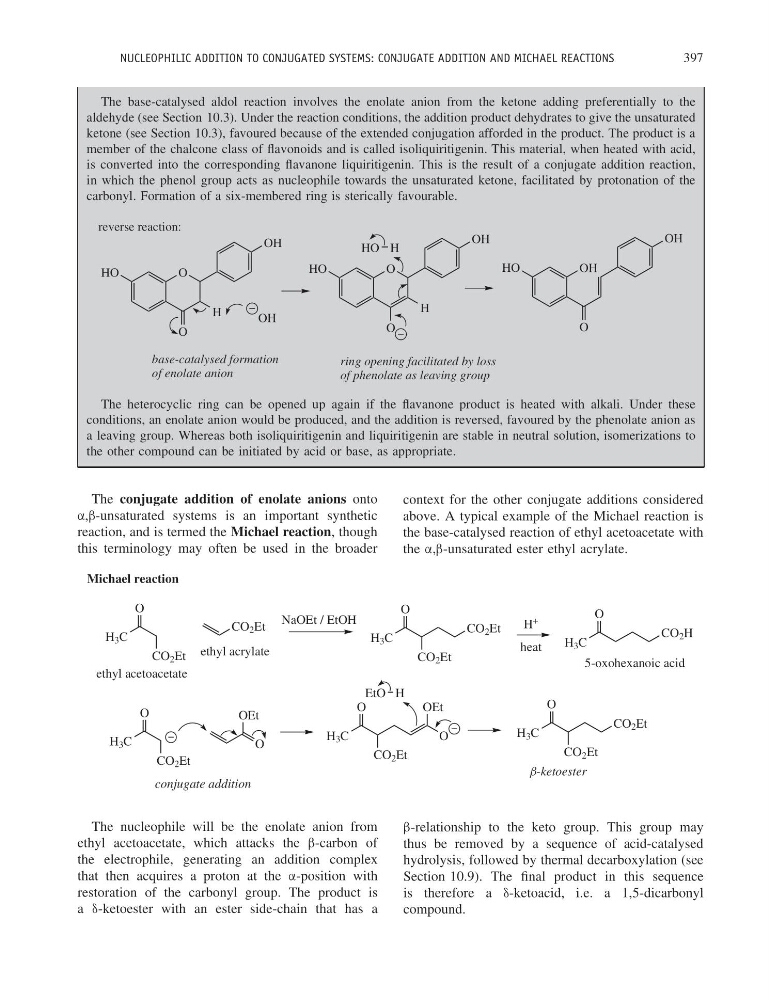
The base-catalysed aldol reaction involves the enolate anion from the ketone adding preferentially to the
aldehyde (see Section 10.3). Under the reaction conditions, the addition product dehydrates to give the unsaturated
ketone (see Section 10.3), favoured because of the extended conjugation afforded in the product. The product is a
member of the chalcone class of flavonoids and is called isoliquiritigenin. This material, when heated with acid,
is converted into the corresponding flavanone liquiritigenin. This is the result of a conjugate addition reaction,
in which the phenol group acts as nucleophile towards the unsaturated ketone, facilitated by protonation of the
carbonyl. Formation of a six-membered ring is sterically favourable.
O
O
HO
OH
H
OH
O
O
HO
OH
H
HO H
O
HO
OH
reverse reaction:
base-catalysed formation
of enolate anion
ring opening facilitated by loss
of phenolate as leaving group
OH
The heterocyclic ring can be opened up again if the flavanone product is heated with alkali. Under these
conditions, an enolate anion would be produced, and the addition is reversed, favoured by the phenolate anion as
a leaving group. Whereas both isoliquiritigenin and liquiritigenin are stable in neutral solution, isomerizations to
the other compound can be initiated by acid or base, as appropriate.
The conjugate addition of enolate anions onto
α,β-unsaturated systems is an important synthetic
reaction, and is termed the Michael reaction, though
this terminology may often be used in the broader
context for the other conjugate additions considered
above. A typical example of the Michael reaction is
the base-catalysed reaction of ethyl acetoacetate with
the α,β-unsaturated ester ethyl acrylate.
ethyl acrylate
NaOEt / EtOH
H 3 C
CO 2 H
O
H 3 C
CO 2 Et
O
CO 2 Et
H 3 C
O
CO 2 Et
CO 2 Et
H 3 C
O
CO 2 Et
OEt
O
H 3 C
O
CO 2 Et
O
OEt
EtO H
H 3 C
CO 2 Et
O
CO 2 Et
H +
heat
ethyl acetoacetate
5-oxohexanoic acid
conjugate addition
b-ketoester
Michael reaction
The nucleophile will be the enolate anion from
ethyl acetoacetate, which attacks the β-carbon of
the electrophile, generating an addition complex
that then acquires a proton at the α-position with
restoration of the carbonyl group. The product is
a δ-ketoester with an ester side-chain that has a
β-relationship to the keto group. This group may
thus be removed by a sequence of acid-catalysed
hydrolysis, followed by thermal decarboxylation (see
Section 10.9). The final product in this sequence
is therefore a δ-ketoacid, i.e. a 1,5-dicarbonyl
compound.
397
The base-catalysed aldol reaction involves the enolate anion from the ketone adding preferentially to the
aldehyde (see Section 10.3). Under the reaction conditions, the addition product dehydrates to give the unsaturated
ketone (see Section 10.3), favoured because of the extended conjugation afforded in the product. The product is a
member of the chalcone class of flavonoids and is called isoliquiritigenin. This material, when heated with acid,
is converted into the corresponding flavanone liquiritigenin. This is the result of a conjugate addition reaction,
in which the phenol group acts as nucleophile towards the unsaturated ketone, facilitated by protonation of the
carbonyl. Formation of a six-membered ring is sterically favourable.
O
O
HO
OH
H
OH
O
O
HO
OH
H
HO H
O
HO
OH
reverse reaction:
base-catalysed formation
of enolate anion
ring opening facilitated by loss
of phenolate as leaving group
OH
The heterocyclic ring can be opened up again if the flavanone product is heated with alkali. Under these
conditions, an enolate anion would be produced, and the addition is reversed, favoured by the phenolate anion as
a leaving group. Whereas both isoliquiritigenin and liquiritigenin are stable in neutral solution, isomerizations to
the other compound can be initiated by acid or base, as appropriate.
The conjugate addition of enolate anions onto
α,β-unsaturated systems is an important synthetic
reaction, and is termed the Michael reaction, though
this terminology may often be used in the broader
context for the other conjugate additions considered
above. A typical example of the Michael reaction is
the base-catalysed reaction of ethyl acetoacetate with
the α,β-unsaturated ester ethyl acrylate.
ethyl acrylate
NaOEt / EtOH
H 3 C
CO 2 H
O
H 3 C
CO 2 Et
O
CO 2 Et
H 3 C
O
CO 2 Et
CO 2 Et
H 3 C
O
CO 2 Et
OEt
O
H 3 C
O
CO 2 Et
O
OEt
EtO H
H 3 C
CO 2 Et
O
CO 2 Et
H +
heat
ethyl acetoacetate
5-oxohexanoic acid
conjugate addition
b-ketoester
Michael reaction
The nucleophile will be the enolate anion from
ethyl acetoacetate, which attacks the β-carbon of
the electrophile, generating an addition complex
that then acquires a proton at the α-position with
restoration of the carbonyl group. The product is
a δ-ketoester with an ester side-chain that has a
β-relationship to the keto group. This group may
thus be removed by a sequence of acid-catalysed
hydrolysis, followed by thermal decarboxylation (see
Section 10.9). The final product in this sequence
is therefore a δ-ketoacid, i.e. a 1,5-dicarbonyl
compound.