

NUCLEOPHILIC ADDITION TO CONJUGATED SYSTEMS: CONJUGATE ADDITION AND MICHAEL REACTIONS
395
If the 1,2-addition is reversible (the nucleophile
is a good leaving group), then we get thermodynamic control and the conjugate addition product
predominates. When the 1,2-addition is not reversible
(the nucleophile is a poor leaving group), we get
kinetic control and simple addition. Stereochemical
considerations are also partly responsible, since it will
be easier for larger nucleophiles, especially enolate
anions, to attack the C=C double bond that is less
hindered, particularly if this is a H 2 C=group.
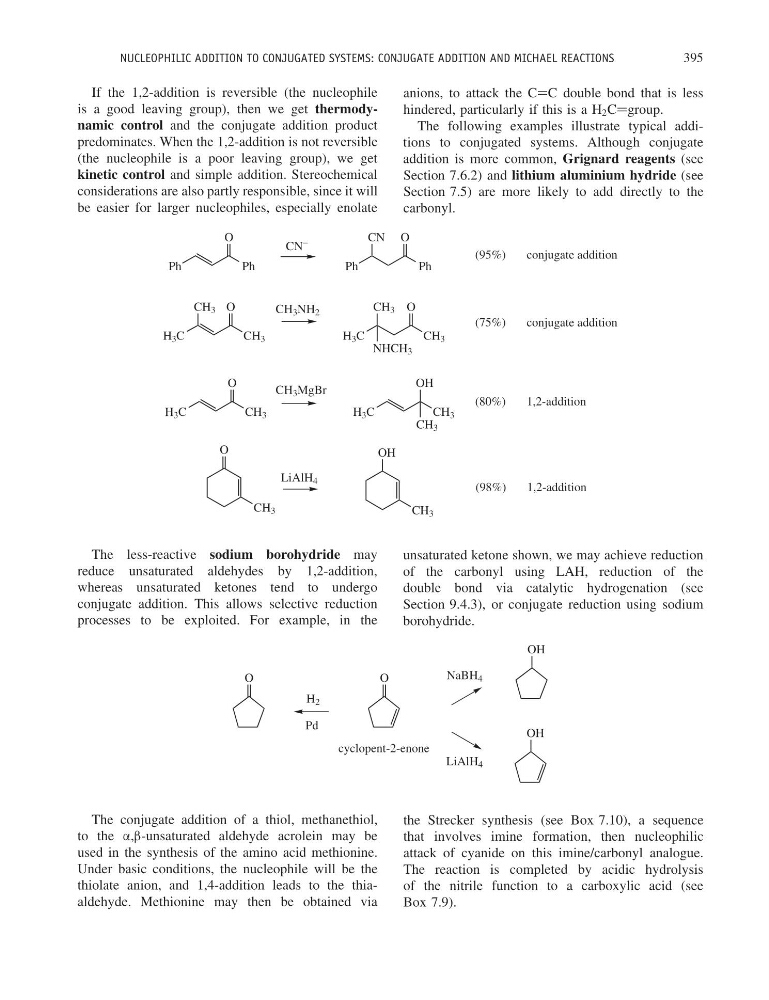
The following examples illustrate typical additions to conjugated systems. Although conjugate
addition is more common, Grignard reagents (see
Section 7.6.2) and lithium aluminium hydride (see
Section 7.5) are more likely to add directly to the
carbonyl.
Ph
Ph
O
Ph
Ph
O
CN −
CN
conjugate addition
H 3 C
CH 3
CH 3 O
CH 3 NH 2
H 3 C
CH 3
CH 3 O
NHCH 3
conjugate addition
H 3 C
CH 3
O
CH 3 MgBr
H 3 C
CH 3
OH
CH 3
1,2-addition
(95%)
(75%)
(80%)
O
LiAlH 4
OH
1,2-addition
CH 3
CH 3
(98%)
The less-reactive sodium borohydride may
reduce unsaturated aldehydes by 1,2-addition,
whereas unsaturated ketones tend to undergo
conjugate addition. This allows selective reduction
processes to be exploited. For example, in the
unsaturated ketone shown, we may achieve reduction
of the carbonyl using LAH, reduction of the
double bond via catalytic hydrogenation (see
Section 9.4.3), or conjugate reduction using sodium
borohydride.
O
OH
NaBH 4
OH
LiAlH 4
O
H 2
Pd
cyclopent-2-enone
The conjugate addition of a thiol, methanethiol,
to the α,β-unsaturated aldehyde acrolein may be
used in the synthesis of the amino acid methionine.
Under basic conditions, the nucleophile will be the
thiolate anion, and 1,4-addition leads to the thiaaldehyde. Methionine may then be obtained via
the Strecker synthesis (see Box 7.10), a sequence
that involves imine formation, then nucleophilic
attack of cyanide on this imine/carbonyl analogue.
The reaction is completed by acidic hydrolysis
of the nitrile function to a carboxylic acid (see
Box 7.9).
395
If the 1,2-addition is reversible (the nucleophile
is a good leaving group), then we get thermodynamic control and the conjugate addition product
predominates. When the 1,2-addition is not reversible
(the nucleophile is a poor leaving group), we get
kinetic control and simple addition. Stereochemical
considerations are also partly responsible, since it will
be easier for larger nucleophiles, especially enolate
anions, to attack the C=C double bond that is less
hindered, particularly if this is a H 2 C=group.
The following examples illustrate typical additions to conjugated systems. Although conjugate
addition is more common, Grignard reagents (see
Section 7.6.2) and lithium aluminium hydride (see
Section 7.5) are more likely to add directly to the
carbonyl.
Ph
Ph
O
Ph
Ph
O
CN −
CN
conjugate addition
H 3 C
CH 3
CH 3 O
CH 3 NH 2
H 3 C
CH 3
CH 3 O
NHCH 3
conjugate addition
H 3 C
CH 3
O
CH 3 MgBr
H 3 C
CH 3
OH
CH 3
1,2-addition
(95%)
(75%)
(80%)
O
LiAlH 4
OH
1,2-addition
CH 3
CH 3
(98%)
The less-reactive sodium borohydride may
reduce unsaturated aldehydes by 1,2-addition,
whereas unsaturated ketones tend to undergo
conjugate addition. This allows selective reduction
processes to be exploited. For example, in the
unsaturated ketone shown, we may achieve reduction
of the carbonyl using LAH, reduction of the
double bond via catalytic hydrogenation (see
Section 9.4.3), or conjugate reduction using sodium
borohydride.
O
OH
NaBH 4
OH
LiAlH 4
O
H 2
Pd
cyclopent-2-enone
The conjugate addition of a thiol, methanethiol,
to the α,β-unsaturated aldehyde acrolein may be
used in the synthesis of the amino acid methionine.
Under basic conditions, the nucleophile will be the
thiolate anion, and 1,4-addition leads to the thiaaldehyde. Methionine may then be obtained via
the Strecker synthesis (see Box 7.10), a sequence
that involves imine formation, then nucleophilic
attack of cyanide on this imine/carbonyl analogue.
The reaction is completed by acidic hydrolysis
of the nitrile function to a carboxylic acid (see
Box 7.9).