

394
NUCLEOPHILIC REACTIONS INVOLVING ENOLATE ANIONS
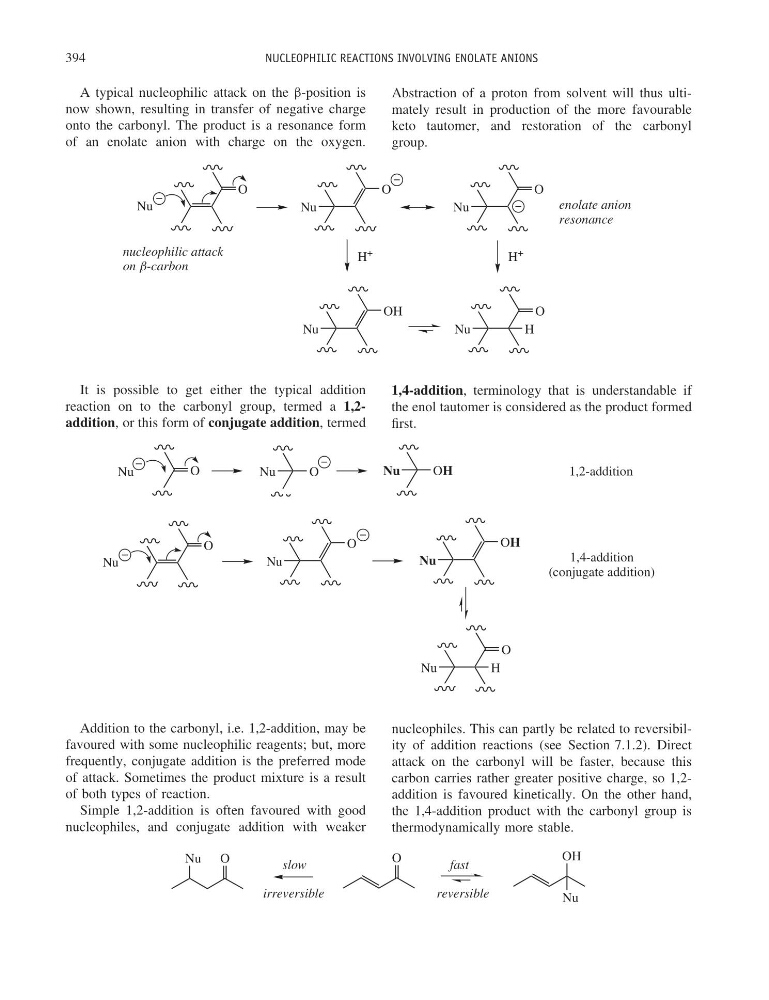
A typical nucleophilic attack on the β-position is
now shown, resulting in transfer of negative charge
onto the carbonyl. The product is a resonance form
of an enolate anion with charge on the oxygen.
Abstraction of a proton from solvent will thus ultimately result in production of the more favourable
keto tautomer, and restoration of the carbonyl
group.
Nu
H +
nucleophilic attack
on b-carbon
H +
enolate anion
resonance
O
O
Nu
O
Nu
O
Nu
H
OH
Nu
It is possible to get either the typical addition
reaction on to the carbonyl group, termed a 1,2addition, or this form of conjugate addition, termed
1,4-addition, terminology that is understandable if
the enol tautomer is considered as the product formed
first.
O
Nu
Nu
O
Nu
OH
1,2-addition
1,4-addition
(conjugate addition)
Nu
O
O
Nu
OH
Nu
O
Nu
H
Addition to the carbonyl, i.e. 1,2-addition, may be
favoured with some nucleophilic reagents; but, more
frequently, conjugate addition is the preferred mode
of attack. Sometimes the product mixture is a result
of both types of reaction.
Simple 1,2-addition is often favoured with good
nucleophiles, and conjugate addition with weaker
nucleophiles. This can partly be related to reversibility of addition reactions (see Section 7.1.2). Direct
attack on the carbonyl will be faster, because this
carbon carries rather greater positive charge, so 1,2addition is favoured kinetically. On the other hand,
the 1,4-addition product with the carbonyl group is
thermodynamically more stable.
O
O
OH
Nu
Nu
slow
irreversible
fast
reversible
NUCLEOPHILIC REACTIONS INVOLVING ENOLATE ANIONS
A typical nucleophilic attack on the β-position is
now shown, resulting in transfer of negative charge
onto the carbonyl. The product is a resonance form
of an enolate anion with charge on the oxygen.
Abstraction of a proton from solvent will thus ultimately result in production of the more favourable
keto tautomer, and restoration of the carbonyl
group.
Nu
H +
nucleophilic attack
on b-carbon
H +
enolate anion
resonance
O
O
Nu
O
Nu
O
Nu
H
OH
Nu
It is possible to get either the typical addition
reaction on to the carbonyl group, termed a 1,2addition, or this form of conjugate addition, termed
1,4-addition, terminology that is understandable if
the enol tautomer is considered as the product formed
first.
O
Nu
Nu
O
Nu
OH
1,2-addition
1,4-addition
(conjugate addition)
Nu
O
O
Nu
OH
Nu
O
Nu
H
Addition to the carbonyl, i.e. 1,2-addition, may be
favoured with some nucleophilic reagents; but, more
frequently, conjugate addition is the preferred mode
of attack. Sometimes the product mixture is a result
of both types of reaction.
Simple 1,2-addition is often favoured with good
nucleophiles, and conjugate addition with weaker
nucleophiles. This can partly be related to reversibility of addition reactions (see Section 7.1.2). Direct
attack on the carbonyl will be faster, because this
carbon carries rather greater positive charge, so 1,2addition is favoured kinetically. On the other hand,
the 1,4-addition product with the carbonyl group is
thermodynamically more stable.
O
O
OH
Nu
Nu
slow
irreversible
fast
reversible