

NUCLEOPHILIC ADDITION TO CONJUGATED SYSTEMS: CONJUGATE ADDITION AND MICHAEL REACTIONS
393
nucleophilic attack on carbonyl but
with simultaneous loss of CO 2
acetoacetyl-CoA
CO 2
biotin
acetyl-CoA
malonyl-CoA
enzymic generation of
enolate anion
B
O
CH 3
SCoA
O
SCoA
O
O
H
O
CH 3
SCoA
O
CH 3
SCoA
SCoA
O
CH 3
SCoA
O
O
O
SCoA
O
O
H
O
CH 2
SCoA
CO 2
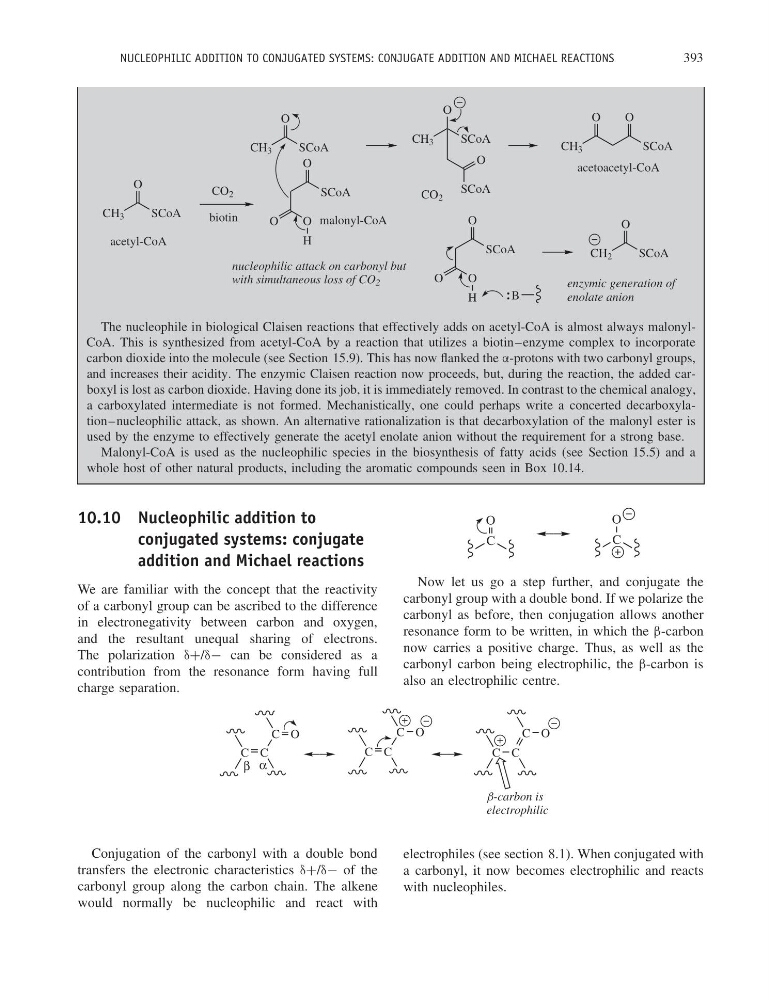
The nucleophile in biological Claisen reactions that effectively adds on acetyl-CoA is almost always malonylCoA. This is synthesized from acetyl-CoA by a reaction that utilizes a biotin–enzyme complex to incorporate
carbon dioxide into the molecule (see Section 15.9). This has now flanked the α-protons with two carbonyl groups,
and increases their acidity. The enzymic Claisen reaction now proceeds, but, during the reaction, the added carboxyl is lost as carbon dioxide. Having done its job, it is immediately removed. In contrast to the chemical analogy,
a carboxylated intermediate is not formed. Mechanistically, one could perhaps write a concerted decarboxylation–nucleophilic attack, as shown. An alternative rationalization is that decarboxylation of the malonyl ester is
used by the enzyme to effectively generate the acetyl enolate anion without the requirement for a strong base.
Malonyl-CoA is used as the nucleophilic species in the biosynthesis of fatty acids (see Section 15.5) and a
whole host of other natural products, including the aromatic compounds seen in Box 10.14.
10.10 Nucleophilic addition to
conjugated systems: conjugate
addition and Michael reactions
We are familiar with the concept that the reactivity
of a carbonyl group can be ascribed to the difference
in electronegativity between carbon and oxygen,
and the resultant unequal sharing of electrons.
The polarization δ+/δ− can be considered as a
contribution from the resonance form having full
charge separation.
C
O
C
O
Now let us go a step further, and conjugate the
carbonyl group with a double bond. If we polarize the
carbonyl as before, then conjugation allows another
resonance form to be written, in which the β-carbon
now carries a positive charge. Thus, as well as the
carbonyl carbon being electrophilic, the β-carbon is
also an electrophilic centre.
C C
C O
C C
C O
C C
C O
b-carbon is
electrophilic
α
β
Conjugation of the carbonyl with a double bond
transfers the electronic characteristics δ+/δ− of the
carbonyl group along the carbon chain. The alkene
would normally be nucleophilic and react with
electrophiles (see section 8.1). When conjugated with
a carbonyl, it now becomes electrophilic and reacts
with nucleophiles.
393
nucleophilic attack on carbonyl but
with simultaneous loss of CO 2
acetoacetyl-CoA
CO 2
biotin
acetyl-CoA
malonyl-CoA
enzymic generation of
enolate anion
B
O
CH 3
SCoA
O
SCoA
O
O
H
O
CH 3
SCoA
O
CH 3
SCoA
SCoA
O
CH 3
SCoA
O
O
O
SCoA
O
O
H
O
CH 2
SCoA
CO 2
The nucleophile in biological Claisen reactions that effectively adds on acetyl-CoA is almost always malonylCoA. This is synthesized from acetyl-CoA by a reaction that utilizes a biotin–enzyme complex to incorporate
carbon dioxide into the molecule (see Section 15.9). This has now flanked the α-protons with two carbonyl groups,
and increases their acidity. The enzymic Claisen reaction now proceeds, but, during the reaction, the added carboxyl is lost as carbon dioxide. Having done its job, it is immediately removed. In contrast to the chemical analogy,
a carboxylated intermediate is not formed. Mechanistically, one could perhaps write a concerted decarboxylation–nucleophilic attack, as shown. An alternative rationalization is that decarboxylation of the malonyl ester is
used by the enzyme to effectively generate the acetyl enolate anion without the requirement for a strong base.
Malonyl-CoA is used as the nucleophilic species in the biosynthesis of fatty acids (see Section 15.5) and a
whole host of other natural products, including the aromatic compounds seen in Box 10.14.
10.10 Nucleophilic addition to
conjugated systems: conjugate
addition and Michael reactions
We are familiar with the concept that the reactivity
of a carbonyl group can be ascribed to the difference
in electronegativity between carbon and oxygen,
and the resultant unequal sharing of electrons.
The polarization δ+/δ− can be considered as a
contribution from the resonance form having full
charge separation.
C
O
C
O
Now let us go a step further, and conjugate the
carbonyl group with a double bond. If we polarize the
carbonyl as before, then conjugation allows another
resonance form to be written, in which the β-carbon
now carries a positive charge. Thus, as well as the
carbonyl carbon being electrophilic, the β-carbon is
also an electrophilic centre.
C C
C O
C C
C O
C C
C O
b-carbon is
electrophilic
α
β
Conjugation of the carbonyl with a double bond
transfers the electronic characteristics δ+/δ− of the
carbonyl group along the carbon chain. The alkene
would normally be nucleophilic and react with
electrophiles (see section 8.1). When conjugated with
a carbonyl, it now becomes electrophilic and reacts
with nucleophiles.