

392
NUCLEOPHILIC REACTIONS INVOLVING ENOLATE ANIONS
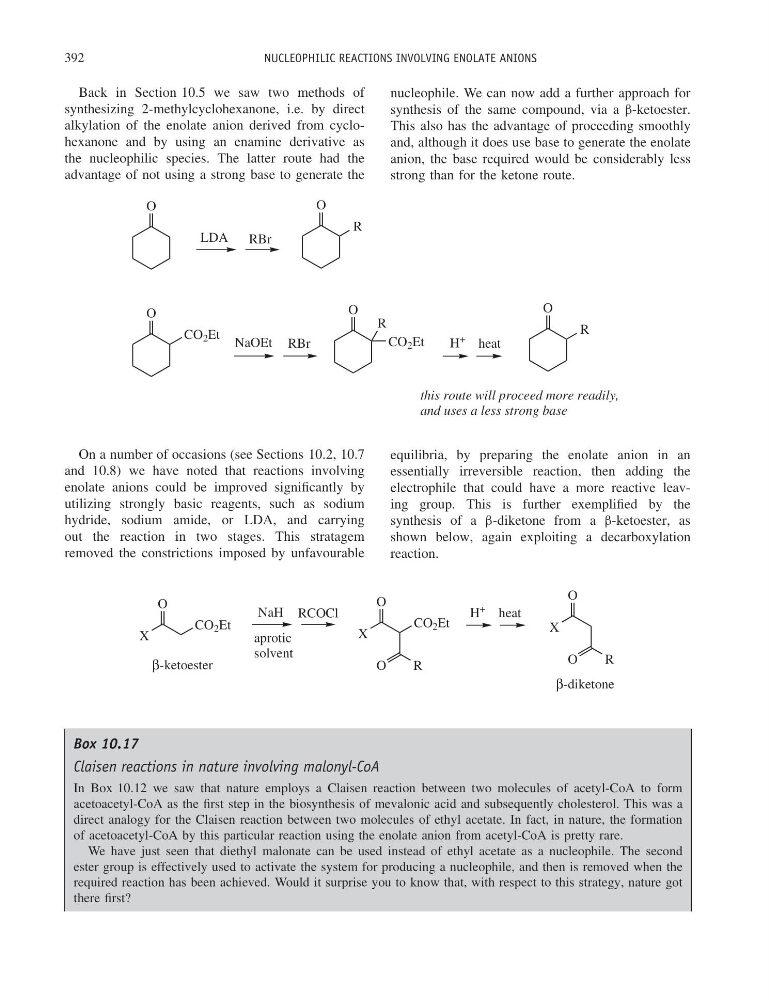
Back in Section 10.5 we saw two methods of
synthesizing 2-methylcyclohexanone, i.e. by direct
alkylation of the enolate anion derived from cyclohexanone and by using an enamine derivative as
the nucleophilic species. The latter route had the
advantage of not using a strong base to generate the
nucleophile. We can now add a further approach for
synthesis of the same compound, via a β-ketoester.
This also has the advantage of proceeding smoothly
and, although it does use base to generate the enolate
anion, the base required would be considerably less
strong than for the ketone route.
O
O
R
O
CO 2 Et
O
R
O
CO 2 Et
R
this route will proceed more readily,
and uses a less strong base
LDA
heat
NaOEt
H
+
RBr
RBr
On a number of occasions (see Sections 10.2, 10.7
and 10.8) we have noted that reactions involving
enolate anions could be improved significantly by
utilizing strongly basic reagents, such as sodium
hydride, sodium amide, or LDA, and carrying
out the reaction in two stages. This stratagem
removed the constrictions imposed by unfavourable
equilibria, by preparing the enolate anion in an
essentially irreversible reaction, then adding the
electrophile that could have a more reactive leaving group. This is further exemplified by the
synthesis of a β-diketone from a β-ketoester, as
shown below, again exploiting a decarboxylation
reaction.
RCOCl
NaH
aprotic
solvent
β-diketone
X
CO 2 Et
O
X
CO 2 Et
O
O
R
X
O
O
R
β-ketoester
heat
H +
Box 10.17
Claisen reactions in nature involving malonyl-CoA
In Box 10.12 we saw that nature employs a Claisen reaction between two molecules of acetyl-CoA to form
acetoacetyl-CoA as the first step in the biosynthesis of mevalonic acid and subsequently cholesterol. This was a
direct analogy for the Claisen reaction between two molecules of ethyl acetate. In fact, in nature, the formation
of acetoacetyl-CoA by this particular reaction using the enolate anion from acetyl-CoA is pretty rare.
We have just seen that diethyl malonate can be used instead of ethyl acetate as a nucleophile. The second
ester group is effectively used to activate the system for producing a nucleophile, and then is removed when the
required reaction has been achieved. Would it surprise you to know that, with respect to this strategy, nature got
there first?
NUCLEOPHILIC REACTIONS INVOLVING ENOLATE ANIONS
Back in Section 10.5 we saw two methods of
synthesizing 2-methylcyclohexanone, i.e. by direct
alkylation of the enolate anion derived from cyclohexanone and by using an enamine derivative as
the nucleophilic species. The latter route had the
advantage of not using a strong base to generate the
nucleophile. We can now add a further approach for
synthesis of the same compound, via a β-ketoester.
This also has the advantage of proceeding smoothly
and, although it does use base to generate the enolate
anion, the base required would be considerably less
strong than for the ketone route.
O
O
R
O
CO 2 Et
O
R
O
CO 2 Et
R
this route will proceed more readily,
and uses a less strong base
LDA
heat
NaOEt
H
+
RBr
RBr
On a number of occasions (see Sections 10.2, 10.7
and 10.8) we have noted that reactions involving
enolate anions could be improved significantly by
utilizing strongly basic reagents, such as sodium
hydride, sodium amide, or LDA, and carrying
out the reaction in two stages. This stratagem
removed the constrictions imposed by unfavourable
equilibria, by preparing the enolate anion in an
essentially irreversible reaction, then adding the
electrophile that could have a more reactive leaving group. This is further exemplified by the
synthesis of a β-diketone from a β-ketoester, as
shown below, again exploiting a decarboxylation
reaction.
RCOCl
NaH
aprotic
solvent
β-diketone
X
CO 2 Et
O
X
CO 2 Et
O
O
R
X
O
O
R
β-ketoester
heat
H +
Box 10.17
Claisen reactions in nature involving malonyl-CoA
In Box 10.12 we saw that nature employs a Claisen reaction between two molecules of acetyl-CoA to form
acetoacetyl-CoA as the first step in the biosynthesis of mevalonic acid and subsequently cholesterol. This was a
direct analogy for the Claisen reaction between two molecules of ethyl acetate. In fact, in nature, the formation
of acetoacetyl-CoA by this particular reaction using the enolate anion from acetyl-CoA is pretty rare.
We have just seen that diethyl malonate can be used instead of ethyl acetate as a nucleophile. The second
ester group is effectively used to activate the system for producing a nucleophile, and then is removed when the
required reaction has been achieved. Would it surprise you to know that, with respect to this strategy, nature got
there first?