

DECARBOXYLATION REACTIONS
391
makes generation of the enolate anion less effective.
One of the ester groups in diethyl malonate can
thus be regarded as a temporary activating group to
increase acidity of the α-protons.
CO 2 Et
CO 2 Et
activating ester groups that can
subsequently be lost through
hydrolysis and decarboxylation
gem-diester
β-ketoester
O
CO 2 Et
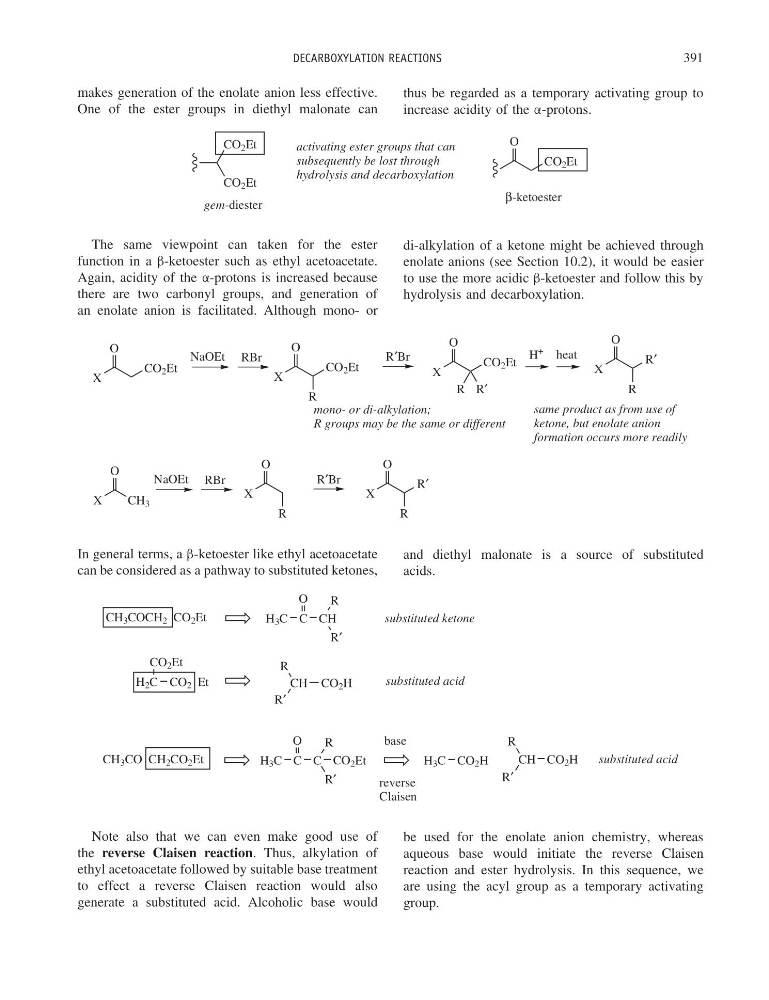
The same viewpoint can taken for the ester
function in a β-ketoester such as ethyl acetoacetate.
Again, acidity of the α-protons is increased because
there are two carbonyl groups, and generation of
an enolate anion is facilitated. Although mono- or
di-alkylation of a ketone might be achieved through
enolate anions (see Section 10.2), it would be easier
to use the more acidic β-ketoester and follow this by
hydrolysis and decarboxylation.
mono- or di-alkylation;
R groups may be the same or different
R′Br
R′Br
same product as from use of
ketone, but enolate anion
formation occurs more readily
X
CO 2 Et
O
X
CO 2 Et
O
R
X
CO 2 Et
O
R R′
X
R′
O
R
X
R′
O
R
X
O
R
X
CH 3
O
H
+ heat
NaOEt RBr
NaOEt RBr
In general terms, a β-ketoester like ethyl acetoacetate
can be considered as a pathway to substituted ketones,
and diethyl malonate is a source of substituted
acids.
CH
R
R′
C
O
H 3 C
R
CH
R′
CO 2 H
substituted ketone
substituted acid
CO 2 Et
H 2 C CO 2 Et
C
R
R′
C
O
H 3 C
substituted acid
CO 2 Et
CH
R
R′
CO 2 H
H 3 C CO 2 H
reverse
Claisen
base
CH 3 COCH 2 CO 2 Et
CH 3 CO CH 2 CO 2 Et
Note also that we can even make good use of
the reverse Claisen reaction. Thus, alkylation of
ethyl acetoacetate followed by suitable base treatment
to effect a reverse Claisen reaction would also
generate a substituted acid. Alcoholic base would
be used for the enolate anion chemistry, whereas
aqueous base would initiate the reverse Claisen
reaction and ester hydrolysis. In this sequence, we
are using the acyl group as a temporary activating
group.
391
makes generation of the enolate anion less effective.
One of the ester groups in diethyl malonate can
thus be regarded as a temporary activating group to
increase acidity of the α-protons.
CO 2 Et
CO 2 Et
activating ester groups that can
subsequently be lost through
hydrolysis and decarboxylation
gem-diester
β-ketoester
O
CO 2 Et
The same viewpoint can taken for the ester
function in a β-ketoester such as ethyl acetoacetate.
Again, acidity of the α-protons is increased because
there are two carbonyl groups, and generation of
an enolate anion is facilitated. Although mono- or
di-alkylation of a ketone might be achieved through
enolate anions (see Section 10.2), it would be easier
to use the more acidic β-ketoester and follow this by
hydrolysis and decarboxylation.
mono- or di-alkylation;
R groups may be the same or different
R′Br
R′Br
same product as from use of
ketone, but enolate anion
formation occurs more readily
X
CO 2 Et
O
X
CO 2 Et
O
R
X
CO 2 Et
O
R R′
X
R′
O
R
X
R′
O
R
X
O
R
X
CH 3
O
H
+ heat
NaOEt RBr
NaOEt RBr
In general terms, a β-ketoester like ethyl acetoacetate
can be considered as a pathway to substituted ketones,
and diethyl malonate is a source of substituted
acids.
CH
R
R′
C
O
H 3 C
R
CH
R′
CO 2 H
substituted ketone
substituted acid
CO 2 Et
H 2 C CO 2 Et
C
R
R′
C
O
H 3 C
substituted acid
CO 2 Et
CH
R
R′
CO 2 H
H 3 C CO 2 H
reverse
Claisen
base
CH 3 COCH 2 CO 2 Et
CH 3 CO CH 2 CO 2 Et
Note also that we can even make good use of
the reverse Claisen reaction. Thus, alkylation of
ethyl acetoacetate followed by suitable base treatment
to effect a reverse Claisen reaction would also
generate a substituted acid. Alcoholic base would
be used for the enolate anion chemistry, whereas
aqueous base would initiate the reverse Claisen
reaction and ester hydrolysis. In this sequence, we
are using the acyl group as a temporary activating
group.