

390
NUCLEOPHILIC REACTIONS INVOLVING ENOLATE ANIONS
Box 10.16 (continued)
It is appropriate here to look at the structure of oxaloacetic acid, a critical intermediate in the Krebs cycle, and
to discover that it too is a β-ketoacid. In contrast to oxalosuccinic acid, it does not suffer decarboxylation in this
enzyme-mediated cycle, but is used as the electrophile for an aldol reaction with acetyl-CoA (see Box 10.4).
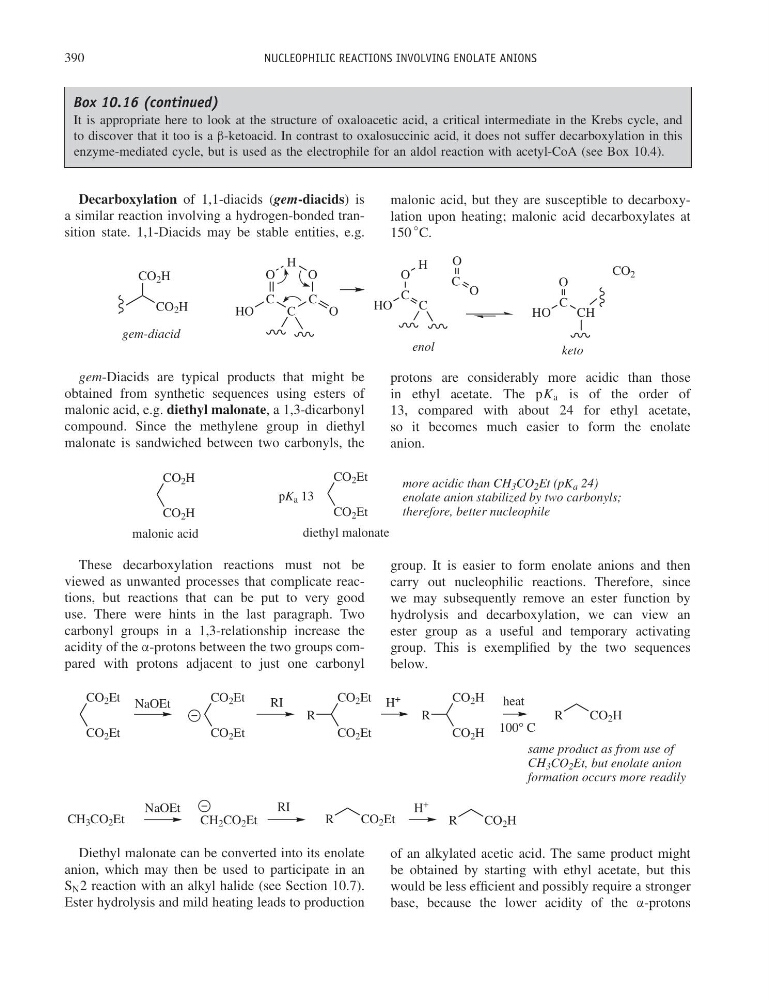
Decarboxylation of 1,1-diacids (gem-diacids) is
a similar reaction involving a hydrogen-bonded transition state. 1,1-Diacids may be stable entities, e.g.
malonic acid, but they are susceptible to decarboxylation upon heating; malonic acid decarboxylates at
150
◦ C.
O
C
C
C
O
H
HO
O
O
C
C
C
O
H
HO
O
O
C
HO
CH
enol
keto
CO 2
CO 2 H
gem-diacid
CO 2 H
gem-Diacids are typical products that might be
obtained from synthetic sequences using esters of
malonic acid, e.g. diethyl malonate, a 1,3-dicarbonyl
compound. Since the methylene group in diethyl
malonate is sandwiched between two carbonyls, the
protons are considerably more acidic than those
in ethyl acetate. The pK a is of the order of
13, compared with about 24 for ethyl acetate,
so it becomes much easier to form the enolate
anion.
CO 2 Et
CO 2 Et
diethyl malonate
pK a 13
more acidic than CH 3 CO 2 Et (pK a 24)
enolate anion stabilized by two carbonyls;
therefore, better nucleophile
CO 2 H
CO 2 H
malonic acid
These decarboxylation reactions must not be
viewed as unwanted processes that complicate reactions, but reactions that can be put to very good
use. There were hints in the last paragraph. Two
carbonyl groups in a 1,3-relationship increase the
acidity of the α-protons between the two groups compared with protons adjacent to just one carbonyl
group. It is easier to form enolate anions and then
carry out nucleophilic reactions. Therefore, since
we may subsequently remove an ester function by
hydrolysis and decarboxylation, we can view an
ester group as a useful and temporary activating
group. This is exemplified by the two sequences
below.
same product as from use of
CH 3 CO 2 Et, but enolate anion
formation occurs more readily
CO 2 Et
CO 2 Et
NaOEt
CO 2 Et
CO 2 Et
RI
CO 2 Et
CO 2 Et
R
CO 2 H
CO 2 H
R
heat
CH 3 CO 2 Et
CH 2 CO 2 Et
NaOEt
RI
H +
H +
R
CO 2 H
R
CO 2 Et
R
CO 2 H
100° C
Diethyl malonate can be converted into its enolate
anion, which may then be used to participate in an
S N 2 reaction with an alkyl halide (see Section 10.7).
Ester hydrolysis and mild heating leads to production
of an alkylated acetic acid. The same product might
be obtained by starting with ethyl acetate, but this
would be less efficient and possibly require a stronger
base, because the lower acidity of the α-protons
NUCLEOPHILIC REACTIONS INVOLVING ENOLATE ANIONS
Box 10.16 (continued)
It is appropriate here to look at the structure of oxaloacetic acid, a critical intermediate in the Krebs cycle, and
to discover that it too is a β-ketoacid. In contrast to oxalosuccinic acid, it does not suffer decarboxylation in this
enzyme-mediated cycle, but is used as the electrophile for an aldol reaction with acetyl-CoA (see Box 10.4).
Decarboxylation of 1,1-diacids (gem-diacids) is
a similar reaction involving a hydrogen-bonded transition state. 1,1-Diacids may be stable entities, e.g.
malonic acid, but they are susceptible to decarboxylation upon heating; malonic acid decarboxylates at
150
◦ C.
O
C
C
C
O
H
HO
O
O
C
C
C
O
H
HO
O
O
C
HO
CH
enol
keto
CO 2
CO 2 H
gem-diacid
CO 2 H
gem-Diacids are typical products that might be
obtained from synthetic sequences using esters of
malonic acid, e.g. diethyl malonate, a 1,3-dicarbonyl
compound. Since the methylene group in diethyl
malonate is sandwiched between two carbonyls, the
protons are considerably more acidic than those
in ethyl acetate. The pK a is of the order of
13, compared with about 24 for ethyl acetate,
so it becomes much easier to form the enolate
anion.
CO 2 Et
CO 2 Et
diethyl malonate
pK a 13
more acidic than CH 3 CO 2 Et (pK a 24)
enolate anion stabilized by two carbonyls;
therefore, better nucleophile
CO 2 H
CO 2 H
malonic acid
These decarboxylation reactions must not be
viewed as unwanted processes that complicate reactions, but reactions that can be put to very good
use. There were hints in the last paragraph. Two
carbonyl groups in a 1,3-relationship increase the
acidity of the α-protons between the two groups compared with protons adjacent to just one carbonyl
group. It is easier to form enolate anions and then
carry out nucleophilic reactions. Therefore, since
we may subsequently remove an ester function by
hydrolysis and decarboxylation, we can view an
ester group as a useful and temporary activating
group. This is exemplified by the two sequences
below.
same product as from use of
CH 3 CO 2 Et, but enolate anion
formation occurs more readily
CO 2 Et
CO 2 Et
NaOEt
CO 2 Et
CO 2 Et
RI
CO 2 Et
CO 2 Et
R
CO 2 H
CO 2 H
R
heat
CH 3 CO 2 Et
CH 2 CO 2 Et
NaOEt
RI
H +
H +
R
CO 2 H
R
CO 2 Et
R
CO 2 H
100° C
Diethyl malonate can be converted into its enolate
anion, which may then be used to participate in an
S N 2 reaction with an alkyl halide (see Section 10.7).
Ester hydrolysis and mild heating leads to production
of an alkylated acetic acid. The same product might
be obtained by starting with ethyl acetate, but this
would be less efficient and possibly require a stronger
base, because the lower acidity of the α-protons