

DECARBOXYLATION REACTIONS
389
O
C
C
C
O
H
O
O
C
C
C
O
H
O
O
C
CH
enol
keto
CO 2
H-bonded
transition state
CO 2 H
O
b-ketoacid
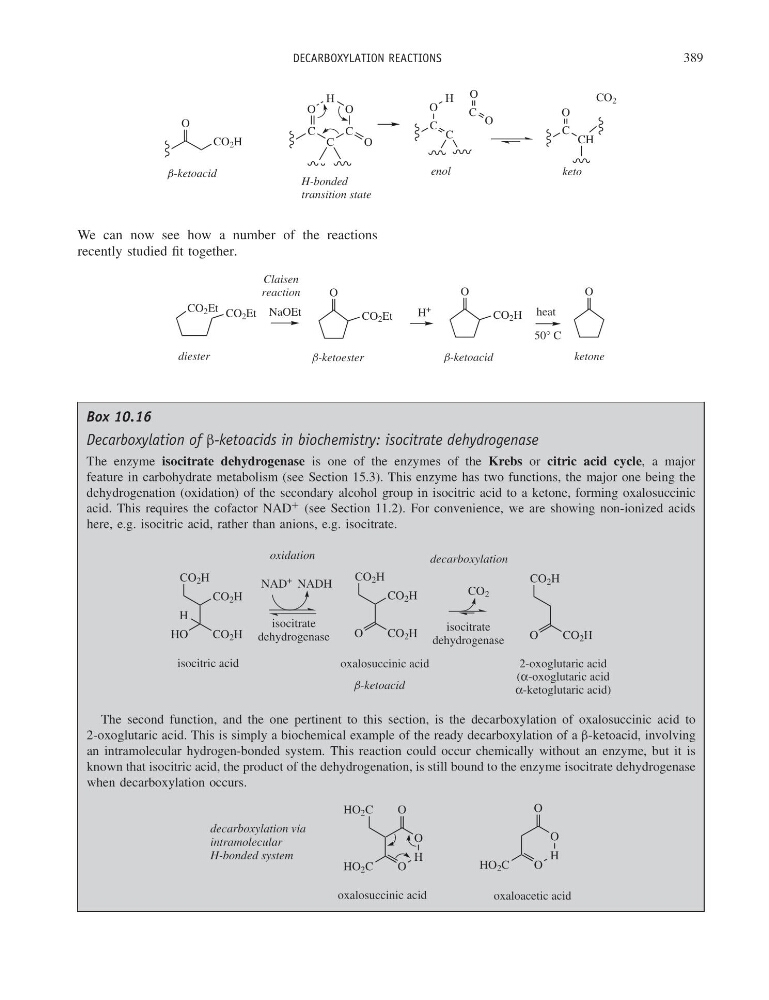
We can now see how a number of the reactions
recently studied fit together.
O
Claisen
reaction
b-ketoester
b-ketoacid
ketone
O
heat
O
CO 2 Et
CO 2 H
CO 2 Et CO 2 Et NaOEt
H +
50° C
diester
Box 10.16
Decarboxylation of β-ketoacids in biochemistry: isocitrate dehydrogenase
The enzyme isocitrate dehydrogenase is one of the enzymes of the Krebs or citric acid cycle, a major
feature in carbohydrate metabolism (see Section 15.3). This enzyme has two functions, the major one being the
dehydrogenation (oxidation) of the secondary alcohol group in isocitric acid to a ketone, forming oxalosuccinic
acid. This requires the cofactor NAD
+ (see Section 11.2). For convenience, we are showing non-ionized acids
here, e.g. isocitric acid, rather than anions, e.g. isocitrate.
oxidation
decarboxylation
isocitric acid
isocitrate
dehydrogenase
oxalosuccinic acid
b-ketoacid
2-oxoglutaric acid
(α-oxoglutaric acid
α-ketoglutaric acid)
isocitrate
dehydrogenase
CO 2 H
CO 2 H
CO 2 H
HO
H
CO 2 H
CO 2 H
CO 2 H
O
CO 2 H
CO 2 H
O
NAD + NADH
CO 2
The second function, and the one pertinent to this section, is the decarboxylation of oxalosuccinic acid to
2-oxoglutaric acid. This is simply a biochemical example of the ready decarboxylation of a β-ketoacid, involving
an intramolecular hydrogen-bonded system. This reaction could occur chemically without an enzyme, but it is
known that isocitric acid, the product of the dehydrogenation, is still bound to the enzyme isocitrate dehydrogenase
when decarboxylation occurs.
decarboxylation via
intramolecular
H-bonded system
oxaloacetic acid
oxalosuccinic acid
O
H
O
HO 2 C
O
O
HO 2 C
HO 2 C
O
O
H
389
O
C
C
C
O
H
O
O
C
C
C
O
H
O
O
C
CH
enol
keto
CO 2
H-bonded
transition state
CO 2 H
O
b-ketoacid
We can now see how a number of the reactions
recently studied fit together.
O
Claisen
reaction
b-ketoester
b-ketoacid
ketone
O
heat
O
CO 2 Et
CO 2 H
CO 2 Et CO 2 Et NaOEt
H +
50° C
diester
Box 10.16
Decarboxylation of β-ketoacids in biochemistry: isocitrate dehydrogenase
The enzyme isocitrate dehydrogenase is one of the enzymes of the Krebs or citric acid cycle, a major
feature in carbohydrate metabolism (see Section 15.3). This enzyme has two functions, the major one being the
dehydrogenation (oxidation) of the secondary alcohol group in isocitric acid to a ketone, forming oxalosuccinic
acid. This requires the cofactor NAD
+ (see Section 11.2). For convenience, we are showing non-ionized acids
here, e.g. isocitric acid, rather than anions, e.g. isocitrate.
oxidation
decarboxylation
isocitric acid
isocitrate
dehydrogenase
oxalosuccinic acid
b-ketoacid
2-oxoglutaric acid
(α-oxoglutaric acid
α-ketoglutaric acid)
isocitrate
dehydrogenase
CO 2 H
CO 2 H
CO 2 H
HO
H
CO 2 H
CO 2 H
CO 2 H
O
CO 2 H
CO 2 H
O
NAD + NADH
CO 2
The second function, and the one pertinent to this section, is the decarboxylation of oxalosuccinic acid to
2-oxoglutaric acid. This is simply a biochemical example of the ready decarboxylation of a β-ketoacid, involving
an intramolecular hydrogen-bonded system. This reaction could occur chemically without an enzyme, but it is
known that isocitric acid, the product of the dehydrogenation, is still bound to the enzyme isocitrate dehydrogenase
when decarboxylation occurs.
decarboxylation via
intramolecular
H-bonded system
oxaloacetic acid
oxalosuccinic acid
O
H
O
HO 2 C
O
O
HO 2 C
HO 2 C
O
O
H