

388
NUCLEOPHILIC REACTIONS INVOLVING ENOLATE ANIONS
Box 10.15
Reverse Claisen reaction in biochemistry: β-oxidation of fatty acids
Perhaps the most important example of the reverse Claisen reaction in biochemistry is that involved in the
β-oxidation of fatty acids, used to optimize energy release from storage fats, or fats ingested as food (see
Section 15.4). In common with most biochemical sequences, thioesters rather than oxygen esters are utilized (see
Box 10.8).
R
SCoA
O
R
SCoA
O
R
SCoA
O
R
SCoA
O
O
H
HO
R
CH 3
SCoA
O
O
SCoA
E
dehydrogenation;
hydrogen atoms
passed to FAD
stereospecific
hydration of
double bond
dehydrogenation;
hydrogen atoms
passed to NAD +
reverse Claisen
reaction
β-oxidation of fatty acids
fatty acyl-CoA
(chain length C 2n )
fatty acyl-CoA
(chain length C 2n–2 )
acetyl-CoA
FAD
S
FADH 2
H 2 O
HSCoA
NAD
+ NADH
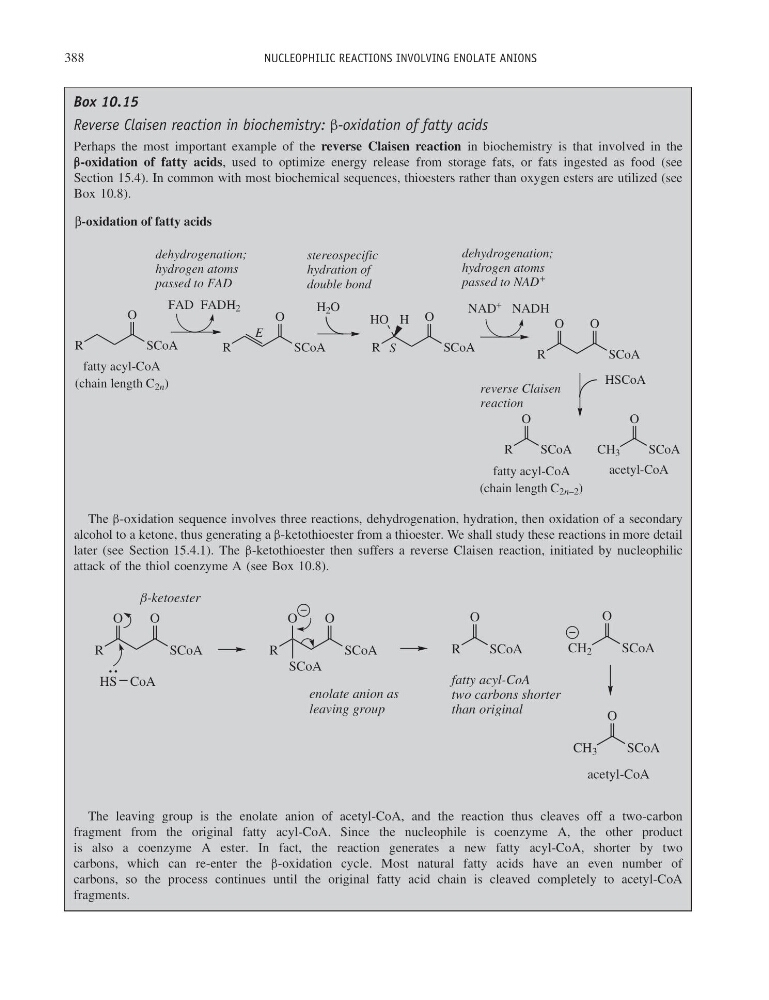
The β-oxidation sequence involves three reactions, dehydrogenation, hydration, then oxidation of a secondary
alcohol to a ketone, thus generating a β-ketothioester from a thioester. We shall study these reactions in more detail
later (see Section 15.4.1). The β-ketothioester then suffers a reverse Claisen reaction, initiated by nucleophilic
attack of the thiol coenzyme A (see Box 10.8).
enolate anion as
leaving group
b-ketoester
fatty acyl-CoA
two carbons shorter
than original
acetyl-CoA
R
SCoA
O
O
HS CoA
R
SCoA
O
O
SCoA
R
O
SCoA
CH 2
SCoA
O
CH 3
SCoA
O
The leaving group is the enolate anion of acetyl-CoA, and the reaction thus cleaves off a two-carbon
fragment from the original fatty acyl-CoA. Since the nucleophile is coenzyme A, the other product
is also a coenzyme A ester. In fact, the reaction generates a new fatty acyl-CoA, shorter by two
carbons, which can re-enter the β-oxidation cycle. Most natural fatty acids have an even number of
carbons, so the process continues until the original fatty acid chain is cleaved completely to acetyl-CoA
fragments.
NUCLEOPHILIC REACTIONS INVOLVING ENOLATE ANIONS
Box 10.15
Reverse Claisen reaction in biochemistry: β-oxidation of fatty acids
Perhaps the most important example of the reverse Claisen reaction in biochemistry is that involved in the
β-oxidation of fatty acids, used to optimize energy release from storage fats, or fats ingested as food (see
Section 15.4). In common with most biochemical sequences, thioesters rather than oxygen esters are utilized (see
Box 10.8).
R
SCoA
O
R
SCoA
O
R
SCoA
O
R
SCoA
O
O
H
HO
R
CH 3
SCoA
O
O
SCoA
E
dehydrogenation;
hydrogen atoms
passed to FAD
stereospecific
hydration of
double bond
dehydrogenation;
hydrogen atoms
passed to NAD +
reverse Claisen
reaction
β-oxidation of fatty acids
fatty acyl-CoA
(chain length C 2n )
fatty acyl-CoA
(chain length C 2n–2 )
acetyl-CoA
FAD
S
FADH 2
H 2 O
HSCoA
NAD
+ NADH
The β-oxidation sequence involves three reactions, dehydrogenation, hydration, then oxidation of a secondary
alcohol to a ketone, thus generating a β-ketothioester from a thioester. We shall study these reactions in more detail
later (see Section 15.4.1). The β-ketothioester then suffers a reverse Claisen reaction, initiated by nucleophilic
attack of the thiol coenzyme A (see Box 10.8).
enolate anion as
leaving group
b-ketoester
fatty acyl-CoA
two carbons shorter
than original
acetyl-CoA
R
SCoA
O
O
HS CoA
R
SCoA
O
O
SCoA
R
O
SCoA
CH 2
SCoA
O
CH 3
SCoA
O
The leaving group is the enolate anion of acetyl-CoA, and the reaction thus cleaves off a two-carbon
fragment from the original fatty acyl-CoA. Since the nucleophile is coenzyme A, the other product
is also a coenzyme A ester. In fact, the reaction generates a new fatty acyl-CoA, shorter by two
carbons, which can re-enter the β-oxidation cycle. Most natural fatty acids have an even number of
carbons, so the process continues until the original fatty acid chain is cleaved completely to acetyl-CoA
fragments.