

DECARBOXYLATION REACTIONS
387
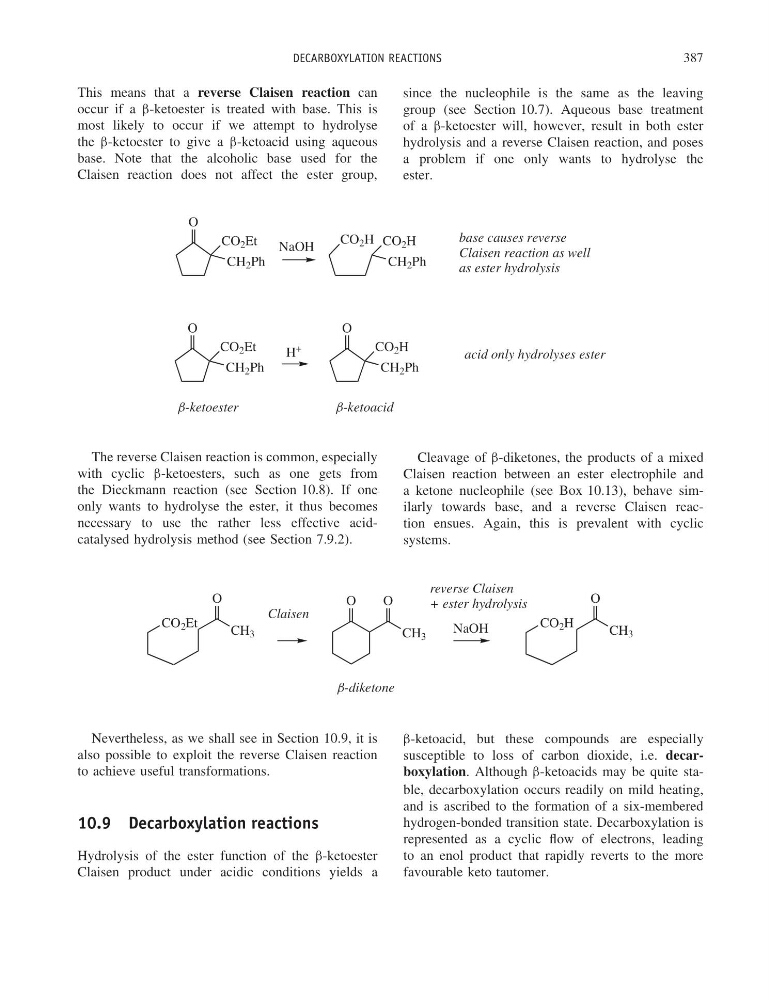
This means that a reverse Claisen reaction can
occur if a β-ketoester is treated with base. This is
most likely to occur if we attempt to hydrolyse
the β-ketoester to give a β-ketoacid using aqueous
base. Note that the alcoholic base used for the
Claisen reaction does not affect the ester group,
since the nucleophile is the same as the leaving
group (see Section 10.7). Aqueous base treatment
of a β-ketoester will, however, result in both ester
hydrolysis and a reverse Claisen reaction, and poses
a problem if one only wants to hydrolyse the
ester.
O
CO 2 H
CO 2 Et
CH 2 Ph
CH 2 Ph
CO 2 H
O
CO 2 Et
CH 2 Ph
O
CO 2 H
CH 2 Ph
b-ketoacid
base causes reverse
Claisen reaction as well
as ester hydrolysis
acid only hydrolyses ester
b-ketoester
H
+
NaOH
The reverse Claisen reaction is common, especially
with cyclic β-ketoesters, such as one gets from
the Dieckmann reaction (see Section 10.8). If one
only wants to hydrolyse the ester, it thus becomes
necessary to use the rather less effective acidcatalysed hydrolysis method (see Section 7.9.2).
Cleavage of β-diketones, the products of a mixed
Claisen reaction between an ester electrophile and
a ketone nucleophile (see Box 10.13), behave similarly towards base, and a reverse Claisen reaction ensues. Again, this is prevalent with cyclic
systems.
O
CH 3
O
CO 2 H
CH 3
O
b-diketone
CO 2 Et
CH 3
O
Claisen
reverse Claisen
+ ester hydrolysis
NaOH
Nevertheless, as we shall see in Section 10.9, it is
also possible to exploit the reverse Claisen reaction
to achieve useful transformations.
10.9 Decarboxylation reactions
Hydrolysis of the ester function of the β-ketoester
Claisen product under acidic conditions yields a
β-ketoacid, but these compounds are especially
susceptible to loss of carbon dioxide, i.e. decarboxylation. Although β-ketoacids may be quite stable, decarboxylation occurs readily on mild heating,
and is ascribed to the formation of a six-membered
hydrogen-bonded transition state. Decarboxylation is
represented as a cyclic flow of electrons, leading
to an enol product that rapidly reverts to the more
favourable keto tautomer.
387
This means that a reverse Claisen reaction can
occur if a β-ketoester is treated with base. This is
most likely to occur if we attempt to hydrolyse
the β-ketoester to give a β-ketoacid using aqueous
base. Note that the alcoholic base used for the
Claisen reaction does not affect the ester group,
since the nucleophile is the same as the leaving
group (see Section 10.7). Aqueous base treatment
of a β-ketoester will, however, result in both ester
hydrolysis and a reverse Claisen reaction, and poses
a problem if one only wants to hydrolyse the
ester.
O
CO 2 H
CO 2 Et
CH 2 Ph
CH 2 Ph
CO 2 H
O
CO 2 Et
CH 2 Ph
O
CO 2 H
CH 2 Ph
b-ketoacid
base causes reverse
Claisen reaction as well
as ester hydrolysis
acid only hydrolyses ester
b-ketoester
H
+
NaOH
The reverse Claisen reaction is common, especially
with cyclic β-ketoesters, such as one gets from
the Dieckmann reaction (see Section 10.8). If one
only wants to hydrolyse the ester, it thus becomes
necessary to use the rather less effective acidcatalysed hydrolysis method (see Section 7.9.2).
Cleavage of β-diketones, the products of a mixed
Claisen reaction between an ester electrophile and
a ketone nucleophile (see Box 10.13), behave similarly towards base, and a reverse Claisen reaction ensues. Again, this is prevalent with cyclic
systems.
O
CH 3
O
CO 2 H
CH 3
O
b-diketone
CO 2 Et
CH 3
O
Claisen
reverse Claisen
+ ester hydrolysis
NaOH
Nevertheless, as we shall see in Section 10.9, it is
also possible to exploit the reverse Claisen reaction
to achieve useful transformations.
10.9 Decarboxylation reactions
Hydrolysis of the ester function of the β-ketoester
Claisen product under acidic conditions yields a
β-ketoacid, but these compounds are especially
susceptible to loss of carbon dioxide, i.e. decarboxylation. Although β-ketoacids may be quite stable, decarboxylation occurs readily on mild heating,
and is ascribed to the formation of a six-membered
hydrogen-bonded transition state. Decarboxylation is
represented as a cyclic flow of electrons, leading
to an enol product that rapidly reverts to the more
favourable keto tautomer.