

386
NUCLEOPHILIC REACTIONS INVOLVING ENOLATE ANIONS
Box 10.14 (continued)
SEnz
O
O
O
O
SEnz
O
O
O
OH
H
SEnz
O
O
O
CO 2 H
OH
HO
O
O
SEnz
O
aldol addition
on to carbonyl
O
dehydration favoured
by formation of
conjugated system
O
O
O
enolization favoured
by formation of
aromatic ring
reformation of carbonyl
possible by expulsion of
leaving group; this also
releases product from enzyme
O
enolization favoured
by formation of
aromatic ring
OH
HO
OH
O
orsellinic acid
phloracetophenone
enolization
hydrolysis
enolization
aldol reaction
O
O
SEnz
O
O
Claisen reaction
O
O
SEnz
O
O
poly-β-ketoester
folding
A
folding
B
hydrolysis releases
product from
enzyme
H
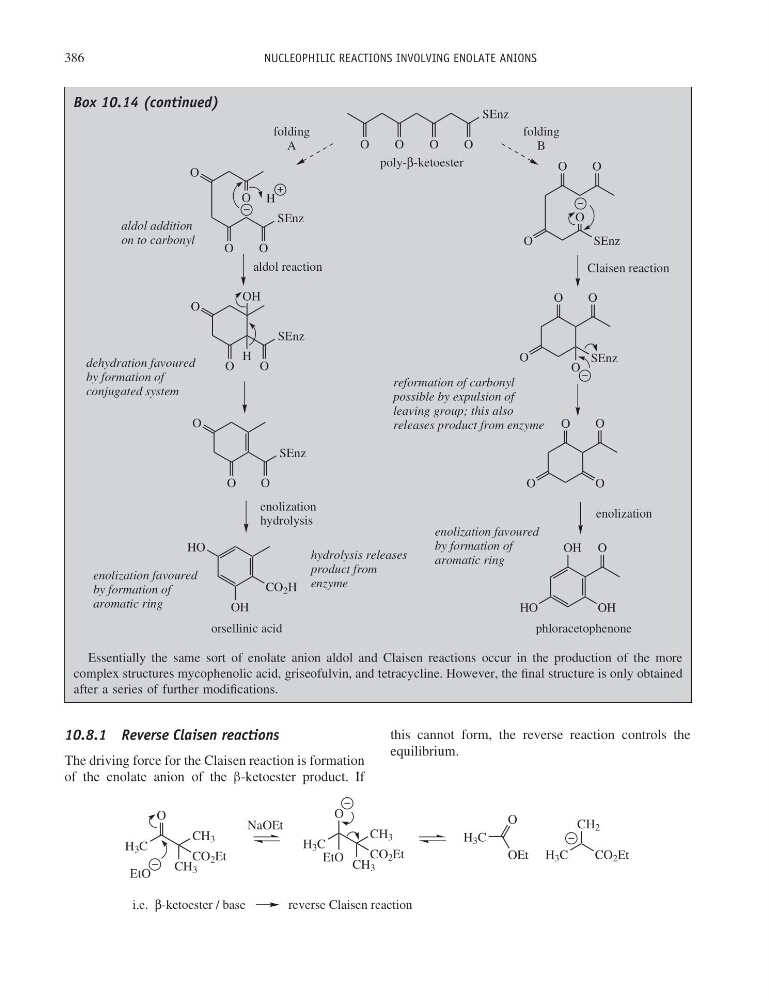
Essentially the same sort of enolate anion aldol and Claisen reactions occur in the production of the more
complex structures mycophenolic acid, griseofulvin, and tetracycline. However, the final structure is only obtained
after a series of further modifications.
10.8.1 Reverse Claisen reactions
The driving force for the Claisen reaction is formation
of the enolate anion of the β-ketoester product. If
this cannot form, the reverse reaction controls the
equilibrium.
i.e. β-ketoester / base
reverse Claisen reaction
H 3 C
OEt
O
O
H 3 C
CO 2 Et
CH 3
CH 3
O
H 3 C
CO 2 Et
CH 3
CH 3
EtO
CH 2
H 3 C
CO 2 Et
NaOEt
EtO
NUCLEOPHILIC REACTIONS INVOLVING ENOLATE ANIONS
Box 10.14 (continued)
SEnz
O
O
O
O
SEnz
O
O
O
OH
H
SEnz
O
O
O
CO 2 H
OH
HO
O
O
SEnz
O
aldol addition
on to carbonyl
O
dehydration favoured
by formation of
conjugated system
O
O
O
enolization favoured
by formation of
aromatic ring
reformation of carbonyl
possible by expulsion of
leaving group; this also
releases product from enzyme
O
enolization favoured
by formation of
aromatic ring
OH
HO
OH
O
orsellinic acid
phloracetophenone
enolization
hydrolysis
enolization
aldol reaction
O
O
SEnz
O
O
Claisen reaction
O
O
SEnz
O
O
poly-β-ketoester
folding
A
folding
B
hydrolysis releases
product from
enzyme
H
Essentially the same sort of enolate anion aldol and Claisen reactions occur in the production of the more
complex structures mycophenolic acid, griseofulvin, and tetracycline. However, the final structure is only obtained
after a series of further modifications.
10.8.1 Reverse Claisen reactions
The driving force for the Claisen reaction is formation
of the enolate anion of the β-ketoester product. If
this cannot form, the reverse reaction controls the
equilibrium.
i.e. β-ketoester / base
reverse Claisen reaction
H 3 C
OEt
O
O
H 3 C
CO 2 Et
CH 3
CH 3
O
H 3 C
CO 2 Et
CH 3
CH 3
EtO
CH 2
H 3 C
CO 2 Et
NaOEt
EtO