

ACYLATION OF ENOLATE ANIONS: THE CLAISEN REACTION
385
Box 10.14
Aldol and Claisen reactions in the biosynthesis of phenols
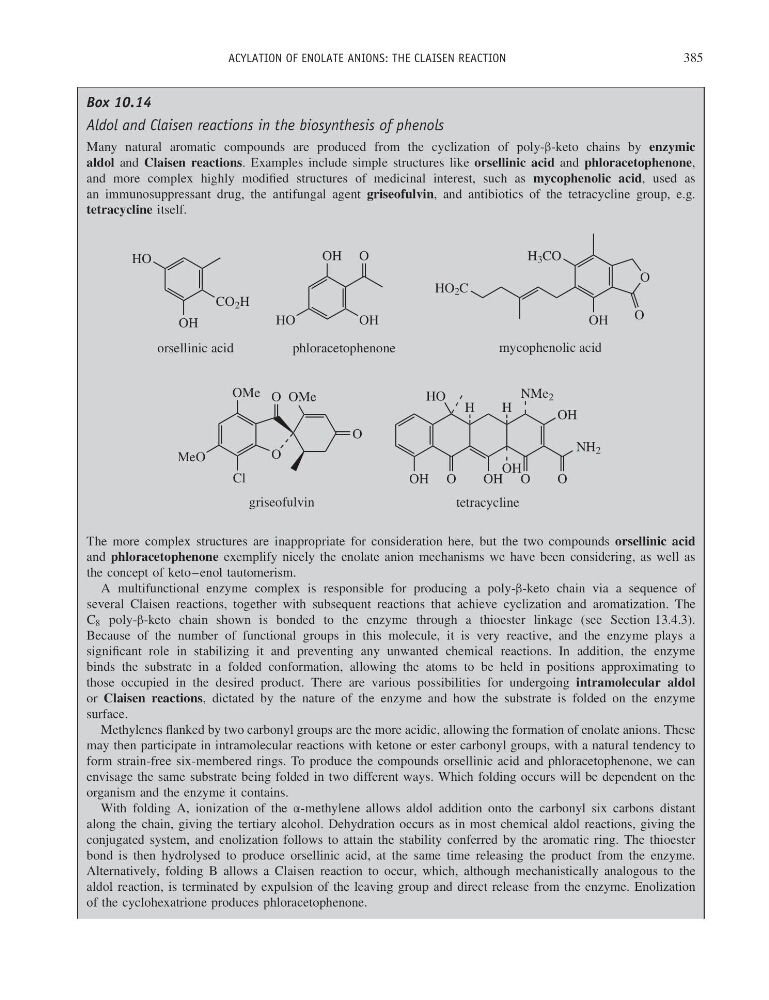
Many natural aromatic compounds are produced from the cyclization of poly-β-keto chains by enzymic
aldol and Claisen reactions. Examples include simple structures like orsellinic acid and phloracetophenone,
and more complex highly modified structures of medicinal interest, such as mycophenolic acid, used as
an immunosuppressant drug, the antifungal agent griseofulvin, and antibiotics of the tetracycline group, e.g.
tetracycline itself.
HO 2 C
OH
H 3 CO
O
O
mycophenolic acid
O
OMe
MeO
Cl
O
O OMe
griseofulvin
OH
NH 2
O
O
OH
O
OH
NMe 2
H
OH
HO
H
tetracycline
CO 2 H
OH
HO
OH
HO
OH
O
orsellinic acid
phloracetophenone
The more complex structures are inappropriate for consideration here, but the two compounds orsellinic acid
and phloracetophenone exemplify nicely the enolate anion mechanisms we have been considering, as well as
the concept of keto–enol tautomerism.
A multifunctional enzyme complex is responsible for producing a poly-β-keto chain via a sequence of
several Claisen reactions, together with subsequent reactions that achieve cyclization and aromatization. The
C 8 poly-β-keto chain shown is bonded to the enzyme through a thioester linkage (see Section 13.4.3).
Because of the number of functional groups in this molecule, it is very reactive, and the enzyme plays a
significant role in stabilizing it and preventing any unwanted chemical reactions. In addition, the enzyme
binds the substrate in a folded conformation, allowing the atoms to be held in positions approximating to
those occupied in the desired product. There are various possibilities for undergoing intramolecular aldol
or Claisen reactions, dictated by the nature of the enzyme and how the substrate is folded on the enzyme
surface.
Methylenes flanked by two carbonyl groups are the more acidic, allowing the formation of enolate anions. These
may then participate in intramolecular reactions with ketone or ester carbonyl groups, with a natural tendency to
form strain-free six-membered rings. To produce the compounds orsellinic acid and phloracetophenone, we can
envisage the same substrate being folded in two different ways. Which folding occurs will be dependent on the
organism and the enzyme it contains.
With folding A, ionization of the α-methylene allows aldol addition onto the carbonyl six carbons distant
along the chain, giving the tertiary alcohol. Dehydration occurs as in most chemical aldol reactions, giving the
conjugated system, and enolization follows to attain the stability conferred by the aromatic ring. The thioester
bond is then hydrolysed to produce orsellinic acid, at the same time releasing the product from the enzyme.
Alternatively, folding B allows a Claisen reaction to occur, which, although mechanistically analogous to the
aldol reaction, is terminated by expulsion of the leaving group and direct release from the enzyme. Enolization
of the cyclohexatrione produces phloracetophenone.
385
Box 10.14
Aldol and Claisen reactions in the biosynthesis of phenols
Many natural aromatic compounds are produced from the cyclization of poly-β-keto chains by enzymic
aldol and Claisen reactions. Examples include simple structures like orsellinic acid and phloracetophenone,
and more complex highly modified structures of medicinal interest, such as mycophenolic acid, used as
an immunosuppressant drug, the antifungal agent griseofulvin, and antibiotics of the tetracycline group, e.g.
tetracycline itself.
HO 2 C
OH
H 3 CO
O
O
mycophenolic acid
O
OMe
MeO
Cl
O
O OMe
griseofulvin
OH
NH 2
O
O
OH
O
OH
NMe 2
H
OH
HO
H
tetracycline
CO 2 H
OH
HO
OH
HO
OH
O
orsellinic acid
phloracetophenone
The more complex structures are inappropriate for consideration here, but the two compounds orsellinic acid
and phloracetophenone exemplify nicely the enolate anion mechanisms we have been considering, as well as
the concept of keto–enol tautomerism.
A multifunctional enzyme complex is responsible for producing a poly-β-keto chain via a sequence of
several Claisen reactions, together with subsequent reactions that achieve cyclization and aromatization. The
C 8 poly-β-keto chain shown is bonded to the enzyme through a thioester linkage (see Section 13.4.3).
Because of the number of functional groups in this molecule, it is very reactive, and the enzyme plays a
significant role in stabilizing it and preventing any unwanted chemical reactions. In addition, the enzyme
binds the substrate in a folded conformation, allowing the atoms to be held in positions approximating to
those occupied in the desired product. There are various possibilities for undergoing intramolecular aldol
or Claisen reactions, dictated by the nature of the enzyme and how the substrate is folded on the enzyme
surface.
Methylenes flanked by two carbonyl groups are the more acidic, allowing the formation of enolate anions. These
may then participate in intramolecular reactions with ketone or ester carbonyl groups, with a natural tendency to
form strain-free six-membered rings. To produce the compounds orsellinic acid and phloracetophenone, we can
envisage the same substrate being folded in two different ways. Which folding occurs will be dependent on the
organism and the enzyme it contains.
With folding A, ionization of the α-methylene allows aldol addition onto the carbonyl six carbons distant
along the chain, giving the tertiary alcohol. Dehydration occurs as in most chemical aldol reactions, giving the
conjugated system, and enolization follows to attain the stability conferred by the aromatic ring. The thioester
bond is then hydrolysed to produce orsellinic acid, at the same time releasing the product from the enzyme.
Alternatively, folding B allows a Claisen reaction to occur, which, although mechanistically analogous to the
aldol reaction, is terminated by expulsion of the leaving group and direct release from the enzyme. Enolization
of the cyclohexatrione produces phloracetophenone.