

382
NUCLEOPHILIC REACTIONS INVOLVING ENOLATE ANIONS
OH
CO 2 H
O
HO
H
HO
O
pravastatin
CoAS
OH
CO 2 H
HO
H
CoAS
O
CO 2 H
HO
mevaldic acid
hemithioacetal
HMG-CoA
NADPH
mevalonic
acid
HMG-CoA
reductase
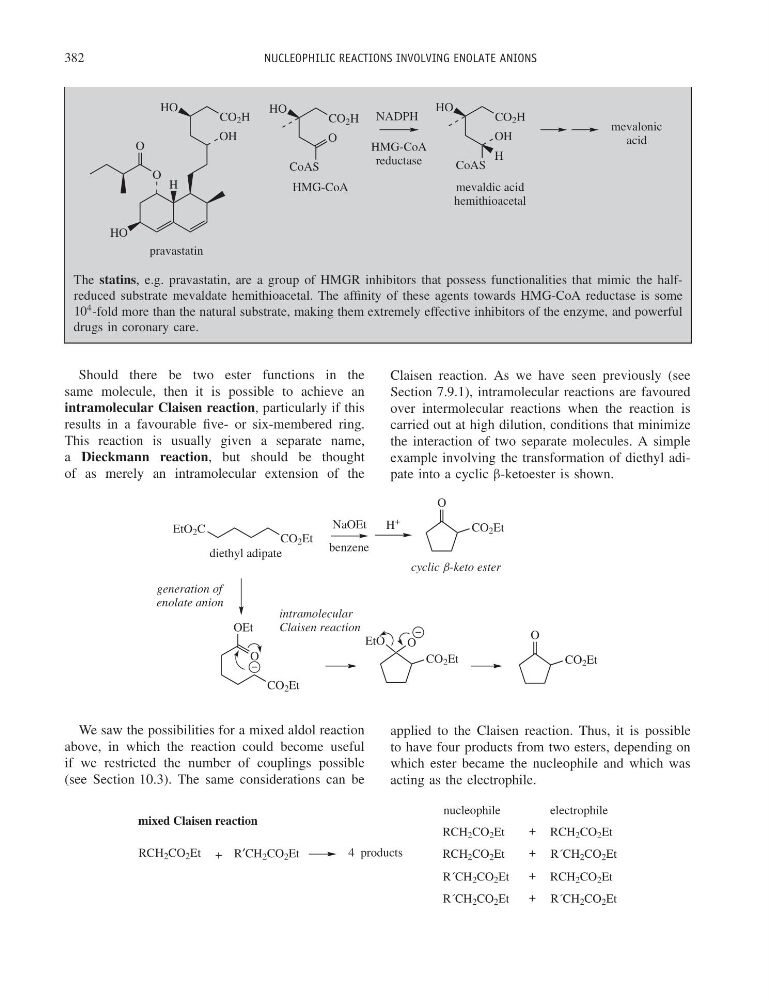
The statins, e.g. pravastatin, are a group of HMGR inhibitors that possess functionalities that mimic the halfreduced substrate mevaldate hemithioacetal. The affinity of these agents towards HMG-CoA reductase is some
10
4 -fold more than the natural substrate, making them extremely effective inhibitors of the enzyme, and powerful
drugs in coronary care.
Should there be two ester functions in the
same molecule, then it is possible to achieve an
intramolecular Claisen reaction, particularly if this
results in a favourable five- or six-membered ring.
This reaction is usually given a separate name,
a Dieckmann reaction, but should be thought
of as merely an intramolecular extension of the
Claisen reaction. As we have seen previously (see
Section 7.9.1), intramolecular reactions are favoured
over intermolecular reactions when the reaction is
carried out at high dilution, conditions that minimize
the interaction of two separate molecules. A simple
example involving the transformation of diethyl adipate into a cyclic β-ketoester is shown.
diethyl adipate
O
CO 2 Et
cyclic b-keto ester
EtO 2 C
CO 2 Et
O
CO 2 Et
EtO
O
CO 2 Et
generation of
enolate anion
intramolecular
Claisen reaction
O
OEt
CO 2 Et
NaOEt
benzene
H +
We saw the possibilities for a mixed aldol reaction
above, in which the reaction could become useful
if we restricted the number of couplings possible
(see Section 10.3). The same considerations can be
applied to the Claisen reaction. Thus, it is possible
to have four products from two esters, depending on
which ester became the nucleophile and which was
acting as the electrophile.
RCH 2 CO 2 Et
nucleophile
electrophile
RCH 2 CO 2 Et
RCH 2 CO 2 Et
R´CH 2 CO 2 Et
R´CH 2 CO 2 Et
R´CH 2 CO 2 Et
R´CH 2 CO 2 Et
RCH 2 CO 2 Et
mixed Claisen reaction
R′CH 2 CO 2 Et
+
4 products
+
+
+
+
RCH 2 CO 2 Et
NUCLEOPHILIC REACTIONS INVOLVING ENOLATE ANIONS
OH
CO 2 H
O
HO
H
HO
O
pravastatin
CoAS
OH
CO 2 H
HO
H
CoAS
O
CO 2 H
HO
mevaldic acid
hemithioacetal
HMG-CoA
NADPH
mevalonic
acid
HMG-CoA
reductase
The statins, e.g. pravastatin, are a group of HMGR inhibitors that possess functionalities that mimic the halfreduced substrate mevaldate hemithioacetal. The affinity of these agents towards HMG-CoA reductase is some
10
4 -fold more than the natural substrate, making them extremely effective inhibitors of the enzyme, and powerful
drugs in coronary care.
Should there be two ester functions in the
same molecule, then it is possible to achieve an
intramolecular Claisen reaction, particularly if this
results in a favourable five- or six-membered ring.
This reaction is usually given a separate name,
a Dieckmann reaction, but should be thought
of as merely an intramolecular extension of the
Claisen reaction. As we have seen previously (see
Section 7.9.1), intramolecular reactions are favoured
over intermolecular reactions when the reaction is
carried out at high dilution, conditions that minimize
the interaction of two separate molecules. A simple
example involving the transformation of diethyl adipate into a cyclic β-ketoester is shown.
diethyl adipate
O
CO 2 Et
cyclic b-keto ester
EtO 2 C
CO 2 Et
O
CO 2 Et
EtO
O
CO 2 Et
generation of
enolate anion
intramolecular
Claisen reaction
O
OEt
CO 2 Et
NaOEt
benzene
H +
We saw the possibilities for a mixed aldol reaction
above, in which the reaction could become useful
if we restricted the number of couplings possible
(see Section 10.3). The same considerations can be
applied to the Claisen reaction. Thus, it is possible
to have four products from two esters, depending on
which ester became the nucleophile and which was
acting as the electrophile.
RCH 2 CO 2 Et
nucleophile
electrophile
RCH 2 CO 2 Et
RCH 2 CO 2 Et
R´CH 2 CO 2 Et
R´CH 2 CO 2 Et
R´CH 2 CO 2 Et
R´CH 2 CO 2 Et
RCH 2 CO 2 Et
mixed Claisen reaction
R′CH 2 CO 2 Et
+
4 products
+
+
+
+
RCH 2 CO 2 Et