

ACYLATION OF ENOLATE ANIONS: THE CLAISEN REACTION
381
Using sodium ethoxide as base, the reaction does
not proceed. This can be ascribed to the nature of
the β-ketoester product, which contains no protons
sandwiched between two carbonyls and, therefore,
no protons that are sufficiently acidic for the final
equilibrium-disturbing step. The reaction can be made
to proceed, however, and the solution is simple: use a
stronger base. In this way, the base used is sufficiently
powerful to remove a less acidic proton from the
product, removing it from the reaction mixture and
disturbing the equilibrium. Any of the strong bases
sodium hydride, sodium amide, or LDA might be
employed. Although such bases will produce the
enolate anion irreversibly (see Section 10.2), it is still
necessary to ionize the product to overcome the effect
of the poor leaving group. In the β-ketoester product,
the pK a of the only acidic proton is about 20, so
this requires a strong base to achieve an equilibriumdisturbing ionization.
Box 10.12
Claisen and aldol reactions in nature: HMG-CoA and mevalonic acid
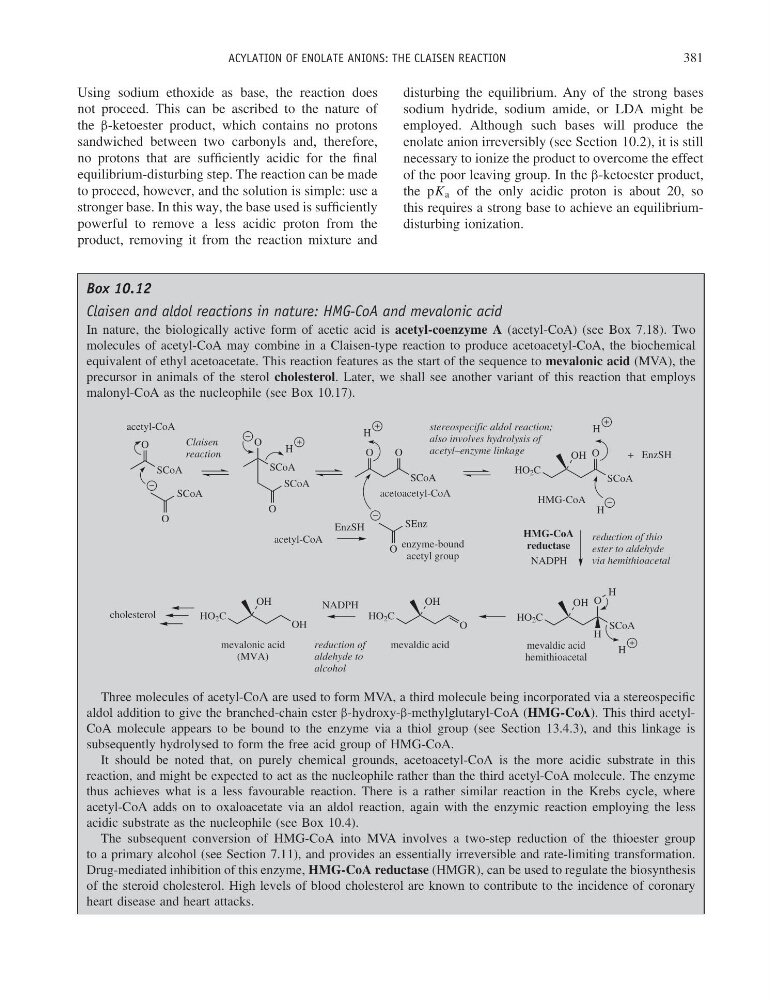
In nature, the biologically active form of acetic acid is acetyl-coenzyme A (acetyl-CoA) (see Box 7.18). Two
molecules of acetyl-CoA may combine in a Claisen-type reaction to produce acetoacetyl-CoA, the biochemical
equivalent of ethyl acetoacetate. This reaction features as the start of the sequence to mevalonic acid (MVA), the
precursor in animals of the sterol cholesterol. Later, we shall see another variant of this reaction that employs
malonyl-CoA as the nucleophile (see Box 10.17).
SCoA
O
SCoA
O
SCoA
O
O
SEnz
O
HO 2 C
OH
SCoA
O
HO 2 C
OH
SCoA
O
H
HO 2 C
OH
O
HO 2 C
OH
OH
acetyl-CoA
EnzSH
HMG-CoA
mevalonic acid
(MVA)
mevaldic acid
NADPH
NADPH
Claisen
reaction
stereospecific aldol reaction;
also involves hydrolysis of
acetyl–enzyme linkage
acetoacetyl-CoA
enzyme-bound
acetyl group
+ EnzSH
reduction of thio
ester to aldehyde
via hemithioacetal
mevaldic acid
hemithioacetal
reduction of
aldehyde to
alcohol
HMG-CoA
reductase
H
cholesterol
H
SCoA
O
SCoA
O
acetyl-CoA
H
H
H
H
Three molecules of acetyl-CoA are used to form MVA, a third molecule being incorporated via a stereospecific
aldol addition to give the branched-chain ester β-hydroxy-β-methylglutaryl-CoA (HMG-CoA). This third acetylCoA molecule appears to be bound to the enzyme via a thiol group (see Section 13.4.3), and this linkage is
subsequently hydrolysed to form the free acid group of HMG-CoA.
It should be noted that, on purely chemical grounds, acetoacetyl-CoA is the more acidic substrate in this
reaction, and might be expected to act as the nucleophile rather than the third acetyl-CoA molecule. The enzyme
thus achieves what is a less favourable reaction. There is a rather similar reaction in the Krebs cycle, where
acetyl-CoA adds on to oxaloacetate via an aldol reaction, again with the enzymic reaction employing the less
acidic substrate as the nucleophile (see Box 10.4).
The subsequent conversion of HMG-CoA into MVA involves a two-step reduction of the thioester group
to a primary alcohol (see Section 7.11), and provides an essentially irreversible and rate-limiting transformation.
Drug-mediated inhibition of this enzyme, HMG-CoA reductase (HMGR), can be used to regulate the biosynthesis
of the steroid cholesterol. High levels of blood cholesterol are known to contribute to the incidence of coronary
heart disease and heart attacks.
381
Using sodium ethoxide as base, the reaction does
not proceed. This can be ascribed to the nature of
the β-ketoester product, which contains no protons
sandwiched between two carbonyls and, therefore,
no protons that are sufficiently acidic for the final
equilibrium-disturbing step. The reaction can be made
to proceed, however, and the solution is simple: use a
stronger base. In this way, the base used is sufficiently
powerful to remove a less acidic proton from the
product, removing it from the reaction mixture and
disturbing the equilibrium. Any of the strong bases
sodium hydride, sodium amide, or LDA might be
employed. Although such bases will produce the
enolate anion irreversibly (see Section 10.2), it is still
necessary to ionize the product to overcome the effect
of the poor leaving group. In the β-ketoester product,
the pK a of the only acidic proton is about 20, so
this requires a strong base to achieve an equilibriumdisturbing ionization.
Box 10.12
Claisen and aldol reactions in nature: HMG-CoA and mevalonic acid
In nature, the biologically active form of acetic acid is acetyl-coenzyme A (acetyl-CoA) (see Box 7.18). Two
molecules of acetyl-CoA may combine in a Claisen-type reaction to produce acetoacetyl-CoA, the biochemical
equivalent of ethyl acetoacetate. This reaction features as the start of the sequence to mevalonic acid (MVA), the
precursor in animals of the sterol cholesterol. Later, we shall see another variant of this reaction that employs
malonyl-CoA as the nucleophile (see Box 10.17).
SCoA
O
SCoA
O
SCoA
O
O
SEnz
O
HO 2 C
OH
SCoA
O
HO 2 C
OH
SCoA
O
H
HO 2 C
OH
O
HO 2 C
OH
OH
acetyl-CoA
EnzSH
HMG-CoA
mevalonic acid
(MVA)
mevaldic acid
NADPH
NADPH
Claisen
reaction
stereospecific aldol reaction;
also involves hydrolysis of
acetyl–enzyme linkage
acetoacetyl-CoA
enzyme-bound
acetyl group
+ EnzSH
reduction of thio
ester to aldehyde
via hemithioacetal
mevaldic acid
hemithioacetal
reduction of
aldehyde to
alcohol
HMG-CoA
reductase
H
cholesterol
H
SCoA
O
SCoA
O
acetyl-CoA
H
H
H
H
Three molecules of acetyl-CoA are used to form MVA, a third molecule being incorporated via a stereospecific
aldol addition to give the branched-chain ester β-hydroxy-β-methylglutaryl-CoA (HMG-CoA). This third acetylCoA molecule appears to be bound to the enzyme via a thiol group (see Section 13.4.3), and this linkage is
subsequently hydrolysed to form the free acid group of HMG-CoA.
It should be noted that, on purely chemical grounds, acetoacetyl-CoA is the more acidic substrate in this
reaction, and might be expected to act as the nucleophile rather than the third acetyl-CoA molecule. The enzyme
thus achieves what is a less favourable reaction. There is a rather similar reaction in the Krebs cycle, where
acetyl-CoA adds on to oxaloacetate via an aldol reaction, again with the enzymic reaction employing the less
acidic substrate as the nucleophile (see Box 10.4).
The subsequent conversion of HMG-CoA into MVA involves a two-step reduction of the thioester group
to a primary alcohol (see Section 7.11), and provides an essentially irreversible and rate-limiting transformation.
Drug-mediated inhibition of this enzyme, HMG-CoA reductase (HMGR), can be used to regulate the biosynthesis
of the steroid cholesterol. High levels of blood cholesterol are known to contribute to the incidence of coronary
heart disease and heart attacks.