

380
NUCLEOPHILIC REACTIONS INVOLVING ENOLATE ANIONS
To participate in this sort of reaction, the carboxylic
acid derivative acting as nucleophile must have
α-hydrogens in order to generate an enolate anion.
In practice, esters are most commonly employed in
Claisen-type reactions.
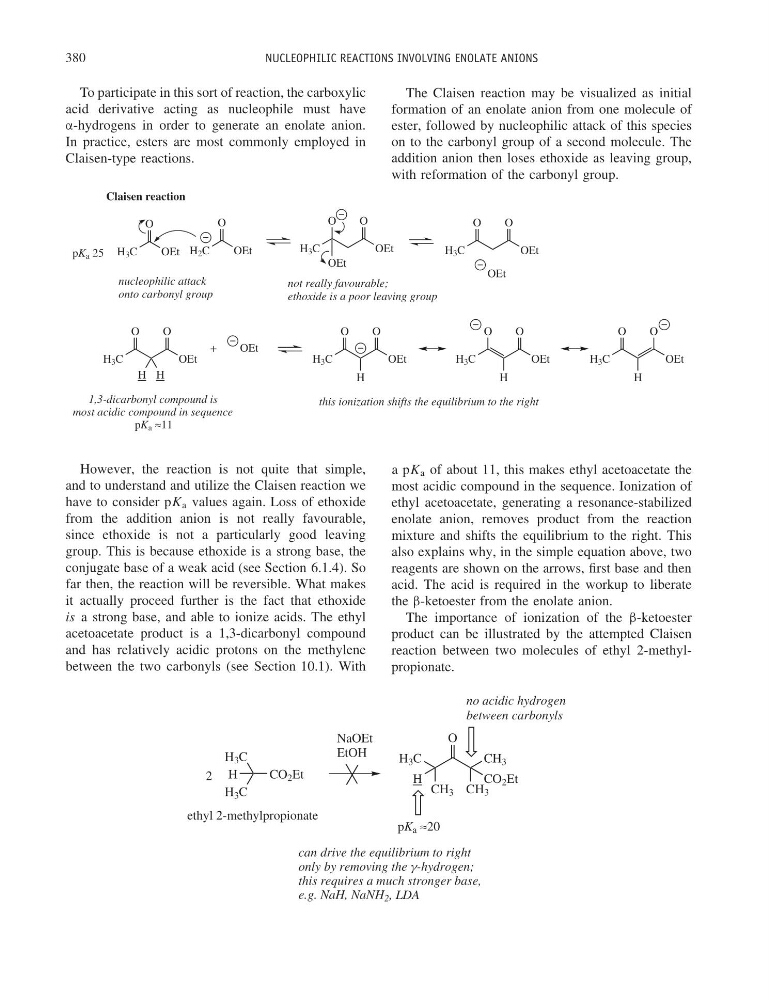
The Claisen reaction may be visualized as initial
formation of an enolate anion from one molecule of
ester, followed by nucleophilic attack of this species
on to the carbonyl group of a second molecule. The
addition anion then loses ethoxide as leaving group,
with reformation of the carbonyl group.
1,3-dicarbonyl compound is
most acidic compound in sequence
pK a ≈11
+
Claisen reaction
not really favourable;
ethoxide is a poor leaving group
this ionization shifts the equilibrium to the right
nucleophilic attack
onto carbonyl group
H 3 C
OEt
O
O
O
H 3 C
OEt
O
H 2 C
OEt
H 3 C
OEt
O
O
OEt
H 3 C
OEt
O
O
H H
H 3 C
OEt
O
O
H
H 3 C
OEt
O
O
H
H 3 C
OEt
O
O
H
pK a 25
OEt
OEt
However, the reaction is not quite that simple,
and to understand and utilize the Claisen reaction we
have to consider pK a values again. Loss of ethoxide
from the addition anion is not really favourable,
since ethoxide is not a particularly good leaving
group. This is because ethoxide is a strong base, the
conjugate base of a weak acid (see Section 6.1.4). So
far then, the reaction will be reversible. What makes
it actually proceed further is the fact that ethoxide
is a strong base, and able to ionize acids. The ethyl
acetoacetate product is a 1,3-dicarbonyl compound
and has relatively acidic protons on the methylene
between the two carbonyls (see Section 10.1). With
a pK a of about 11, this makes ethyl acetoacetate the
most acidic compound in the sequence. Ionization of
ethyl acetoacetate, generating a resonance-stabilized
enolate anion, removes product from the reaction
mixture and shifts the equilibrium to the right. This
also explains why, in the simple equation above, two
reagents are shown on the arrows, first base and then
acid. The acid is required in the workup to liberate
the β-ketoester from the enolate anion.
The importance of ionization of the β-ketoester
product can be illustrated by the attempted Claisen
reaction between two molecules of ethyl 2-methylpropionate.
2
NaOEt
EtOH
no acidic hydrogen
between carbonyls
pK a ≈20
can drive the equilibrium to right
only by removing the g-hydrogen;
this requires a much stronger base,
e.g. NaH, NaNH 2 , LDA
CO 2 Et
H 3 C
H 3 C
H
O
CO 2 Et
H 3 C
CH 3
H
CH 3
CH 3
ethyl 2-methylpropionate
NUCLEOPHILIC REACTIONS INVOLVING ENOLATE ANIONS
To participate in this sort of reaction, the carboxylic
acid derivative acting as nucleophile must have
α-hydrogens in order to generate an enolate anion.
In practice, esters are most commonly employed in
Claisen-type reactions.
The Claisen reaction may be visualized as initial
formation of an enolate anion from one molecule of
ester, followed by nucleophilic attack of this species
on to the carbonyl group of a second molecule. The
addition anion then loses ethoxide as leaving group,
with reformation of the carbonyl group.
1,3-dicarbonyl compound is
most acidic compound in sequence
pK a ≈11
+
Claisen reaction
not really favourable;
ethoxide is a poor leaving group
this ionization shifts the equilibrium to the right
nucleophilic attack
onto carbonyl group
H 3 C
OEt
O
O
O
H 3 C
OEt
O
H 2 C
OEt
H 3 C
OEt
O
O
OEt
H 3 C
OEt
O
O
H H
H 3 C
OEt
O
O
H
H 3 C
OEt
O
O
H
H 3 C
OEt
O
O
H
pK a 25
OEt
OEt
However, the reaction is not quite that simple,
and to understand and utilize the Claisen reaction we
have to consider pK a values again. Loss of ethoxide
from the addition anion is not really favourable,
since ethoxide is not a particularly good leaving
group. This is because ethoxide is a strong base, the
conjugate base of a weak acid (see Section 6.1.4). So
far then, the reaction will be reversible. What makes
it actually proceed further is the fact that ethoxide
is a strong base, and able to ionize acids. The ethyl
acetoacetate product is a 1,3-dicarbonyl compound
and has relatively acidic protons on the methylene
between the two carbonyls (see Section 10.1). With
a pK a of about 11, this makes ethyl acetoacetate the
most acidic compound in the sequence. Ionization of
ethyl acetoacetate, generating a resonance-stabilized
enolate anion, removes product from the reaction
mixture and shifts the equilibrium to the right. This
also explains why, in the simple equation above, two
reagents are shown on the arrows, first base and then
acid. The acid is required in the workup to liberate
the β-ketoester from the enolate anion.
The importance of ionization of the β-ketoester
product can be illustrated by the attempted Claisen
reaction between two molecules of ethyl 2-methylpropionate.
2
NaOEt
EtOH
no acidic hydrogen
between carbonyls
pK a ≈20
can drive the equilibrium to right
only by removing the g-hydrogen;
this requires a much stronger base,
e.g. NaH, NaNH 2 , LDA
CO 2 Et
H 3 C
H 3 C
H
O
CO 2 Et
H 3 C
CH 3
H
CH 3
CH 3
ethyl 2-methylpropionate