

ACYLATION OF ENOLATE ANIONS: THE CLAISEN REACTION
379
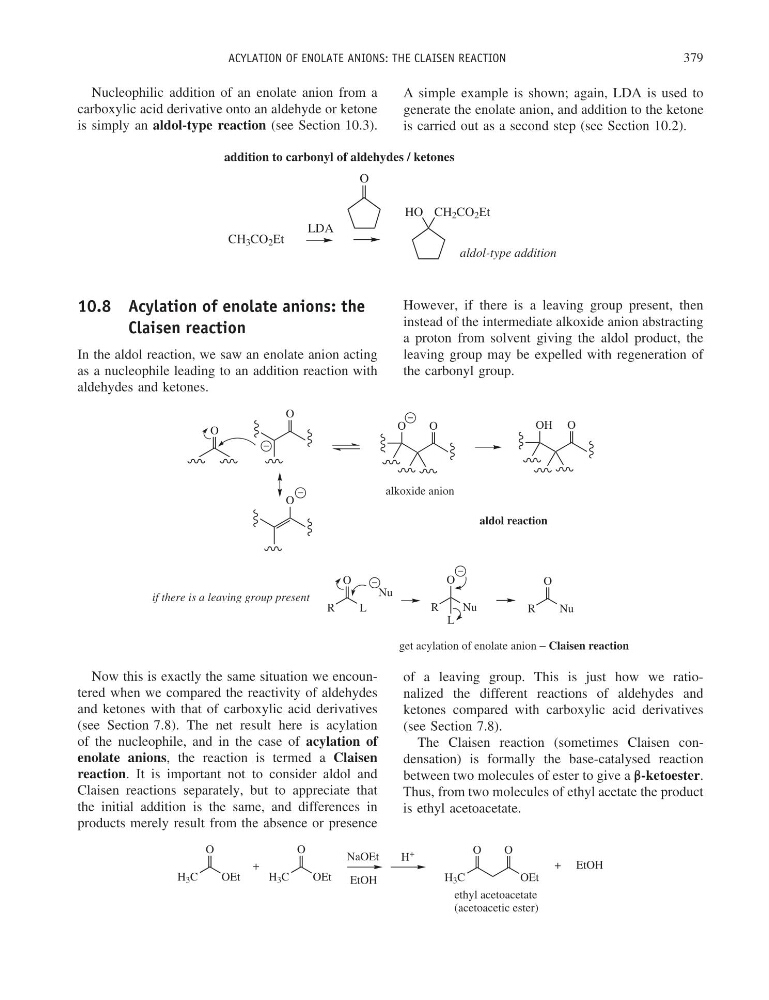
Nucleophilic addition of an enolate anion from a
carboxylic acid derivative onto an aldehyde or ketone
is simply an aldol-type reaction (see Section 10.3).
A simple example is shown; again, LDA is used to
generate the enolate anion, and addition to the ketone
is carried out as a second step (see Section 10.2).
O
addition to carbonyl of aldehydes / ketones
CH 2 CO 2 Et
HO
LDA
aldol-type addition
CH 3 CO 2 Et
10.8 Acylation of enolate anions: the
Claisen reaction
In the aldol reaction, we saw an enolate anion acting
as a nucleophile leading to an addition reaction with
aldehydes and ketones.
However, if there is a leaving group present, then
instead of the intermediate alkoxide anion abstracting
a proton from solvent giving the aldol product, the
leaving group may be expelled with regeneration of
the carbonyl group.
O
O
O
O
O
O
OH
aldol reaction
alkoxide anion
O
R
L
O
R
Nu
if there is a leaving group present
Nu
get acylation of enolate anion − Claisen reaction
O
R
Nu
L
Now this is exactly the same situation we encountered when we compared the reactivity of aldehydes
and ketones with that of carboxylic acid derivatives
(see Section 7.8). The net result here is acylation
of the nucleophile, and in the case of acylation of
enolate anions, the reaction is termed a Claisen
reaction. It is important not to consider aldol and
Claisen reactions separately, but to appreciate that
the initial addition is the same, and differences in
products merely result from the absence or presence
of a leaving group. This is just how we rationalized the different reactions of aldehydes and
ketones compared with carboxylic acid derivatives
(see Section 7.8).
The Claisen reaction (sometimes Claisen condensation) is formally the base-catalysed reaction
between two molecules of ester to give a β-ketoester.
Thus, from two molecules of ethyl acetate the product
is ethyl acetoacetate.
+
ethyl acetoacetate
(acetoacetic ester)
H 3 C
OEt
O
O
O
H 3 C
OEt
O
H 3 C
OEt
+
NaOEt
EtOH
H +
EtOH
379
Nucleophilic addition of an enolate anion from a
carboxylic acid derivative onto an aldehyde or ketone
is simply an aldol-type reaction (see Section 10.3).
A simple example is shown; again, LDA is used to
generate the enolate anion, and addition to the ketone
is carried out as a second step (see Section 10.2).
O
addition to carbonyl of aldehydes / ketones
CH 2 CO 2 Et
HO
LDA
aldol-type addition
CH 3 CO 2 Et
10.8 Acylation of enolate anions: the
Claisen reaction
In the aldol reaction, we saw an enolate anion acting
as a nucleophile leading to an addition reaction with
aldehydes and ketones.
However, if there is a leaving group present, then
instead of the intermediate alkoxide anion abstracting
a proton from solvent giving the aldol product, the
leaving group may be expelled with regeneration of
the carbonyl group.
O
O
O
O
O
O
OH
aldol reaction
alkoxide anion
O
R
L
O
R
Nu
if there is a leaving group present
Nu
get acylation of enolate anion − Claisen reaction
O
R
Nu
L
Now this is exactly the same situation we encountered when we compared the reactivity of aldehydes
and ketones with that of carboxylic acid derivatives
(see Section 7.8). The net result here is acylation
of the nucleophile, and in the case of acylation of
enolate anions, the reaction is termed a Claisen
reaction. It is important not to consider aldol and
Claisen reactions separately, but to appreciate that
the initial addition is the same, and differences in
products merely result from the absence or presence
of a leaving group. This is just how we rationalized the different reactions of aldehydes and
ketones compared with carboxylic acid derivatives
(see Section 7.8).
The Claisen reaction (sometimes Claisen condensation) is formally the base-catalysed reaction
between two molecules of ester to give a β-ketoester.
Thus, from two molecules of ethyl acetate the product
is ethyl acetoacetate.
+
ethyl acetoacetate
(acetoacetic ester)
H 3 C
OEt
O
O
O
H 3 C
OEt
O
H 3 C
OEt
+
NaOEt
EtOH
H +
EtOH