

378
NUCLEOPHILIC REACTIONS INVOLVING ENOLATE ANIONS
Box 10.11 (continued)
H
O
OH
H
R (inactive)
S (active)
OH
O
B
A
H
B
H
A
H
B
A
H
OH
O
base-catalysed conversion:
acid-catalysed conversion:
H
O
OH
H
OH
O
B
A
H
A
H
B
A
H
OH
O
B
H
O
OH
B
H
A
H
R (inactive)
S (active)
enediol with favourable
conjugation
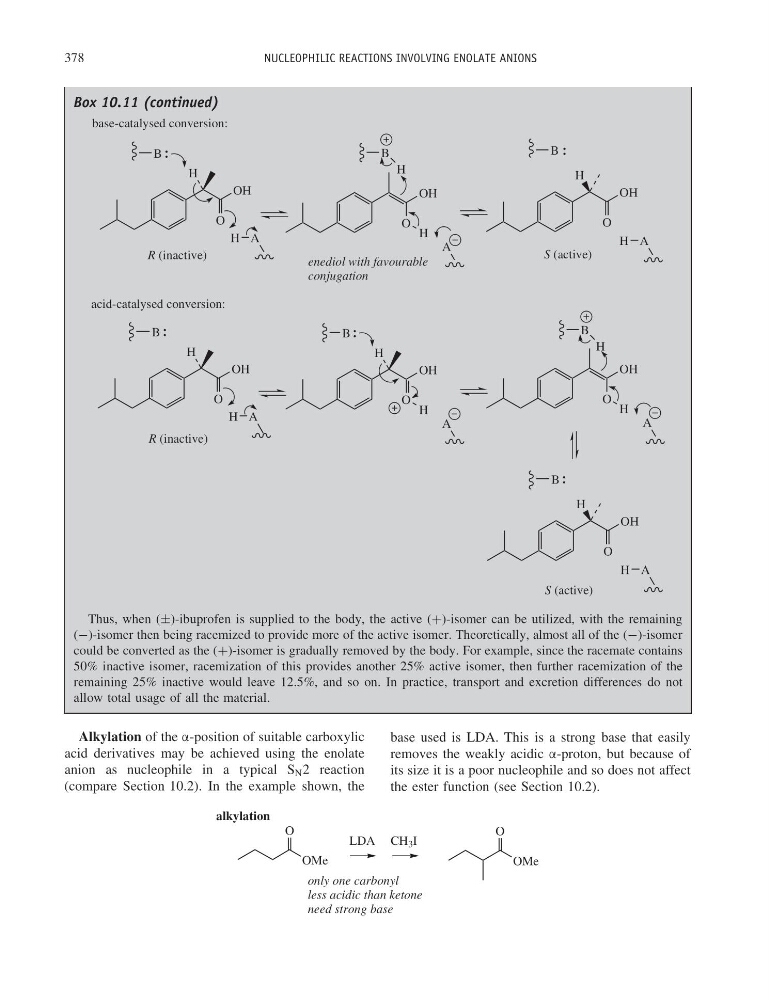
Thus, when (±)-ibuprofen is supplied to the body, the active (+)-isomer can be utilized, with the remaining
(−)-isomer then being racemized to provide more of the active isomer. Theoretically, almost all of the (−)-isomer
could be converted as the (+)-isomer is gradually removed by the body. For example, since the racemate contains
50% inactive isomer, racemization of this provides another 25% active isomer, then further racemization of the
remaining 25% inactive would leave 12.5%, and so on. In practice, transport and excretion differences do not
allow total usage of all the material.
Alkylation of the α-position of suitable carboxylic
acid derivatives may be achieved using the enolate
anion as nucleophile in a typical S N 2 reaction
(compare Section 10.2). In the example shown, the
base used is LDA. This is a strong base that easily
removes the weakly acidic α-proton, but because of
its size it is a poor nucleophile and so does not affect
the ester function (see Section 10.2).
OMe
O
OMe
O
alkylation
only one carbonyl
less acidic than ketone
need strong base
LDA CH 3 I
NUCLEOPHILIC REACTIONS INVOLVING ENOLATE ANIONS
Box 10.11 (continued)
H
O
OH
H
R (inactive)
S (active)
OH
O
B
A
H
B
H
A
H
B
A
H
OH
O
base-catalysed conversion:
acid-catalysed conversion:
H
O
OH
H
OH
O
B
A
H
A
H
B
A
H
OH
O
B
H
O
OH
B
H
A
H
R (inactive)
S (active)
enediol with favourable
conjugation
Thus, when (±)-ibuprofen is supplied to the body, the active (+)-isomer can be utilized, with the remaining
(−)-isomer then being racemized to provide more of the active isomer. Theoretically, almost all of the (−)-isomer
could be converted as the (+)-isomer is gradually removed by the body. For example, since the racemate contains
50% inactive isomer, racemization of this provides another 25% active isomer, then further racemization of the
remaining 25% inactive would leave 12.5%, and so on. In practice, transport and excretion differences do not
allow total usage of all the material.
Alkylation of the α-position of suitable carboxylic
acid derivatives may be achieved using the enolate
anion as nucleophile in a typical S N 2 reaction
(compare Section 10.2). In the example shown, the
base used is LDA. This is a strong base that easily
removes the weakly acidic α-proton, but because of
its size it is a poor nucleophile and so does not affect
the ester function (see Section 10.2).
OMe
O
OMe
O
alkylation
only one carbonyl
less acidic than ketone
need strong base
LDA CH 3 I