

ENOLATE ANIONS FROM CARBOXYLIC ACID DERIVATIVES
377
N
N
H
H
O
H
R
N
N
H
H
O
N
N
H
H
O
R
H
L
R
epimerization through
an intermediate
enol-like tautomer
B
A
H
B
A
H
H
D
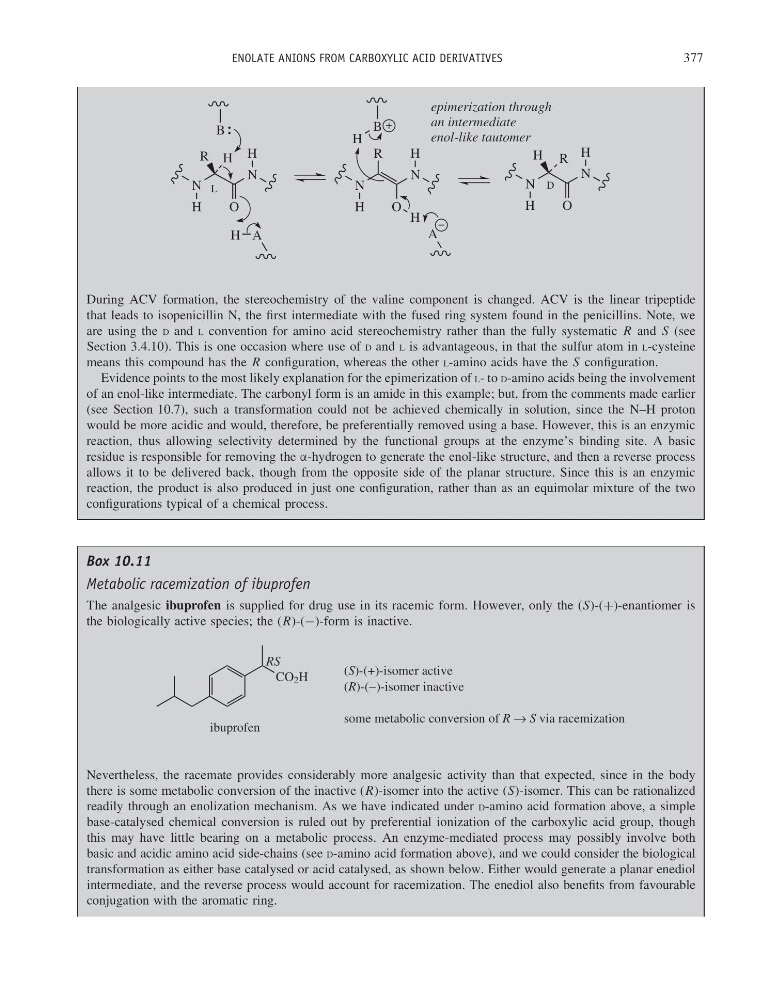
During ACV formation, the stereochemistry of the valine component is changed. ACV is the linear tripeptide
that leads to isopenicillin N, the first intermediate with the fused ring system found in the penicillins. Note, we
are using the D and L convention for amino acid stereochemistry rather than the fully systematic R and S (see
Section 3.4.10). This is one occasion where use of D and L is advantageous, in that the sulfur atom in L-cysteine
means this compound has the R configuration, whereas the other L-amino acids have the S configuration.
Evidence points to the most likely explanation for the epimerization of L- to D-amino acids being the involvement
of an enol-like intermediate. The carbonyl form is an amide in this example; but, from the comments made earlier
(see Section 10.7), such a transformation could not be achieved chemically in solution, since the N–H proton
would be more acidic and would, therefore, be preferentially removed using a base. However, this is an enzymic
reaction, thus allowing selectivity determined by the functional groups at the enzyme’s binding site. A basic
residue is responsible for removing the α-hydrogen to generate the enol-like structure, and then a reverse process
allows it to be delivered back, though from the opposite side of the planar structure. Since this is an enzymic
reaction, the product is also produced in just one configuration, rather than as an equimolar mixture of the two
configurations typical of a chemical process.
Box 10.11
Metabolic racemization of ibuprofen
The analgesic ibuprofen is supplied for drug use in its racemic form. However, only the (S)-(+)-enantiomer is
the biologically active species; the (R)-(−)-form is inactive.
CO 2 H
RS
ibuprofen
(S)-(+)-isomer active
(R)-(−)-isomer inactive
some metabolic conversion of R → S via racemization
Nevertheless, the racemate provides considerably more analgesic activity than that expected, since in the body
there is some metabolic conversion of the inactive (R)-isomer into the active (S)-isomer. This can be rationalized
readily through an enolization mechanism. As we have indicated under D-amino acid formation above, a simple
base-catalysed chemical conversion is ruled out by preferential ionization of the carboxylic acid group, though
this may have little bearing on a metabolic process. An enzyme-mediated process may possibly involve both
basic and acidic amino acid side-chains (see D-amino acid formation above), and we could consider the biological
transformation as either base catalysed or acid catalysed, as shown below. Either would generate a planar enediol
intermediate, and the reverse process would account for racemization. The enediol also benefits from favourable
conjugation with the aromatic ring.
377
N
N
H
H
O
H
R
N
N
H
H
O
N
N
H
H
O
R
H
L
R
epimerization through
an intermediate
enol-like tautomer
B
A
H
B
A
H
H
D
During ACV formation, the stereochemistry of the valine component is changed. ACV is the linear tripeptide
that leads to isopenicillin N, the first intermediate with the fused ring system found in the penicillins. Note, we
are using the D and L convention for amino acid stereochemistry rather than the fully systematic R and S (see
Section 3.4.10). This is one occasion where use of D and L is advantageous, in that the sulfur atom in L-cysteine
means this compound has the R configuration, whereas the other L-amino acids have the S configuration.
Evidence points to the most likely explanation for the epimerization of L- to D-amino acids being the involvement
of an enol-like intermediate. The carbonyl form is an amide in this example; but, from the comments made earlier
(see Section 10.7), such a transformation could not be achieved chemically in solution, since the N–H proton
would be more acidic and would, therefore, be preferentially removed using a base. However, this is an enzymic
reaction, thus allowing selectivity determined by the functional groups at the enzyme’s binding site. A basic
residue is responsible for removing the α-hydrogen to generate the enol-like structure, and then a reverse process
allows it to be delivered back, though from the opposite side of the planar structure. Since this is an enzymic
reaction, the product is also produced in just one configuration, rather than as an equimolar mixture of the two
configurations typical of a chemical process.
Box 10.11
Metabolic racemization of ibuprofen
The analgesic ibuprofen is supplied for drug use in its racemic form. However, only the (S)-(+)-enantiomer is
the biologically active species; the (R)-(−)-form is inactive.
CO 2 H
RS
ibuprofen
(S)-(+)-isomer active
(R)-(−)-isomer inactive
some metabolic conversion of R → S via racemization
Nevertheless, the racemate provides considerably more analgesic activity than that expected, since in the body
there is some metabolic conversion of the inactive (R)-isomer into the active (S)-isomer. This can be rationalized
readily through an enolization mechanism. As we have indicated under D-amino acid formation above, a simple
base-catalysed chemical conversion is ruled out by preferential ionization of the carboxylic acid group, though
this may have little bearing on a metabolic process. An enzyme-mediated process may possibly involve both
basic and acidic amino acid side-chains (see D-amino acid formation above), and we could consider the biological
transformation as either base catalysed or acid catalysed, as shown below. Either would generate a planar enediol
intermediate, and the reverse process would account for racemization. The enediol also benefits from favourable
conjugation with the aromatic ring.