

ACYLATION OF ENOLATE ANIONS: THE CLAISEN REACTION
383
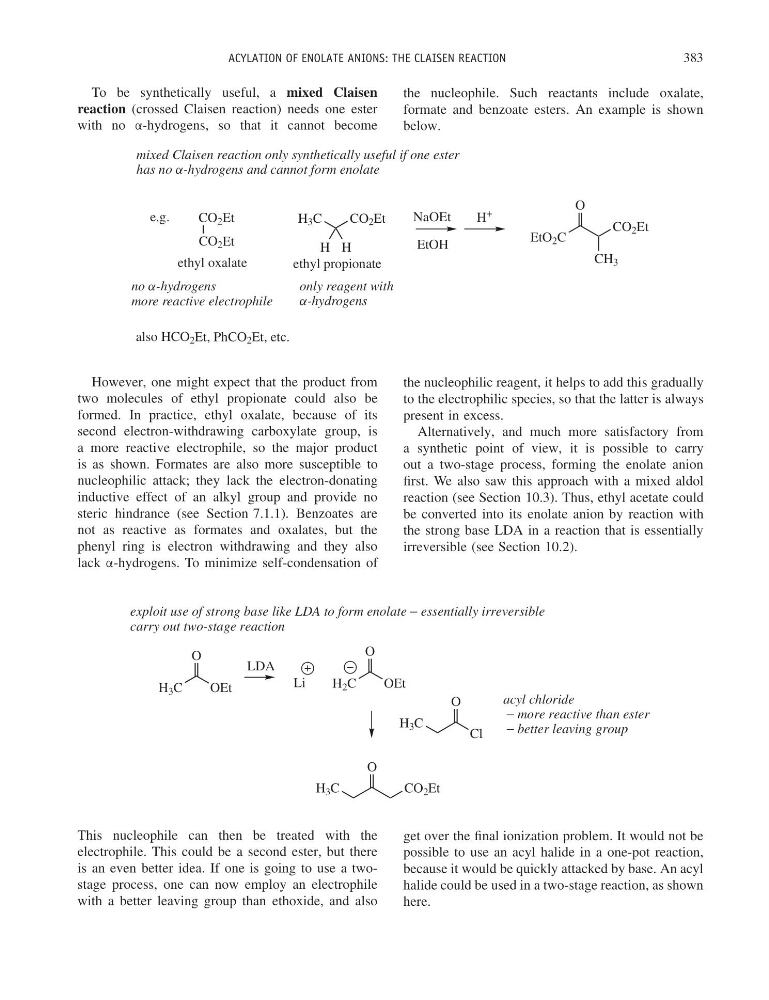
To be synthetically useful, a mixed Claisen
reaction (crossed Claisen reaction) needs one ester
with no α-hydrogens, so that it cannot become
the nucleophile. Such reactants include oxalate,
formate and benzoate esters. An example is shown
below.
CO 2 Et
CO 2 Et
mixed Claisen reaction only synthetically useful if one ester
has no a-hydrogens and cannot form enolate
ethyl oxalate
also HCO 2 Et, PhCO 2 Et, etc.
e.g.
no a-hydrogens
more reactive electrophile
only reagent with
a-hydrogens
NaOEt
EtOH
H
+
H 3 C
CO 2 Et
H
H
EtO 2 C
CO 2 Et
CH 3
O
ethyl propionate
However, one might expect that the product from
two molecules of ethyl propionate could also be
formed. In practice, ethyl oxalate, because of its
second electron-withdrawing carboxylate group, is
a more reactive electrophile, so the major product
is as shown. Formates are also more susceptible to
nucleophilic attack; they lack the electron-donating
inductive effect of an alkyl group and provide no
steric hindrance (see Section 7.1.1). Benzoates are
not as reactive as formates and oxalates, but the
phenyl ring is electron withdrawing and they also
lack α-hydrogens. To minimize self-condensation of
the nucleophilic reagent, it helps to add this gradually
to the electrophilic species, so that the latter is always
present in excess.
Alternatively, and much more satisfactory from
a synthetic point of view, it is possible to carry
out a two-stage process, forming the enolate anion
first. We also saw this approach with a mixed aldol
reaction (see Section 10.3). Thus, ethyl acetate could
be converted into its enolate anion by reaction with
the strong base LDA in a reaction that is essentially
irreversible (see Section 10.2).
exploit use of strong base like LDA to form enolate − essentially irreversible
carry out two-stage reaction
LDA
acyl chloride
− more reactive than ester
− better leaving group
H 3 C
CO 2 Et
O
O
H 3 C
OEt
H 3 C
Cl
O
O
H 2 C
OEt
Li
This nucleophile can then be treated with the
electrophile. This could be a second ester, but there
is an even better idea. If one is going to use a twostage process, one can now employ an electrophile
with a better leaving group than ethoxide, and also
get over the final ionization problem. It would not be
possible to use an acyl halide in a one-pot reaction,
because it would be quickly attacked by base. An acyl
halide could be used in a two-stage reaction, as shown
here.
383
To be synthetically useful, a mixed Claisen
reaction (crossed Claisen reaction) needs one ester
with no α-hydrogens, so that it cannot become
the nucleophile. Such reactants include oxalate,
formate and benzoate esters. An example is shown
below.
CO 2 Et
CO 2 Et
mixed Claisen reaction only synthetically useful if one ester
has no a-hydrogens and cannot form enolate
ethyl oxalate
also HCO 2 Et, PhCO 2 Et, etc.
e.g.
no a-hydrogens
more reactive electrophile
only reagent with
a-hydrogens
NaOEt
EtOH
H
+
H 3 C
CO 2 Et
H
H
EtO 2 C
CO 2 Et
CH 3
O
ethyl propionate
However, one might expect that the product from
two molecules of ethyl propionate could also be
formed. In practice, ethyl oxalate, because of its
second electron-withdrawing carboxylate group, is
a more reactive electrophile, so the major product
is as shown. Formates are also more susceptible to
nucleophilic attack; they lack the electron-donating
inductive effect of an alkyl group and provide no
steric hindrance (see Section 7.1.1). Benzoates are
not as reactive as formates and oxalates, but the
phenyl ring is electron withdrawing and they also
lack α-hydrogens. To minimize self-condensation of
the nucleophilic reagent, it helps to add this gradually
to the electrophilic species, so that the latter is always
present in excess.
Alternatively, and much more satisfactory from
a synthetic point of view, it is possible to carry
out a two-stage process, forming the enolate anion
first. We also saw this approach with a mixed aldol
reaction (see Section 10.3). Thus, ethyl acetate could
be converted into its enolate anion by reaction with
the strong base LDA in a reaction that is essentially
irreversible (see Section 10.2).
exploit use of strong base like LDA to form enolate − essentially irreversible
carry out two-stage reaction
LDA
acyl chloride
− more reactive than ester
− better leaving group
H 3 C
CO 2 Et
O
O
H 3 C
OEt
H 3 C
Cl
O
O
H 2 C
OEt
Li
This nucleophile can then be treated with the
electrophile. This could be a second ester, but there
is an even better idea. If one is going to use a twostage process, one can now employ an electrophile
with a better leaving group than ethoxide, and also
get over the final ionization problem. It would not be
possible to use an acyl halide in a one-pot reaction,
because it would be quickly attacked by base. An acyl
halide could be used in a two-stage reaction, as shown
here.