

374
NUCLEOPHILIC REACTIONS INVOLVING ENOLATE ANIONS
Box 10.8 (continued)
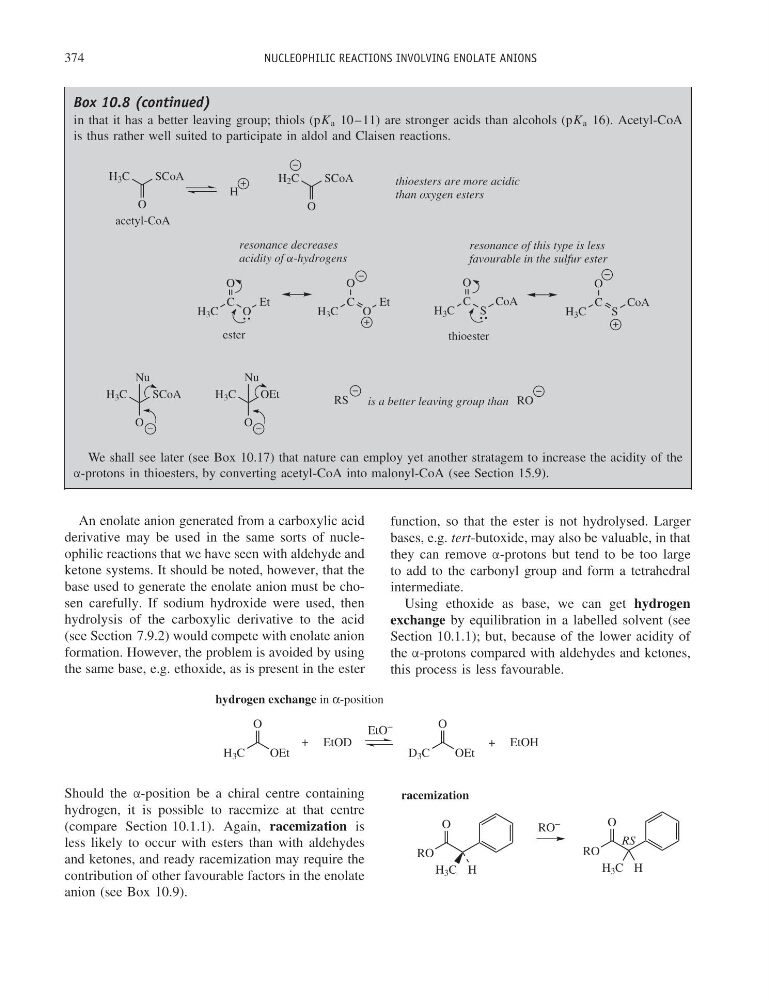
in that it has a better leaving group; thiols (pK a 10–11) are stronger acids than alcohols (pK a 16). Acetyl-CoA
is thus rather well suited to participate in aldol and Claisen reactions.
H 3 C
C
S
CoA
O
H 3 C
C
O
Et
O
H 3 C
C
O
Et
O
acetyl-CoA
H 3 C
SCoA
O
H 2 C
SCoA
O
thioester
ester
H 3 C
C
S
CoA
O
resonance decreases
acidity of a-hydrogens
resonance of this type is less
favourable in the sulfur ester
thioesters are more acidic
than oxygen esters
RS
is a better leaving group than RO
H 3 C
SCoA
O
Nu
H 3 C
OEt
O
Nu
H
We shall see later (see Box 10.17) that nature can employ yet another stratagem to increase the acidity of the
α-protons in thioesters, by converting acetyl-CoA into malonyl-CoA (see Section 15.9).
An enolate anion generated from a carboxylic acid
derivative may be used in the same sorts of nucleophilic reactions that we have seen with aldehyde and
ketone systems. It should be noted, however, that the
base used to generate the enolate anion must be chosen carefully. If sodium hydroxide were used, then
hydrolysis of the carboxylic derivative to the acid
(see Section 7.9.2) would compete with enolate anion
formation. However, the problem is avoided by using
the same base, e.g. ethoxide, as is present in the ester
function, so that the ester is not hydrolysed. Larger
bases, e.g. tert-butoxide, may also be valuable, in that
they can remove α-protons but tend to be too large
to add to the carbonyl group and form a tetrahedral
intermediate.
Using ethoxide as base, we can get hydrogen
exchange by equilibration in a labelled solvent (see
Section 10.1.1); but, because of the lower acidity of
the α-protons compared with aldehydes and ketones,
this process is less favourable.
hydrogen exchange in α-position
+
+
O
H 3 C
OEt
O
D 3 C
OEt
EtO −
EtOD
EtOH
Should the α-position be a chiral centre containing
hydrogen, it is possible to racemize at that centre
(compare Section 10.1.1). Again, racemization is
less likely to occur with esters than with aldehydes
and ketones, and ready racemization may require the
contribution of other favourable factors in the enolate
anion (see Box 10.9).
racemization
RO
O
H 3 C H
RO
−
RO
O
H 3 C H
RS
NUCLEOPHILIC REACTIONS INVOLVING ENOLATE ANIONS
Box 10.8 (continued)
in that it has a better leaving group; thiols (pK a 10–11) are stronger acids than alcohols (pK a 16). Acetyl-CoA
is thus rather well suited to participate in aldol and Claisen reactions.
H 3 C
C
S
CoA
O
H 3 C
C
O
Et
O
H 3 C
C
O
Et
O
acetyl-CoA
H 3 C
SCoA
O
H 2 C
SCoA
O
thioester
ester
H 3 C
C
S
CoA
O
resonance decreases
acidity of a-hydrogens
resonance of this type is less
favourable in the sulfur ester
thioesters are more acidic
than oxygen esters
RS
is a better leaving group than RO
H 3 C
SCoA
O
Nu
H 3 C
OEt
O
Nu
H
We shall see later (see Box 10.17) that nature can employ yet another stratagem to increase the acidity of the
α-protons in thioesters, by converting acetyl-CoA into malonyl-CoA (see Section 15.9).
An enolate anion generated from a carboxylic acid
derivative may be used in the same sorts of nucleophilic reactions that we have seen with aldehyde and
ketone systems. It should be noted, however, that the
base used to generate the enolate anion must be chosen carefully. If sodium hydroxide were used, then
hydrolysis of the carboxylic derivative to the acid
(see Section 7.9.2) would compete with enolate anion
formation. However, the problem is avoided by using
the same base, e.g. ethoxide, as is present in the ester
function, so that the ester is not hydrolysed. Larger
bases, e.g. tert-butoxide, may also be valuable, in that
they can remove α-protons but tend to be too large
to add to the carbonyl group and form a tetrahedral
intermediate.
Using ethoxide as base, we can get hydrogen
exchange by equilibration in a labelled solvent (see
Section 10.1.1); but, because of the lower acidity of
the α-protons compared with aldehydes and ketones,
this process is less favourable.
hydrogen exchange in α-position
+
+
O
H 3 C
OEt
O
D 3 C
OEt
EtO −
EtOD
EtOH
Should the α-position be a chiral centre containing
hydrogen, it is possible to racemize at that centre
(compare Section 10.1.1). Again, racemization is
less likely to occur with esters than with aldehydes
and ketones, and ready racemization may require the
contribution of other favourable factors in the enolate
anion (see Box 10.9).
racemization
RO
O
H 3 C H
RO
−
RO
O
H 3 C H
RS