

ENOLATE ANIONS FROM CARBOXYLIC ACID DERIVATIVES
373
Whereas the pK a for the α-protons of aldehydes
and ketones is in the region 17–19, for esters such
as ethyl acetate it is about 25. This difference must
relate to the presence of the second oxygen in the
ester, since resonance stabilization in the enolate
anion should be the same. To explain this difference,
overlap of the non-carbonyl oxygen lone pair is
invoked. Because this introduces charge separation,
it is a form of resonance stabilization that can occur
only in the neutral ester, not in the enolate anion.
It thus stabilizes the neutral ester, reduces carbonyl
character, and there is less tendency to lose a proton
from the α-carbon to produce the enolate. Note that
this is not a new concept; we used the same reasoning
to explain why amides were not basic like amines (see
Section 4.5.4).
The α-hydrogens in thioesters are more acidic than
in oxygen esters, comparable in fact to those in the
equivalent ketone. This can be rationalized from the
larger size of sulfur. The sulfur lone pair is located
in a 3p orbital, whereas oxygen lone pairs are in
2p orbitals; there is consequently less overlap of
orbitals. There can be relatively little contribution
from this type of resonance stabilization in thioesters.
Accordingly, normal enolate anion stabilization is not
affected.
Note that acids, and primary and secondary amides
cannot be employed to generate enolate anions. With
acids, the carboxylic acid group has pK a of about
3–5, so the carboxylic proton will be lost much
more easily than the α-hydrogens. In primary and
secondary amides, the N–H (pK a about 18) will
be removed more readily than the α-hydrogens.
Their acidity may be explained because of resonance
stabilization of the anion. Tertiary amides might be
used, however, since there are no other protons that
are more acidic.
Box 10.8
Coenzyme A and acetyl-CoA
The increased acidity associated with thioesters is one of the reasons that biochemical reactions tend to involve
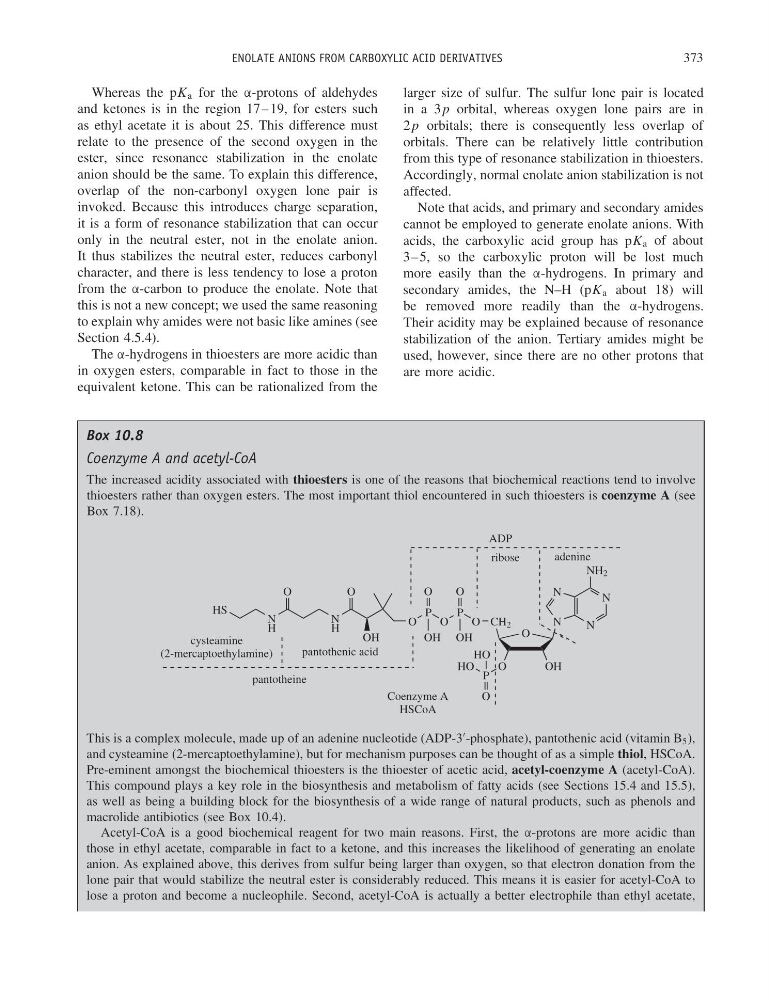
thioesters rather than oxygen esters. The most important thiol encountered in such thioesters is coenzyme A (see
Box 7.18).
N
N
N
NH 2
O
OH
N
CH 2
N
H
N
H
OH
O
O
HS
Coenzyme A
HSCoA
O
P
O
O
OH
P
O
O
OH
O
P
HO
O
HO
adenine
ribose
ADP
pantothenic acid
pantotheine
cysteamine
(2-mercaptoethylamine)
This is a complex molecule, made up of an adenine nucleotide (ADP-3
-phosphate), pantothenic acid (vitamin B 5 ),
and cysteamine (2-mercaptoethylamine), but for mechanism purposes can be thought of as a simple thiol, HSCoA.
Pre-eminent amongst the biochemical thioesters is the thioester of acetic acid, acetyl-coenzyme A (acetyl-CoA).
This compound plays a key role in the biosynthesis and metabolism of fatty acids (see Sections 15.4 and 15.5),
as well as being a building block for the biosynthesis of a wide range of natural products, such as phenols and
macrolide antibiotics (see Box 10.4).
Acetyl-CoA is a good biochemical reagent for two main reasons. First, the α-protons are more acidic than
those in ethyl acetate, comparable in fact to a ketone, and this increases the likelihood of generating an enolate
anion. As explained above, this derives from sulfur being larger than oxygen, so that electron donation from the
lone pair that would stabilize the neutral ester is considerably reduced. This means it is easier for acetyl-CoA to
lose a proton and become a nucleophile. Second, acetyl-CoA is actually a better electrophile than ethyl acetate,
373
Whereas the pK a for the α-protons of aldehydes
and ketones is in the region 17–19, for esters such
as ethyl acetate it is about 25. This difference must
relate to the presence of the second oxygen in the
ester, since resonance stabilization in the enolate
anion should be the same. To explain this difference,
overlap of the non-carbonyl oxygen lone pair is
invoked. Because this introduces charge separation,
it is a form of resonance stabilization that can occur
only in the neutral ester, not in the enolate anion.
It thus stabilizes the neutral ester, reduces carbonyl
character, and there is less tendency to lose a proton
from the α-carbon to produce the enolate. Note that
this is not a new concept; we used the same reasoning
to explain why amides were not basic like amines (see
Section 4.5.4).
The α-hydrogens in thioesters are more acidic than
in oxygen esters, comparable in fact to those in the
equivalent ketone. This can be rationalized from the
larger size of sulfur. The sulfur lone pair is located
in a 3p orbital, whereas oxygen lone pairs are in
2p orbitals; there is consequently less overlap of
orbitals. There can be relatively little contribution
from this type of resonance stabilization in thioesters.
Accordingly, normal enolate anion stabilization is not
affected.
Note that acids, and primary and secondary amides
cannot be employed to generate enolate anions. With
acids, the carboxylic acid group has pK a of about
3–5, so the carboxylic proton will be lost much
more easily than the α-hydrogens. In primary and
secondary amides, the N–H (pK a about 18) will
be removed more readily than the α-hydrogens.
Their acidity may be explained because of resonance
stabilization of the anion. Tertiary amides might be
used, however, since there are no other protons that
are more acidic.
Box 10.8
Coenzyme A and acetyl-CoA
The increased acidity associated with thioesters is one of the reasons that biochemical reactions tend to involve
thioesters rather than oxygen esters. The most important thiol encountered in such thioesters is coenzyme A (see
Box 7.18).
N
N
N
NH 2
O
OH
N
CH 2
N
H
N
H
OH
O
O
HS
Coenzyme A
HSCoA
O
P
O
O
OH
P
O
O
OH
O
P
HO
O
HO
adenine
ribose
ADP
pantothenic acid
pantotheine
cysteamine
(2-mercaptoethylamine)
This is a complex molecule, made up of an adenine nucleotide (ADP-3
-phosphate), pantothenic acid (vitamin B 5 ),
and cysteamine (2-mercaptoethylamine), but for mechanism purposes can be thought of as a simple thiol, HSCoA.
Pre-eminent amongst the biochemical thioesters is the thioester of acetic acid, acetyl-coenzyme A (acetyl-CoA).
This compound plays a key role in the biosynthesis and metabolism of fatty acids (see Sections 15.4 and 15.5),
as well as being a building block for the biosynthesis of a wide range of natural products, such as phenols and
macrolide antibiotics (see Box 10.4).
Acetyl-CoA is a good biochemical reagent for two main reasons. First, the α-protons are more acidic than
those in ethyl acetate, comparable in fact to a ketone, and this increases the likelihood of generating an enolate
anion. As explained above, this derives from sulfur being larger than oxygen, so that electron donation from the
lone pair that would stabilize the neutral ester is considerably reduced. This means it is easier for acetyl-CoA to
lose a proton and become a nucleophile. Second, acetyl-CoA is actually a better electrophile than ethyl acetate,