

372
NUCLEOPHILIC REACTIONS INVOLVING ENOLATE ANIONS
Box 10.7 (continued)
Acetaldehyde is typically formed after ingestion of alcohol (see Section 3.4.7). Since the urine product is
racemic, it would appear that a chemical Pictet–Spengler synthesis is being observed here rather than an enzymic
one.
In Box 9.4, we saw that tetrahydroisoquinoline alkaloids with appropriate phenol substituents could be involved
in radical coupling processes. The complex alkaloids tubocurarine and morphine are derived in nature from simpler
tetrahydroisoquinoline alkaloids.
10.7 Enolate anions from carboxylic
acid derivatives
The α-hydrogens of carboxylic acid derivatives
show enhanced acidity, as do those of aldehydes
and ketones, and for the same reasons, that the
carbonyl group stabilizes the conjugate base. Thus,
we can generate enolate anions from carboxylic acid
derivatives and use these as nucleophiles in much
the same way as we have already seen with enolate
anions from aldehydes and ketones.
resonance-stabilized enolate anion
O
H 2 C
OEt
O
OEt
O
H 3 C
OEt
H
Unfortunately, there are some limitations in the
carboxylic acid group of compounds, and the derivatives most often used to form enolate anions are
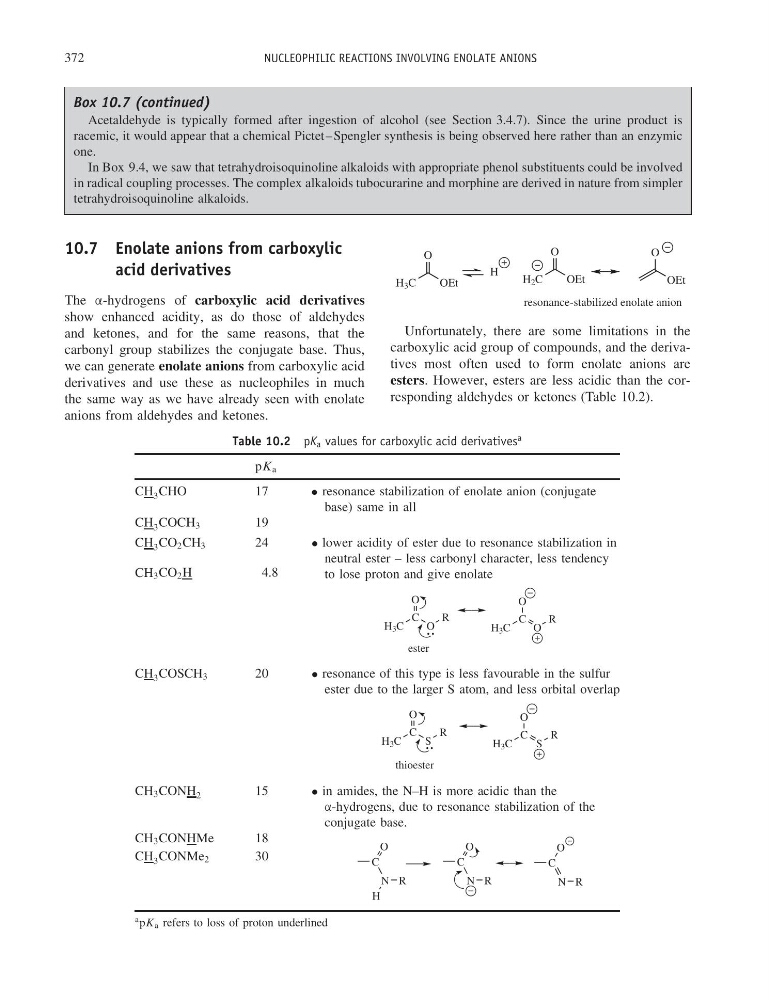
esters. However, esters are less acidic than the corresponding aldehydes or ketones (Table 10.2).
Table 10.2 pK a values for carboxylic acid derivatives
a
pK a
CH 3 CHO
17
• resonance stabilization of enolate anion (conjugate
base) same in all
CH 3 COCH 3
19
CH 3 CO 2 CH 3
24
• lower acidity of ester due to resonance stabilization in
neutral ester – less carbonyl character, less tendency
to lose proton and give enolate
CH 3 CO 2 H
4.8
H 3 C
C
O
R
O
H 3 C
C
O
R
O
ester
CH 3 COSCH 3
20
• resonance of this type is less favourable in the sulfur
ester due to the larger S atom, and less orbital overlap
H 3 C
C
S
R
O
thioester
H 3 C
C
S
R
O
CH 3 CONH 2
15
• in amides, the N–H is more acidic than the
α-hydrogens, due to resonance stabilization of the
conjugate base.
CH 3 CONHMe
18
C
O
N R
C
O
N R
C
O
N R
H
CH 3 CONMe 2
30
a pK a refers to loss of proton underlined
NUCLEOPHILIC REACTIONS INVOLVING ENOLATE ANIONS
Box 10.7 (continued)
Acetaldehyde is typically formed after ingestion of alcohol (see Section 3.4.7). Since the urine product is
racemic, it would appear that a chemical Pictet–Spengler synthesis is being observed here rather than an enzymic
one.
In Box 9.4, we saw that tetrahydroisoquinoline alkaloids with appropriate phenol substituents could be involved
in radical coupling processes. The complex alkaloids tubocurarine and morphine are derived in nature from simpler
tetrahydroisoquinoline alkaloids.
10.7 Enolate anions from carboxylic
acid derivatives
The α-hydrogens of carboxylic acid derivatives
show enhanced acidity, as do those of aldehydes
and ketones, and for the same reasons, that the
carbonyl group stabilizes the conjugate base. Thus,
we can generate enolate anions from carboxylic acid
derivatives and use these as nucleophiles in much
the same way as we have already seen with enolate
anions from aldehydes and ketones.
resonance-stabilized enolate anion
O
H 2 C
OEt
O
OEt
O
H 3 C
OEt
H
Unfortunately, there are some limitations in the
carboxylic acid group of compounds, and the derivatives most often used to form enolate anions are
esters. However, esters are less acidic than the corresponding aldehydes or ketones (Table 10.2).
Table 10.2 pK a values for carboxylic acid derivatives
a
pK a
CH 3 CHO
17
• resonance stabilization of enolate anion (conjugate
base) same in all
CH 3 COCH 3
19
CH 3 CO 2 CH 3
24
• lower acidity of ester due to resonance stabilization in
neutral ester – less carbonyl character, less tendency
to lose proton and give enolate
CH 3 CO 2 H
4.8
H 3 C
C
O
R
O
H 3 C
C
O
R
O
ester
CH 3 COSCH 3
20
• resonance of this type is less favourable in the sulfur
ester due to the larger S atom, and less orbital overlap
H 3 C
C
S
R
O
thioester
H 3 C
C
S
R
O
CH 3 CONH 2
15
• in amides, the N–H is more acidic than the
α-hydrogens, due to resonance stabilization of the
conjugate base.
CH 3 CONHMe
18
C
O
N R
C
O
N R
C
O
N R
H
CH 3 CONMe 2
30
a pK a refers to loss of proton underlined