

THE MANNICH REACTION
371
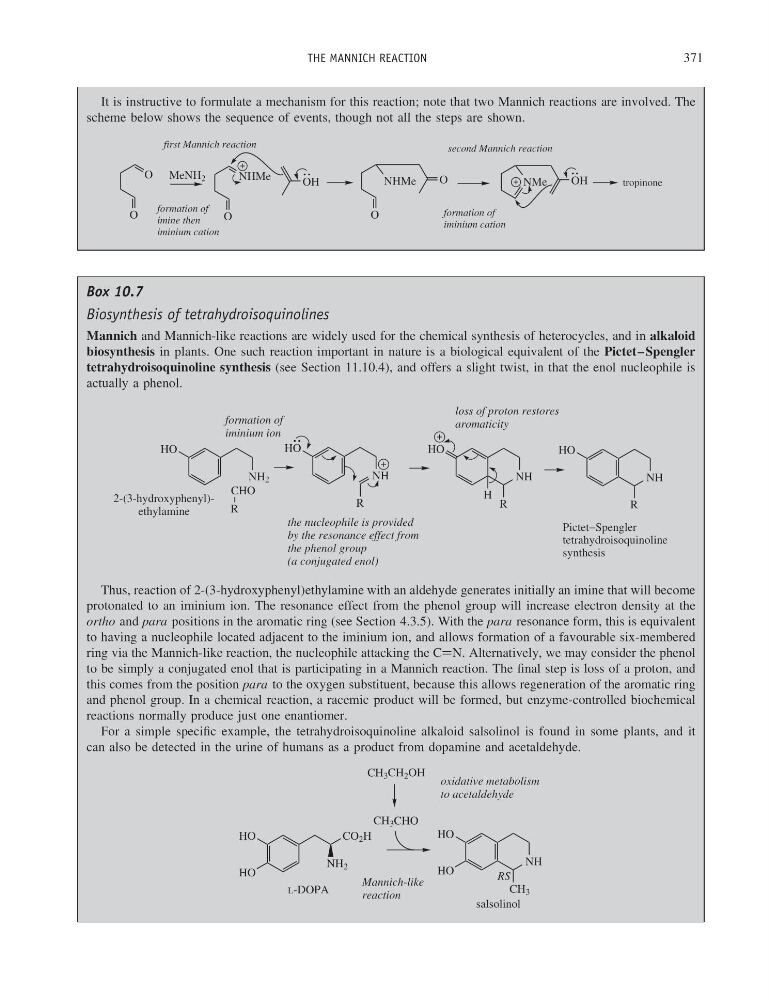
It is instructive to formulate a mechanism for this reaction; note that two Mannich reactions are involved. The
scheme below shows the sequence of events, though not all the steps are shown.
O
O
NHMe
O
OH
O
NHMe
O
NMe
OH
MeNH 2
formation of
imine then
iminium cation
first Mannich reaction
second Mannich reaction
tropinone
formation of
iminium cation
Box 10.7
Biosynthesis of tetrahydroisoquinolines
Mannich and Mannich-like reactions are widely used for the chemical synthesis of heterocycles, and in alkaloid
biosynthesis in plants. One such reaction important in nature is a biological equivalent of the Pictet–Spengler
tetrahydroisoquinoline synthesis (see Section 11.10.4), and offers a slight twist, in that the enol nucleophile is
actually a phenol.
NH
HO
NH
HO
R
R
HO
NH 2
CHO
R
H
NH
HO
R
the nucleophile is provided
by the resonance effect from
the phenol group
(a conjugated enol)
Pictet−Spengler
tetrahydroisoquinoline
synthesis
formation of
iminium ion
loss of proton restores
aromaticity
2-(3-hydroxyphenyl)ethylamine
Thus, reaction of 2-(3-hydroxyphenyl)ethylamine with an aldehyde generates initially an imine that will become
protonated to an iminium ion. The resonance effect from the phenol group will increase electron density at the
ortho and para positions in the aromatic ring (see Section 4.3.5). With the para resonance form, this is equivalent
to having a nucleophile located adjacent to the iminium ion, and allows formation of a favourable six-membered
ring via the Mannich-like reaction, the nucleophile attacking the C=N. Alternatively, we may consider the phenol
to be simply a conjugated enol that is participating in a Mannich reaction. The final step is loss of a proton, and
this comes from the position para to the oxygen substituent, because this allows regeneration of the aromatic ring
and phenol group. In a chemical reaction, a racemic product will be formed, but enzyme-controlled biochemical
reactions normally produce just one enantiomer.
For a simple specific example, the tetrahydroisoquinoline alkaloid salsolinol is found in some plants, and it
can also be detected in the urine of humans as a product from dopamine and acetaldehyde.
HO
NH 2
HO
CO 2 H
HO
NH
HO
CH 3
L-DOPA
salsolinol
RS
oxidative metabolism
to acetaldehyde
Mannich-like
reaction
CH 3 CHO
CH 3 CH 2 OH
371
It is instructive to formulate a mechanism for this reaction; note that two Mannich reactions are involved. The
scheme below shows the sequence of events, though not all the steps are shown.
O
O
NHMe
O
OH
O
NHMe
O
NMe
OH
MeNH 2
formation of
imine then
iminium cation
first Mannich reaction
second Mannich reaction
tropinone
formation of
iminium cation
Box 10.7
Biosynthesis of tetrahydroisoquinolines
Mannich and Mannich-like reactions are widely used for the chemical synthesis of heterocycles, and in alkaloid
biosynthesis in plants. One such reaction important in nature is a biological equivalent of the Pictet–Spengler
tetrahydroisoquinoline synthesis (see Section 11.10.4), and offers a slight twist, in that the enol nucleophile is
actually a phenol.
NH
HO
NH
HO
R
R
HO
NH 2
CHO
R
H
NH
HO
R
the nucleophile is provided
by the resonance effect from
the phenol group
(a conjugated enol)
Pictet−Spengler
tetrahydroisoquinoline
synthesis
formation of
iminium ion
loss of proton restores
aromaticity
2-(3-hydroxyphenyl)ethylamine
Thus, reaction of 2-(3-hydroxyphenyl)ethylamine with an aldehyde generates initially an imine that will become
protonated to an iminium ion. The resonance effect from the phenol group will increase electron density at the
ortho and para positions in the aromatic ring (see Section 4.3.5). With the para resonance form, this is equivalent
to having a nucleophile located adjacent to the iminium ion, and allows formation of a favourable six-membered
ring via the Mannich-like reaction, the nucleophile attacking the C=N. Alternatively, we may consider the phenol
to be simply a conjugated enol that is participating in a Mannich reaction. The final step is loss of a proton, and
this comes from the position para to the oxygen substituent, because this allows regeneration of the aromatic ring
and phenol group. In a chemical reaction, a racemic product will be formed, but enzyme-controlled biochemical
reactions normally produce just one enantiomer.
For a simple specific example, the tetrahydroisoquinoline alkaloid salsolinol is found in some plants, and it
can also be detected in the urine of humans as a product from dopamine and acetaldehyde.
HO
NH 2
HO
CO 2 H
HO
NH
HO
CH 3
L-DOPA
salsolinol
RS
oxidative metabolism
to acetaldehyde
Mannich-like
reaction
CH 3 CHO
CH 3 CH 2 OH