

370
NUCLEOPHILIC REACTIONS INVOLVING ENOLATE ANIONS
N CH 2
H 3 C
H 3 C
although it would be easier to use an
enolate anion as the nucleophile, the
reaction is conducted under mild acid
conditions, so the nucleophile cannot be
an anion and must therefore be the enol
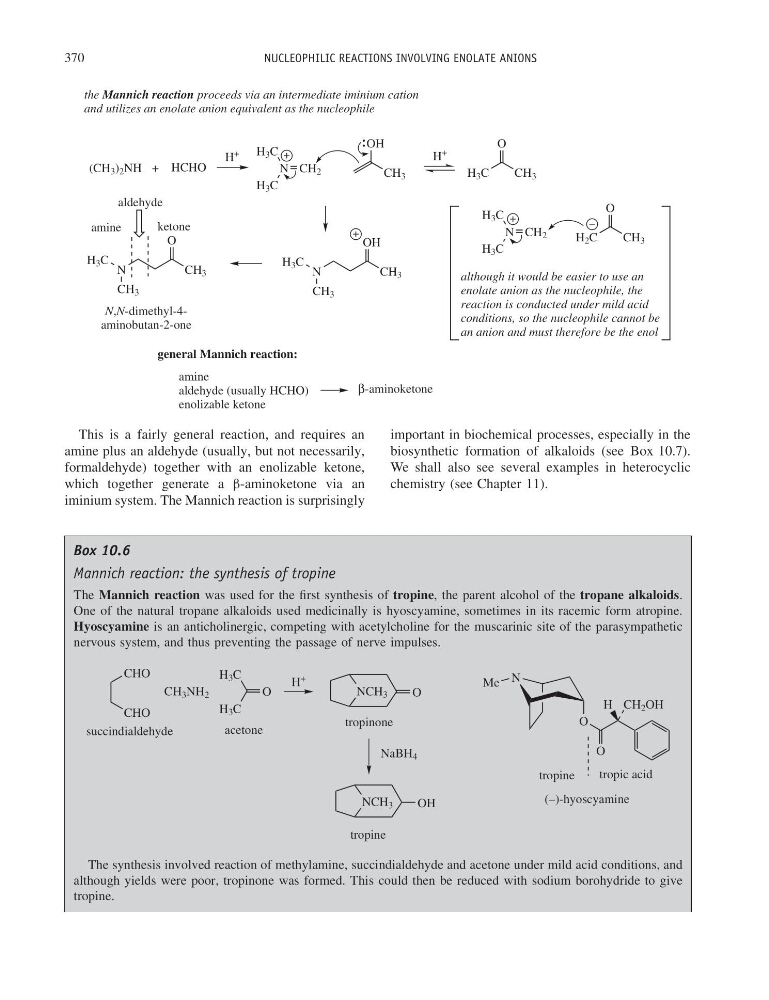
the Mannich reaction proceeds via an intermediate iminium cation
and utilizes an enolate anion equivalent as the nucleophile
+
general Mannich reaction:
amine
aldehyde (usually HCHO)
enolizable ketone
β-aminoketone
N CH 2
H 3 C
H 3 C
H 3 C
N
CH 3
CH 3
OH
O
H 3 C
CH 3
OH
CH 3
O
H 2 C
CH 3
H +
H
+
N,N-dimethyl-4aminobutan-2-one
H 3 C
N
CH 3
CH 3
O
amine
aldehyde
ketone
HCHO
(CH 3 ) 2 NH
This is a fairly general reaction, and requires an
amine plus an aldehyde (usually, but not necessarily,
formaldehyde) together with an enolizable ketone,
which together generate a β-aminoketone via an
iminium system. The Mannich reaction is surprisingly
important in biochemical processes, especially in the
biosynthetic formation of alkaloids (see Box 10.7).
We shall also see several examples in heterocyclic
chemistry (see Chapter 11).
Box 10.6
Mannich reaction: the synthesis of tropine
The Mannich reaction was used for the first synthesis of tropine, the parent alcohol of the tropane alkaloids.
One of the natural tropane alkaloids used medicinally is hyoscyamine, sometimes in its racemic form atropine.
Hyoscyamine is an anticholinergic, competing with acetylcholine for the muscarinic site of the parasympathetic
nervous system, and thus preventing the passage of nerve impulses.
O
H 3 C
H 3 C
NCH 3
O
NCH 3
OH
succindialdehyde
tropinone
tropine
N
Me
O
O
H CH 2 OH
(–)-hyoscyamine
tropine
tropic acid
H +
CHO
CHO
acetone
CH 3 NH 2
NaBH 4
The synthesis involved reaction of methylamine, succindialdehyde and acetone under mild acid conditions, and
although yields were poor, tropinone was formed. This could then be reduced with sodium borohydride to give
tropine.
NUCLEOPHILIC REACTIONS INVOLVING ENOLATE ANIONS
N CH 2
H 3 C
H 3 C
although it would be easier to use an
enolate anion as the nucleophile, the
reaction is conducted under mild acid
conditions, so the nucleophile cannot be
an anion and must therefore be the enol
the Mannich reaction proceeds via an intermediate iminium cation
and utilizes an enolate anion equivalent as the nucleophile
+
general Mannich reaction:
amine
aldehyde (usually HCHO)
enolizable ketone
β-aminoketone
N CH 2
H 3 C
H 3 C
H 3 C
N
CH 3
CH 3
OH
O
H 3 C
CH 3
OH
CH 3
O
H 2 C
CH 3
H +
H
+
N,N-dimethyl-4aminobutan-2-one
H 3 C
N
CH 3
CH 3
O
amine
aldehyde
ketone
HCHO
(CH 3 ) 2 NH
This is a fairly general reaction, and requires an
amine plus an aldehyde (usually, but not necessarily,
formaldehyde) together with an enolizable ketone,
which together generate a β-aminoketone via an
iminium system. The Mannich reaction is surprisingly
important in biochemical processes, especially in the
biosynthetic formation of alkaloids (see Box 10.7).
We shall also see several examples in heterocyclic
chemistry (see Chapter 11).
Box 10.6
Mannich reaction: the synthesis of tropine
The Mannich reaction was used for the first synthesis of tropine, the parent alcohol of the tropane alkaloids.
One of the natural tropane alkaloids used medicinally is hyoscyamine, sometimes in its racemic form atropine.
Hyoscyamine is an anticholinergic, competing with acetylcholine for the muscarinic site of the parasympathetic
nervous system, and thus preventing the passage of nerve impulses.
O
H 3 C
H 3 C
NCH 3
O
NCH 3
OH
succindialdehyde
tropinone
tropine
N
Me
O
O
H CH 2 OH
(–)-hyoscyamine
tropine
tropic acid
H +
CHO
CHO
acetone
CH 3 NH 2
NaBH 4
The synthesis involved reaction of methylamine, succindialdehyde and acetone under mild acid conditions, and
although yields were poor, tropinone was formed. This could then be reduced with sodium borohydride to give
tropine.