

THE MANNICH REACTION
369
O
H
H 2 N Enz
N
H
Enz
amine side-chain
on enzyme
imine
NH
H
Enz
iminium ion
enamine
NH Enz
substrate bound
to enzyme
O
H
NH Enz
OH
H
O
OH
H
H 2 N Enz
hydrolysis
release from
enzyme
carbonyl properties of
substrate are retained
via enamine – there is no
need for strong base
enzymic aldol reaction
aldol reaction
with enamine
as nucleophile
H +
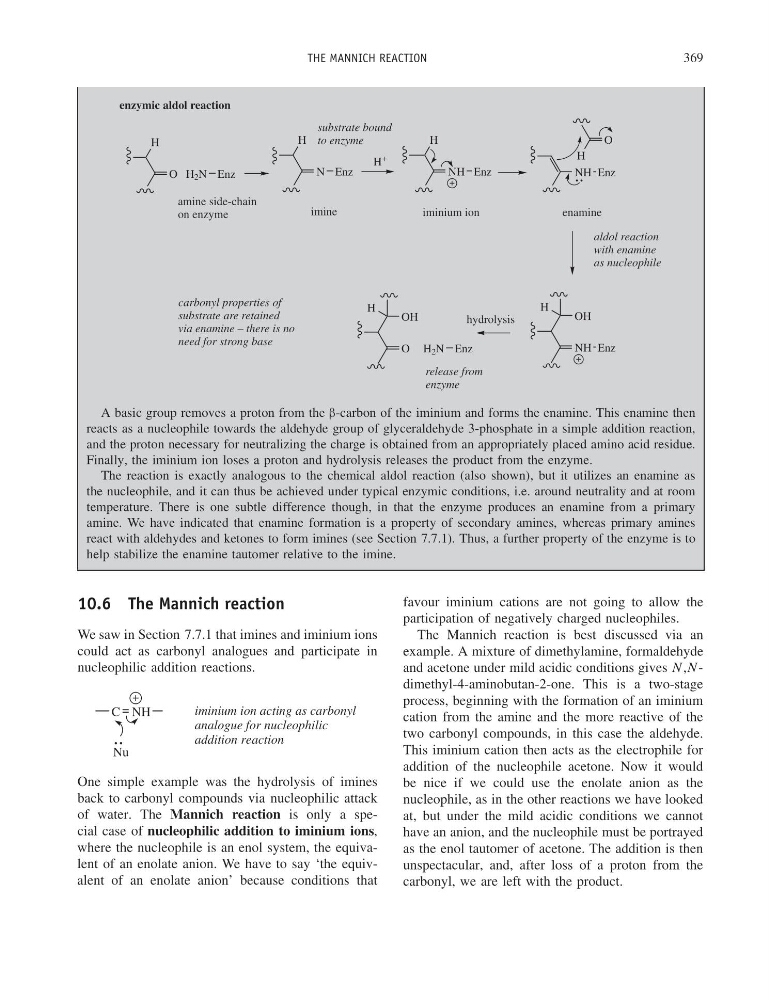
A basic group removes a proton from the β-carbon of the iminium and forms the enamine. This enamine then
reacts as a nucleophile towards the aldehyde group of glyceraldehyde 3-phosphate in a simple addition reaction,
and the proton necessary for neutralizing the charge is obtained from an appropriately placed amino acid residue.
Finally, the iminium ion loses a proton and hydrolysis releases the product from the enzyme.
The reaction is exactly analogous to the chemical aldol reaction (also shown), but it utilizes an enamine as
the nucleophile, and it can thus be achieved under typical enzymic conditions, i.e. around neutrality and at room
temperature. There is one subtle difference though, in that the enzyme produces an enamine from a primary
amine. We have indicated that enamine formation is a property of secondary amines, whereas primary amines
react with aldehydes and ketones to form imines (see Section 7.7.1). Thus, a further property of the enzyme is to
help stabilize the enamine tautomer relative to the imine.
10.6 The Mannich reaction
We saw in Section 7.7.1 that imines and iminium ions
could act as carbonyl analogues and participate in
nucleophilic addition reactions.
C NH
Nu
iminium ion acting as carbonyl
analogue for nucleophilic
addition reaction
One simple example was the hydrolysis of imines
back to carbonyl compounds via nucleophilic attack
of water. The Mannich reaction is only a special case of nucleophilic addition to iminium ions,
where the nucleophile is an enol system, the equivalent of an enolate anion. We have to say ‘the equivalent of an enolate anion’ because conditions that
favour iminium cations are not going to allow the
participation of negatively charged nucleophiles.
The Mannich reaction is best discussed via an
example. A mixture of dimethylamine, formaldehyde
and acetone under mild acidic conditions gives N ,N -
dimethyl-4-aminobutan-2-one. This is a two-stage
process, beginning with the formation of an iminium
cation from the amine and the more reactive of the
two carbonyl compounds, in this case the aldehyde.
This iminium cation then acts as the electrophile for
addition of the nucleophile acetone. Now it would
be nice if we could use the enolate anion as the
nucleophile, as in the other reactions we have looked
at, but under the mild acidic conditions we cannot
have an anion, and the nucleophile must be portrayed
as the enol tautomer of acetone. The addition is then
unspectacular, and, after loss of a proton from the
carbonyl, we are left with the product.
369
O
H
H 2 N Enz
N
H
Enz
amine side-chain
on enzyme
imine
NH
H
Enz
iminium ion
enamine
NH Enz
substrate bound
to enzyme
O
H
NH Enz
OH
H
O
OH
H
H 2 N Enz
hydrolysis
release from
enzyme
carbonyl properties of
substrate are retained
via enamine – there is no
need for strong base
enzymic aldol reaction
aldol reaction
with enamine
as nucleophile
H +
A basic group removes a proton from the β-carbon of the iminium and forms the enamine. This enamine then
reacts as a nucleophile towards the aldehyde group of glyceraldehyde 3-phosphate in a simple addition reaction,
and the proton necessary for neutralizing the charge is obtained from an appropriately placed amino acid residue.
Finally, the iminium ion loses a proton and hydrolysis releases the product from the enzyme.
The reaction is exactly analogous to the chemical aldol reaction (also shown), but it utilizes an enamine as
the nucleophile, and it can thus be achieved under typical enzymic conditions, i.e. around neutrality and at room
temperature. There is one subtle difference though, in that the enzyme produces an enamine from a primary
amine. We have indicated that enamine formation is a property of secondary amines, whereas primary amines
react with aldehydes and ketones to form imines (see Section 7.7.1). Thus, a further property of the enzyme is to
help stabilize the enamine tautomer relative to the imine.
10.6 The Mannich reaction
We saw in Section 7.7.1 that imines and iminium ions
could act as carbonyl analogues and participate in
nucleophilic addition reactions.
C NH
Nu
iminium ion acting as carbonyl
analogue for nucleophilic
addition reaction
One simple example was the hydrolysis of imines
back to carbonyl compounds via nucleophilic attack
of water. The Mannich reaction is only a special case of nucleophilic addition to iminium ions,
where the nucleophile is an enol system, the equivalent of an enolate anion. We have to say ‘the equivalent of an enolate anion’ because conditions that
favour iminium cations are not going to allow the
participation of negatively charged nucleophiles.
The Mannich reaction is best discussed via an
example. A mixture of dimethylamine, formaldehyde
and acetone under mild acidic conditions gives N ,N -
dimethyl-4-aminobutan-2-one. This is a two-stage
process, beginning with the formation of an iminium
cation from the amine and the more reactive of the
two carbonyl compounds, in this case the aldehyde.
This iminium cation then acts as the electrophile for
addition of the nucleophile acetone. Now it would
be nice if we could use the enolate anion as the
nucleophile, as in the other reactions we have looked
at, but under the mild acidic conditions we cannot
have an anion, and the nucleophile must be portrayed
as the enol tautomer of acetone. The addition is then
unspectacular, and, after loss of a proton from the
carbonyl, we are left with the product.