

368
NUCLEOPHILIC REACTIONS INVOLVING ENOLATE ANIONS
Alternatively, cyclohexanone may initially be
transformed into an enamine with a secondary amine,
here pyrrolidine. This intermediate enamine can act
as a nucleophile and can be alkylated at the β-position
using methyl iodide. Finally, 2-methylcyclohexanone
may be generated by hydrolysis of the iminium system, effectively a reversal of enamine formation. This
gives us two routes to 2-methylcyclohexanone, a
short process using the very strong base LDA and
a longer route that involves no strong base and relatively mild conditions. The latter synthesis may well
be preferred, depending upon the nature of any other
functional groups in the starting substrate.
The essential feature of enamines is that they are
nitrogen analogues of enols and behave as enolate
anions. They effectively mask a carbonyl function
while activating the compound towards nucleophilic
substitution.
Box 10.5
Enamine reactions in biochemistry: aldolase
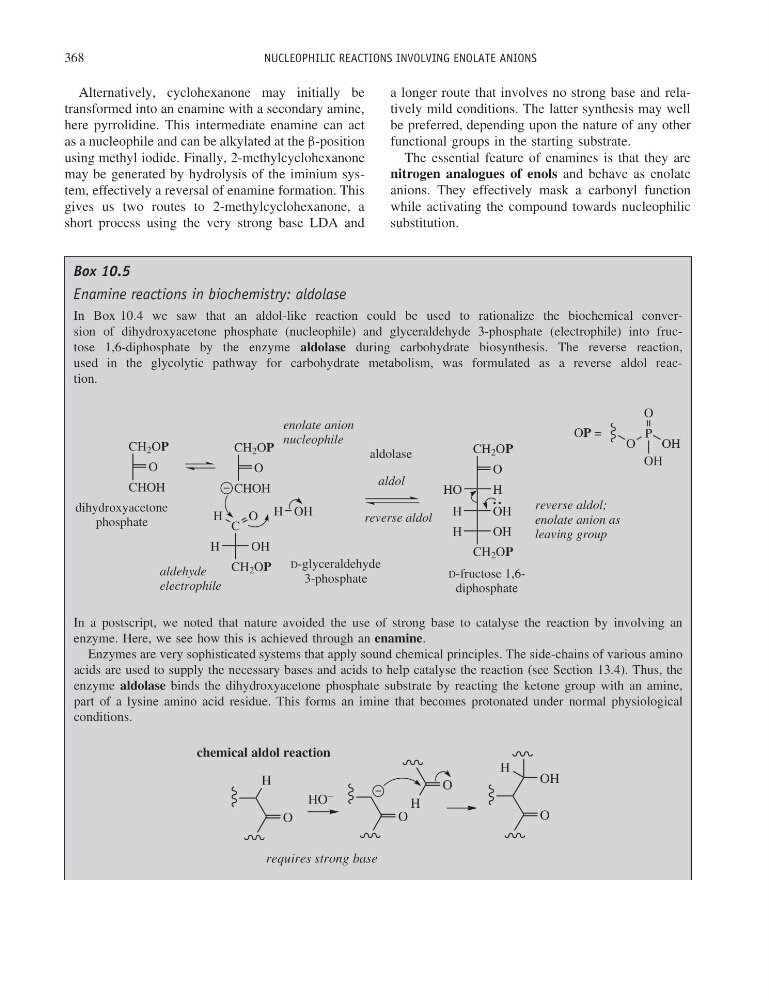
In Box 10.4 we saw that an aldol-like reaction could be used to rationalize the biochemical conversion of dihydroxyacetone phosphate (nucleophile) and glyceraldehyde 3-phosphate (electrophile) into fructose 1,6-diphosphate by the enzyme aldolase during carbohydrate biosynthesis. The reverse reaction,
used in the glycolytic pathway for carbohydrate metabolism, was formulated as a reverse aldol reaction.
C
H
OH
CH 2 OP
CHOH
O
CH 2 OP
H
O
CH 2 OP
O
HO
H
H
OH
H
OH
CH 2 OP
D-glyceraldehyde
3-phosphate
aldol
reverse aldol
dihydroxyacetone
phosphate
D-fructose 1,6diphosphate
H OH
CHOH
O
CH 2 OP
enolate anion
nucleophile
aldehyde
electrophile
reverse aldol;
enolate anion as
leaving group
aldolase
OP =
O
P
O
OH
OH
In a postscript, we noted that nature avoided the use of strong base to catalyse the reaction by involving an
enzyme. Here, we see how this is achieved through an enamine.
Enzymes are very sophisticated systems that apply sound chemical principles. The side-chains of various amino
acids are used to supply the necessary bases and acids to help catalyse the reaction (see Section 13.4). Thus, the
enzyme aldolase binds the dihydroxyacetone phosphate substrate by reacting the ketone group with an amine,
part of a lysine amino acid residue. This forms an imine that becomes protonated under normal physiological
conditions.
O
H
O
O
H
chemical aldol reaction
requires strong base
O
OH
H
HO −
NUCLEOPHILIC REACTIONS INVOLVING ENOLATE ANIONS
Alternatively, cyclohexanone may initially be
transformed into an enamine with a secondary amine,
here pyrrolidine. This intermediate enamine can act
as a nucleophile and can be alkylated at the β-position
using methyl iodide. Finally, 2-methylcyclohexanone
may be generated by hydrolysis of the iminium system, effectively a reversal of enamine formation. This
gives us two routes to 2-methylcyclohexanone, a
short process using the very strong base LDA and
a longer route that involves no strong base and relatively mild conditions. The latter synthesis may well
be preferred, depending upon the nature of any other
functional groups in the starting substrate.
The essential feature of enamines is that they are
nitrogen analogues of enols and behave as enolate
anions. They effectively mask a carbonyl function
while activating the compound towards nucleophilic
substitution.
Box 10.5
Enamine reactions in biochemistry: aldolase
In Box 10.4 we saw that an aldol-like reaction could be used to rationalize the biochemical conversion of dihydroxyacetone phosphate (nucleophile) and glyceraldehyde 3-phosphate (electrophile) into fructose 1,6-diphosphate by the enzyme aldolase during carbohydrate biosynthesis. The reverse reaction,
used in the glycolytic pathway for carbohydrate metabolism, was formulated as a reverse aldol reaction.
C
H
OH
CH 2 OP
CHOH
O
CH 2 OP
H
O
CH 2 OP
O
HO
H
H
OH
H
OH
CH 2 OP
D-glyceraldehyde
3-phosphate
aldol
reverse aldol
dihydroxyacetone
phosphate
D-fructose 1,6diphosphate
H OH
CHOH
O
CH 2 OP
enolate anion
nucleophile
aldehyde
electrophile
reverse aldol;
enolate anion as
leaving group
aldolase
OP =
O
P
O
OH
OH
In a postscript, we noted that nature avoided the use of strong base to catalyse the reaction by involving an
enzyme. Here, we see how this is achieved through an enamine.
Enzymes are very sophisticated systems that apply sound chemical principles. The side-chains of various amino
acids are used to supply the necessary bases and acids to help catalyse the reaction (see Section 13.4). Thus, the
enzyme aldolase binds the dihydroxyacetone phosphate substrate by reacting the ketone group with an amine,
part of a lysine amino acid residue. This forms an imine that becomes protonated under normal physiological
conditions.
O
H
O
O
H
chemical aldol reaction
requires strong base
O
OH
H
HO −