

ENAMINES AS NUCLEOPHILES
367
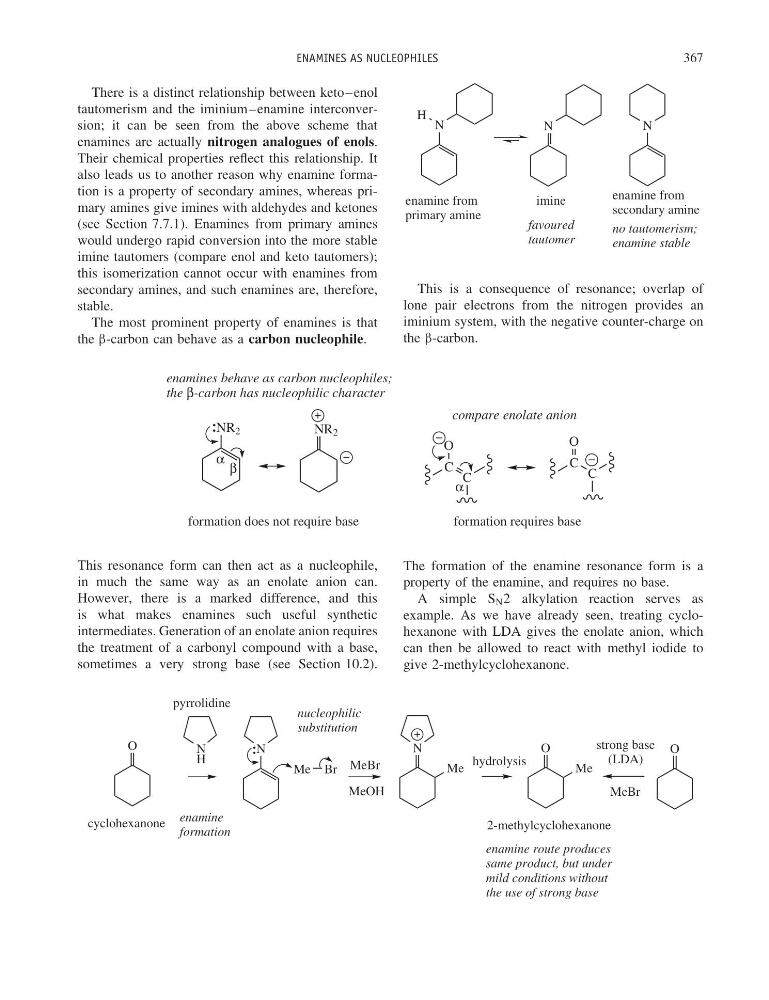
There is a distinct relationship between keto–enol
tautomerism and the iminium–enamine interconversion; it can be seen from the above scheme that
enamines are actually nitrogen analogues of enols.
Their chemical properties reflect this relationship. It
also leads us to another reason why enamine formation is a property of secondary amines, whereas primary amines give imines with aldehydes and ketones
(see Section 7.7.1). Enamines from primary amines
would undergo rapid conversion into the more stable
imine tautomers (compare enol and keto tautomers);
this isomerization cannot occur with enamines from
secondary amines, and such enamines are, therefore,
stable.
The most prominent property of enamines is that
the β-carbon can behave as a carbon nucleophile.
N
N
N
H
enamine from
primary amine
imine
favoured
tautomer
no tautomerism;
enamine stable
enamine from
secondary amine
This is a consequence of resonance; overlap of
lone pair electrons from the nitrogen provides an
iminium system, with the negative counter-charge on
the β-carbon.
NR 2
NR 2
enamines behave as carbon nucleophiles;
the β-carbon has nucleophilic character
α β
compare enolate anion
α
formation does not require base
formation requires base
O
C
C
O
C
C
This resonance form can then act as a nucleophile,
in much the same way as an enolate anion can.
However, there is a marked difference, and this
is what makes enamines such useful synthetic
intermediates. Generation of an enolate anion requires
the treatment of a carbonyl compound with a base,
sometimes a very strong base (see Section 10.2).
The formation of the enamine resonance form is a
property of the enamine, and requires no base.
A simple S N 2 alkylation reaction serves as
example. As we have already seen, treating cyclohexanone with LDA gives the enolate anion, which
can then be allowed to react with methyl iodide to
give 2-methylcyclohexanone.
N
Me Br
N
Me
Me
O
nucleophilic
substitution
O
hydrolysis
strong base
(LDA)
enamine route produces
same product, but under
mild conditions without
the use of strong base
O
N
H
enamine
formation
MeOH
cyclohexanone
pyrrolidine
2-methylcyclohexanone
MeBr
MeBr
367
There is a distinct relationship between keto–enol
tautomerism and the iminium–enamine interconversion; it can be seen from the above scheme that
enamines are actually nitrogen analogues of enols.
Their chemical properties reflect this relationship. It
also leads us to another reason why enamine formation is a property of secondary amines, whereas primary amines give imines with aldehydes and ketones
(see Section 7.7.1). Enamines from primary amines
would undergo rapid conversion into the more stable
imine tautomers (compare enol and keto tautomers);
this isomerization cannot occur with enamines from
secondary amines, and such enamines are, therefore,
stable.
The most prominent property of enamines is that
the β-carbon can behave as a carbon nucleophile.
N
N
N
H
enamine from
primary amine
imine
favoured
tautomer
no tautomerism;
enamine stable
enamine from
secondary amine
This is a consequence of resonance; overlap of
lone pair electrons from the nitrogen provides an
iminium system, with the negative counter-charge on
the β-carbon.
NR 2
NR 2
enamines behave as carbon nucleophiles;
the β-carbon has nucleophilic character
α β
compare enolate anion
α
formation does not require base
formation requires base
O
C
C
O
C
C
This resonance form can then act as a nucleophile,
in much the same way as an enolate anion can.
However, there is a marked difference, and this
is what makes enamines such useful synthetic
intermediates. Generation of an enolate anion requires
the treatment of a carbonyl compound with a base,
sometimes a very strong base (see Section 10.2).
The formation of the enamine resonance form is a
property of the enamine, and requires no base.
A simple S N 2 alkylation reaction serves as
example. As we have already seen, treating cyclohexanone with LDA gives the enolate anion, which
can then be allowed to react with methyl iodide to
give 2-methylcyclohexanone.
N
Me Br
N
Me
Me
O
nucleophilic
substitution
O
hydrolysis
strong base
(LDA)
enamine route produces
same product, but under
mild conditions without
the use of strong base
O
N
H
enamine
formation
MeOH
cyclohexanone
pyrrolidine
2-methylcyclohexanone
MeBr
MeBr