

366
NUCLEOPHILIC REACTIONS INVOLVING ENOLATE ANIONS
2-nitrostyrene
Ph
H
O
CH 2 NO 2
CH 3 NO 2
NaOH
Ph
OH
NO 2
Ph
NO 2
− H 2 O
aldol-type
addition
dehydration giving
conjugated system
Ph
H
O
CH 3 CN
CH 2 CN
NaOEt
Ph
OH
CN
aldol-type
addition
Ph
CN
− H 2 O
dehydration giving
conjugated system
3-phenylacrylonitrile
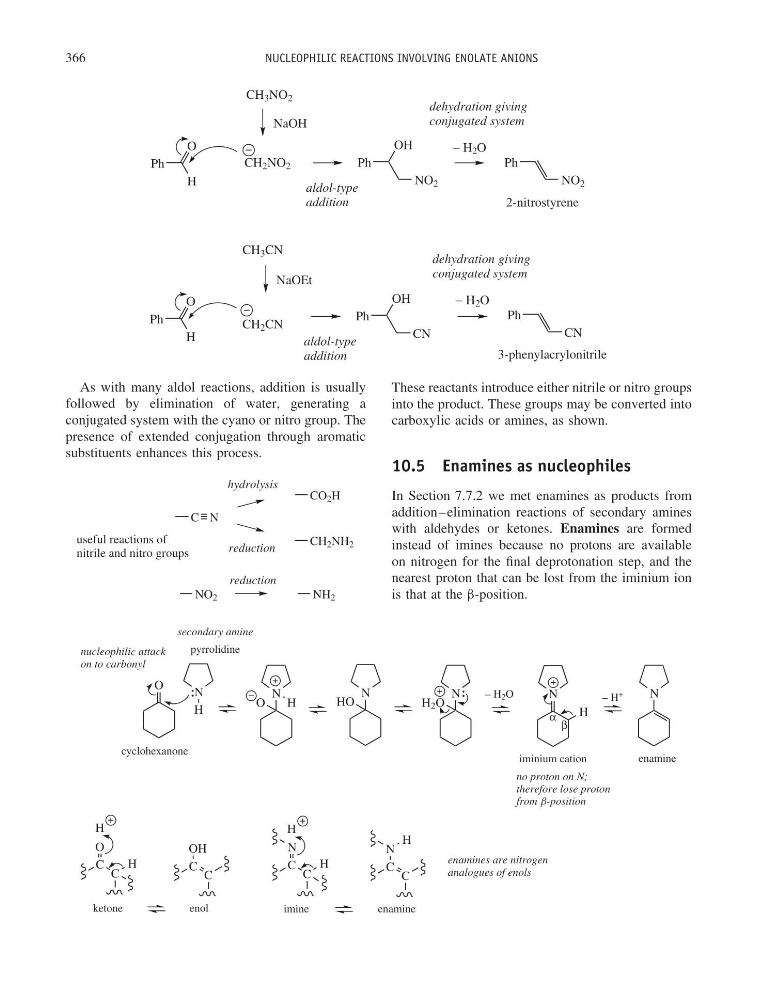
As with many aldol reactions, addition is usually
followed by elimination of water, generating a
conjugated system with the cyano or nitro group. The
presence of extended conjugation through aromatic
substituents enhances this process.
C N
CO 2 H
CH 2 NH 2
hydrolysis
reduction
useful reactions of
nitrile and nitro groups
NO 2
reduction
NH 2
These reactants introduce either nitrile or nitro groups
into the product. These groups may be converted into
carboxylic acids or amines, as shown.
10.5 Enamines as nucleophiles
In Section 7.7.2 we met enamines as products from
addition–elimination reactions of secondary amines
with aldehydes or ketones. Enamines are formed
instead of imines because no protons are available
on nitrogen for the final deprotonation step, and the
nearest proton that can be lost from the iminium ion
is that at the β-position.
O
C
C
OH
C
C
N
C
C
N
C
C
ketone
enamines are nitrogen
analogues of enols
enol
imine
enamine
H
H
H
nucleophilic attack
on to carbonyl
O
N
H
N
H
N
– H 2 O
α β
– H
+
no proton on N;
therefore lose proton
from b-position
enamine
N
O
H
N
HO
N
H 2 O
iminium cation
cyclohexanone
pyrrolidine
secondary amine
H
H
NUCLEOPHILIC REACTIONS INVOLVING ENOLATE ANIONS
2-nitrostyrene
Ph
H
O
CH 2 NO 2
CH 3 NO 2
NaOH
Ph
OH
NO 2
Ph
NO 2
− H 2 O
aldol-type
addition
dehydration giving
conjugated system
Ph
H
O
CH 3 CN
CH 2 CN
NaOEt
Ph
OH
CN
aldol-type
addition
Ph
CN
− H 2 O
dehydration giving
conjugated system
3-phenylacrylonitrile
As with many aldol reactions, addition is usually
followed by elimination of water, generating a
conjugated system with the cyano or nitro group. The
presence of extended conjugation through aromatic
substituents enhances this process.
C N
CO 2 H
CH 2 NH 2
hydrolysis
reduction
useful reactions of
nitrile and nitro groups
NO 2
reduction
NH 2
These reactants introduce either nitrile or nitro groups
into the product. These groups may be converted into
carboxylic acids or amines, as shown.
10.5 Enamines as nucleophiles
In Section 7.7.2 we met enamines as products from
addition–elimination reactions of secondary amines
with aldehydes or ketones. Enamines are formed
instead of imines because no protons are available
on nitrogen for the final deprotonation step, and the
nearest proton that can be lost from the iminium ion
is that at the β-position.
O
C
C
OH
C
C
N
C
C
N
C
C
ketone
enamines are nitrogen
analogues of enols
enol
imine
enamine
H
H
H
nucleophilic attack
on to carbonyl
O
N
H
N
H
N
– H 2 O
α β
– H
+
no proton on N;
therefore lose proton
from b-position
enamine
N
O
H
N
HO
N
H 2 O
iminium cation
cyclohexanone
pyrrolidine
secondary amine
H
H