

OTHER STABILIZED ANIONS AS NUCLEOPHILES: NITRILES AND NITROMETHANE
365
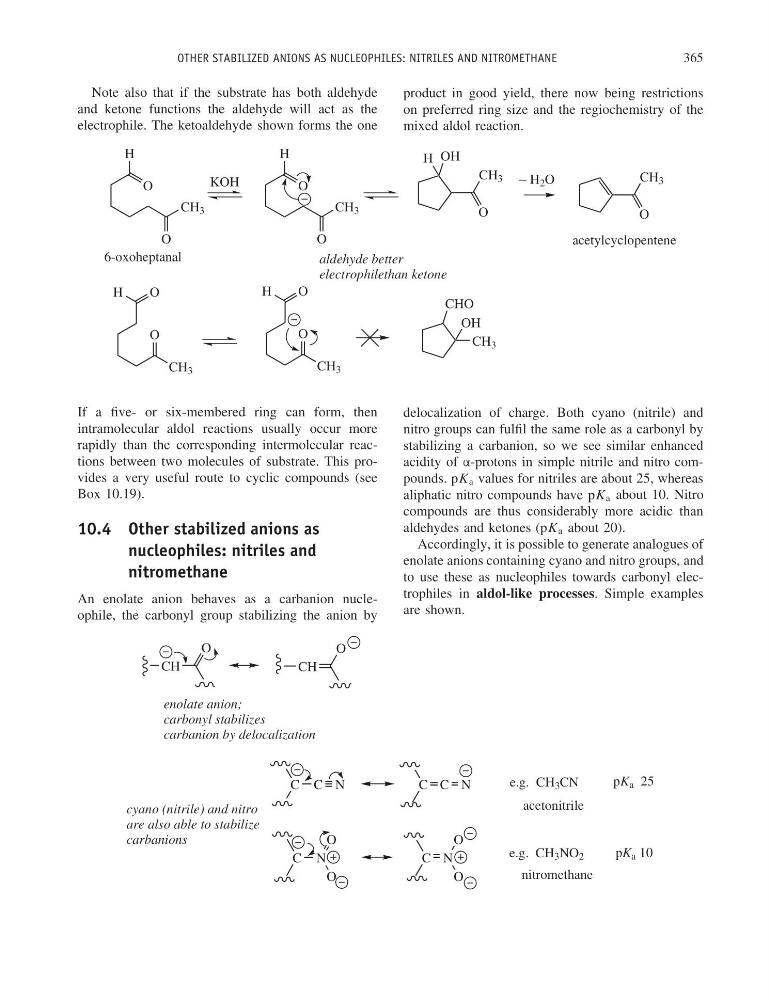
Note also that if the substrate has both aldehyde
and ketone functions the aldehyde will act as the
electrophile. The ketoaldehyde shown forms the one
product in good yield, there now being restrictions
on preferred ring size and the regiochemistry of the
mixed aldol reaction.
H
O
O
CH 3
acetylcyclopentene
CH 3
O
6-oxoheptanal
H
O
CH 3
O
KOH
OH
O
CH 3
H
O
H
O
CH 3
CHO
CH 3
OH
O
H
O
CH 3
aldehyde better
electrophilethan ketone
− H 2 O
If a five- or six-membered ring can form, then
intramolecular aldol reactions usually occur more
rapidly than the corresponding intermolecular reactions between two molecules of substrate. This provides a very useful route to cyclic compounds (see
Box 10.19).
10.4 Other stabilized anions as
nucleophiles: nitriles and
nitromethane
An enolate anion behaves as a carbanion nucleophile, the carbonyl group stabilizing the anion by
delocalization of charge. Both cyano (nitrile) and
nitro groups can fulfil the same role as a carbonyl by
stabilizing a carbanion, so we see similar enhanced
acidity of α-protons in simple nitrile and nitro compounds. pK a values for nitriles are about 25, whereas
aliphatic nitro compounds have pK a about 10. Nitro
compounds are thus considerably more acidic than
aldehydes and ketones (pK a about 20).
Accordingly, it is possible to generate analogues of
enolate anions containing cyano and nitro groups, and
to use these as nucleophiles towards carbonyl electrophiles in aldol-like processes. Simple examples
are shown.
CH
O
CH
O
enolate anion;
carbonyl stabilizes
carbanion by delocalization
cyano (nitrile) and nitro
are also able to stabilize
carbanions
C C N
C C N
C N
O
O
C N
O
O
e.g. CH 3 CN
e.g. CH 3 NO 2
nitromethane
pK a 25
pK a 10
acetonitrile
365
Note also that if the substrate has both aldehyde
and ketone functions the aldehyde will act as the
electrophile. The ketoaldehyde shown forms the one
product in good yield, there now being restrictions
on preferred ring size and the regiochemistry of the
mixed aldol reaction.
H
O
O
CH 3
acetylcyclopentene
CH 3
O
6-oxoheptanal
H
O
CH 3
O
KOH
OH
O
CH 3
H
O
H
O
CH 3
CHO
CH 3
OH
O
H
O
CH 3
aldehyde better
electrophilethan ketone
− H 2 O
If a five- or six-membered ring can form, then
intramolecular aldol reactions usually occur more
rapidly than the corresponding intermolecular reactions between two molecules of substrate. This provides a very useful route to cyclic compounds (see
Box 10.19).
10.4 Other stabilized anions as
nucleophiles: nitriles and
nitromethane
An enolate anion behaves as a carbanion nucleophile, the carbonyl group stabilizing the anion by
delocalization of charge. Both cyano (nitrile) and
nitro groups can fulfil the same role as a carbonyl by
stabilizing a carbanion, so we see similar enhanced
acidity of α-protons in simple nitrile and nitro compounds. pK a values for nitriles are about 25, whereas
aliphatic nitro compounds have pK a about 10. Nitro
compounds are thus considerably more acidic than
aldehydes and ketones (pK a about 20).
Accordingly, it is possible to generate analogues of
enolate anions containing cyano and nitro groups, and
to use these as nucleophiles towards carbonyl electrophiles in aldol-like processes. Simple examples
are shown.
CH
O
CH
O
enolate anion;
carbonyl stabilizes
carbanion by delocalization
cyano (nitrile) and nitro
are also able to stabilize
carbanions
C C N
C C N
C N
O
O
C N
O
O
e.g. CH 3 CN
e.g. CH 3 NO 2
nitromethane
pK a 25
pK a 10
acetonitrile