

364
NUCLEOPHILIC REACTIONS INVOLVING ENOLATE ANIONS
Box 10.4 (continued)
One interesting feature here is that both acetyl-CoA and oxaloacetic acid have the potential to form enolate
anions, and that oxaloacetic acid is actually more acidic than acetyl-CoA, in that there are two carbonyl groups
flanking the methylene. That citrate synthase achieves the aldol reaction as shown reflects that the enzyme active
site must have a basic residue appropriately positioned to abstract a proton from acetyl-CoA rather than oxaloacetic
acid, thus allowing acetyl-CoA to act as the nucleophile.
The obvious product of the aldol reaction would be the thioester citryl-CoA. However, the enzyme citrate
synthase also carries out hydrolysis of the thioester linkage, so that the product is citric acid; hence the terminology.
The hydrolysis of the thioester is actually responsible for disturbing the equilibrium and driving the reaction to
completion.
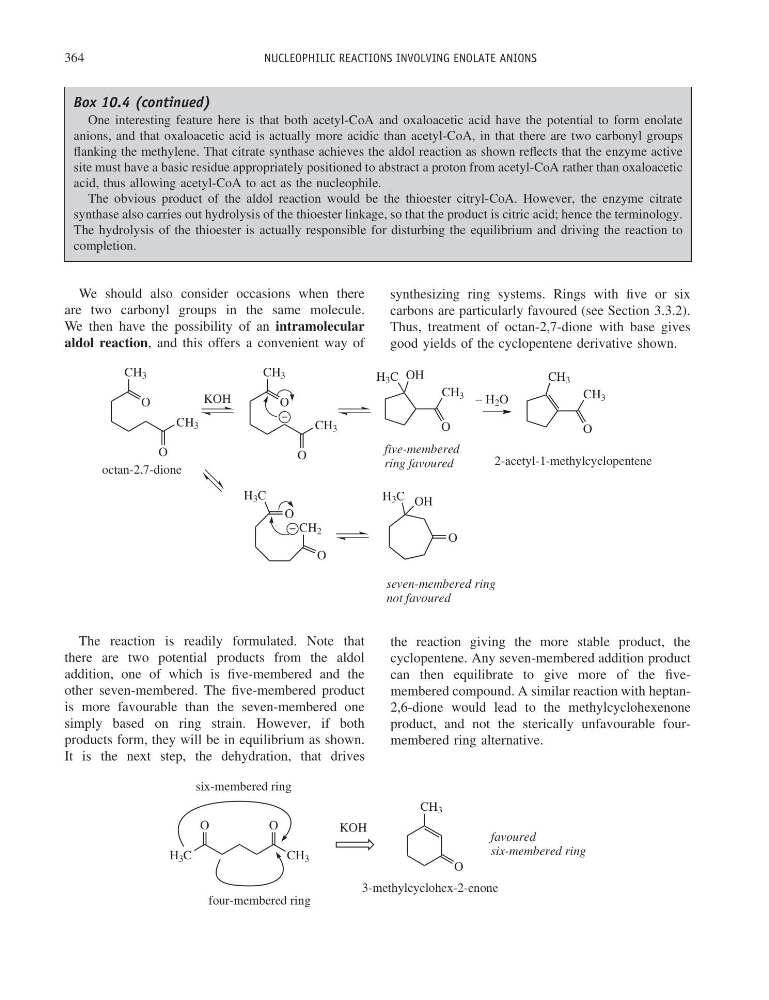
We should also consider occasions when there
are two carbonyl groups in the same molecule.
We then have the possibility of an intramolecular
aldol reaction, and this offers a convenient way of
synthesizing ring systems. Rings with five or six
carbons are particularly favoured (see Section 3.3.2).
Thus, treatment of octan-2,7-dione with base gives
good yields of the cyclopentene derivative shown.
CH 3
O
CH 3
O
CH 3
2-acetyl-1-methylcyclopentene
CH 3
O
octan-2,7-dione
CH 3
O
CH 3
O
KOH
OH
O
CH 3
H 3 C
H 3 C OH
O
seven-membered ring
not favoured
five-membered
ring favoured
CH 2
O
H 3 C
O
− H 2 O
The reaction is readily formulated. Note that
there are two potential products from the aldol
addition, one of which is five-membered and the
other seven-membered. The five-membered product
is more favourable than the seven-membered one
simply based on ring strain. However, if both
products form, they will be in equilibrium as shown.
It is the next step, the dehydration, that drives
the reaction giving the more stable product, the
cyclopentene. Any seven-membered addition product
can then equilibrate to give more of the fivemembered compound. A similar reaction with heptan2,6-dione would lead to the methylcyclohexenone
product, and not the sterically unfavourable fourmembered ring alternative.
H 3 C
CH 3
O
O
six-membered ring
four-membered ring
KOH
CH 3
O
favoured
six-membered ring
3-methylcyclohex-2-enone
NUCLEOPHILIC REACTIONS INVOLVING ENOLATE ANIONS
Box 10.4 (continued)
One interesting feature here is that both acetyl-CoA and oxaloacetic acid have the potential to form enolate
anions, and that oxaloacetic acid is actually more acidic than acetyl-CoA, in that there are two carbonyl groups
flanking the methylene. That citrate synthase achieves the aldol reaction as shown reflects that the enzyme active
site must have a basic residue appropriately positioned to abstract a proton from acetyl-CoA rather than oxaloacetic
acid, thus allowing acetyl-CoA to act as the nucleophile.
The obvious product of the aldol reaction would be the thioester citryl-CoA. However, the enzyme citrate
synthase also carries out hydrolysis of the thioester linkage, so that the product is citric acid; hence the terminology.
The hydrolysis of the thioester is actually responsible for disturbing the equilibrium and driving the reaction to
completion.
We should also consider occasions when there
are two carbonyl groups in the same molecule.
We then have the possibility of an intramolecular
aldol reaction, and this offers a convenient way of
synthesizing ring systems. Rings with five or six
carbons are particularly favoured (see Section 3.3.2).
Thus, treatment of octan-2,7-dione with base gives
good yields of the cyclopentene derivative shown.
CH 3
O
CH 3
O
CH 3
2-acetyl-1-methylcyclopentene
CH 3
O
octan-2,7-dione
CH 3
O
CH 3
O
KOH
OH
O
CH 3
H 3 C
H 3 C OH
O
seven-membered ring
not favoured
five-membered
ring favoured
CH 2
O
H 3 C
O
− H 2 O
The reaction is readily formulated. Note that
there are two potential products from the aldol
addition, one of which is five-membered and the
other seven-membered. The five-membered product
is more favourable than the seven-membered one
simply based on ring strain. However, if both
products form, they will be in equilibrium as shown.
It is the next step, the dehydration, that drives
the reaction giving the more stable product, the
cyclopentene. Any seven-membered addition product
can then equilibrate to give more of the fivemembered compound. A similar reaction with heptan2,6-dione would lead to the methylcyclohexenone
product, and not the sterically unfavourable fourmembered ring alternative.
H 3 C
CH 3
O
O
six-membered ring
four-membered ring
KOH
CH 3
O
favoured
six-membered ring
3-methylcyclohex-2-enone