

ADDITION–DEHYDRATION: THE ALDOL REACTION
363
Box 10.4
Aldol and reverse aldol reactions in biochemistry: aldolase, citrate synthase
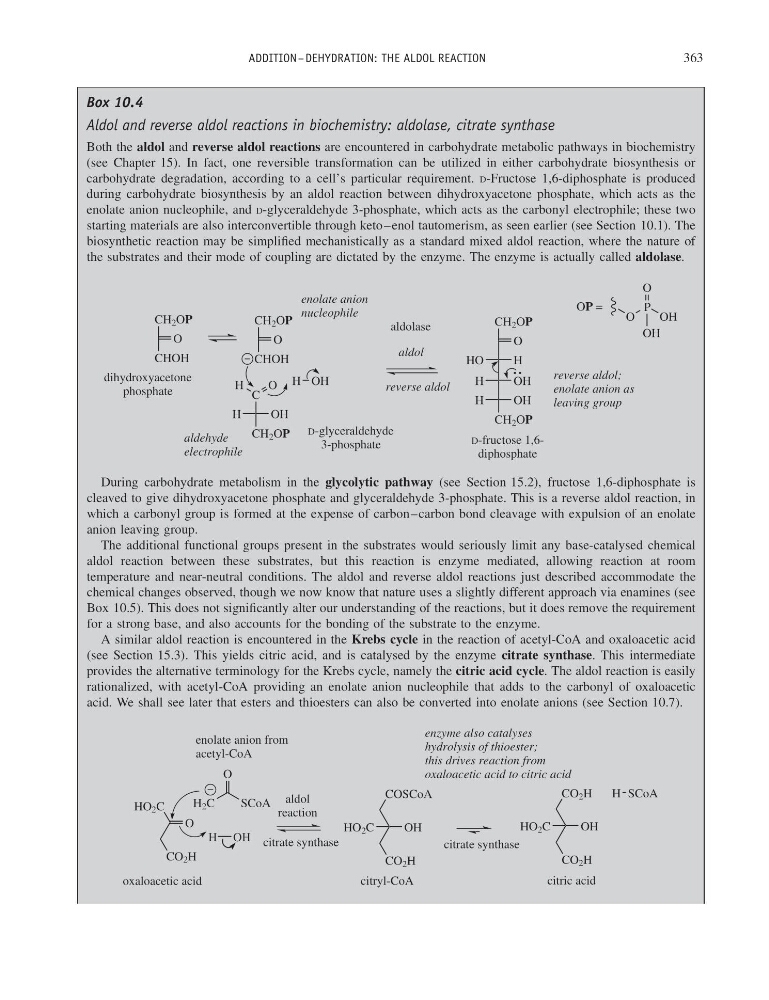
Both the aldol and reverse aldol reactions are encountered in carbohydrate metabolic pathways in biochemistry
(see Chapter 15). In fact, one reversible transformation can be utilized in either carbohydrate biosynthesis or
carbohydrate degradation, according to a cell’s particular requirement. D-Fructose 1,6-diphosphate is produced
during carbohydrate biosynthesis by an aldol reaction between dihydroxyacetone phosphate, which acts as the
enolate anion nucleophile, and D-glyceraldehyde 3-phosphate, which acts as the carbonyl electrophile; these two
starting materials are also interconvertible through keto–enol tautomerism, as seen earlier (see Section 10.1). The
biosynthetic reaction may be simplified mechanistically as a standard mixed aldol reaction, where the nature of
the substrates and their mode of coupling are dictated by the enzyme. The enzyme is actually called aldolase.
C
H
OH
CH 2 OP
CHOH
O
CH 2 OP
H
O
CH 2 OP
O
HO
H
H
OH
H
OH
CH 2 OP
D-glyceraldehyde
3-phosphate
aldol
reverse aldol
dihydroxyacetone
phosphate
D-fructose 1,6diphosphate
H OH
CHOH
O
CH 2 OP
enolate anion
nucleophile
aldehyde
electrophile
reverse aldol;
enolate anion as
leaving group
aldolase
OP =
O
P
O
OH
OH
During carbohydrate metabolism in the glycolytic pathway (see Section 15.2), fructose 1,6-diphosphate is
cleaved to give dihydroxyacetone phosphate and glyceraldehyde 3-phosphate. This is a reverse aldol reaction, in
which a carbonyl group is formed at the expense of carbon–carbon bond cleavage with expulsion of an enolate
anion leaving group.
The additional functional groups present in the substrates would seriously limit any base-catalysed chemical
aldol reaction between these substrates, but this reaction is enzyme mediated, allowing reaction at room
temperature and near-neutral conditions. The aldol and reverse aldol reactions just described accommodate the
chemical changes observed, though we now know that nature uses a slightly different approach via enamines (see
Box 10.5). This does not significantly alter our understanding of the reactions, but it does remove the requirement
for a strong base, and also accounts for the bonding of the substrate to the enzyme.
A similar aldol reaction is encountered in the Krebs cycle in the reaction of acetyl-CoA and oxaloacetic acid
(see Section 15.3). This yields citric acid, and is catalysed by the enzyme citrate synthase. This intermediate
provides the alternative terminology for the Krebs cycle, namely the citric acid cycle. The aldol reaction is easily
rationalized, with acetyl-CoA providing an enolate anion nucleophile that adds to the carbonyl of oxaloacetic
acid. We shall see later that esters and thioesters can also be converted into enolate anions (see Section 10.7).
oxaloacetic acid
citryl-CoA
citric acid
HO 2 C
CO 2 H
O
O
H 2 C
SCoA
citrate synthase
citrate synthase
CO 2 H
CO 2 H
OH
HO 2 C
COSCoA
CO 2 H
OH
HO 2 C
H SCoA
aldol
reaction
enolate anion from
acetyl-CoA
enzyme also catalyses
hydrolysis of thioester;
this drives reaction from
oxaloacetic acid to citric acid
H OH
363
Box 10.4
Aldol and reverse aldol reactions in biochemistry: aldolase, citrate synthase
Both the aldol and reverse aldol reactions are encountered in carbohydrate metabolic pathways in biochemistry
(see Chapter 15). In fact, one reversible transformation can be utilized in either carbohydrate biosynthesis or
carbohydrate degradation, according to a cell’s particular requirement. D-Fructose 1,6-diphosphate is produced
during carbohydrate biosynthesis by an aldol reaction between dihydroxyacetone phosphate, which acts as the
enolate anion nucleophile, and D-glyceraldehyde 3-phosphate, which acts as the carbonyl electrophile; these two
starting materials are also interconvertible through keto–enol tautomerism, as seen earlier (see Section 10.1). The
biosynthetic reaction may be simplified mechanistically as a standard mixed aldol reaction, where the nature of
the substrates and their mode of coupling are dictated by the enzyme. The enzyme is actually called aldolase.
C
H
OH
CH 2 OP
CHOH
O
CH 2 OP
H
O
CH 2 OP
O
HO
H
H
OH
H
OH
CH 2 OP
D-glyceraldehyde
3-phosphate
aldol
reverse aldol
dihydroxyacetone
phosphate
D-fructose 1,6diphosphate
H OH
CHOH
O
CH 2 OP
enolate anion
nucleophile
aldehyde
electrophile
reverse aldol;
enolate anion as
leaving group
aldolase
OP =
O
P
O
OH
OH
During carbohydrate metabolism in the glycolytic pathway (see Section 15.2), fructose 1,6-diphosphate is
cleaved to give dihydroxyacetone phosphate and glyceraldehyde 3-phosphate. This is a reverse aldol reaction, in
which a carbonyl group is formed at the expense of carbon–carbon bond cleavage with expulsion of an enolate
anion leaving group.
The additional functional groups present in the substrates would seriously limit any base-catalysed chemical
aldol reaction between these substrates, but this reaction is enzyme mediated, allowing reaction at room
temperature and near-neutral conditions. The aldol and reverse aldol reactions just described accommodate the
chemical changes observed, though we now know that nature uses a slightly different approach via enamines (see
Box 10.5). This does not significantly alter our understanding of the reactions, but it does remove the requirement
for a strong base, and also accounts for the bonding of the substrate to the enzyme.
A similar aldol reaction is encountered in the Krebs cycle in the reaction of acetyl-CoA and oxaloacetic acid
(see Section 15.3). This yields citric acid, and is catalysed by the enzyme citrate synthase. This intermediate
provides the alternative terminology for the Krebs cycle, namely the citric acid cycle. The aldol reaction is easily
rationalized, with acetyl-CoA providing an enolate anion nucleophile that adds to the carbonyl of oxaloacetic
acid. We shall see later that esters and thioesters can also be converted into enolate anions (see Section 10.7).
oxaloacetic acid
citryl-CoA
citric acid
HO 2 C
CO 2 H
O
O
H 2 C
SCoA
citrate synthase
citrate synthase
CO 2 H
CO 2 H
OH
HO 2 C
COSCoA
CO 2 H
OH
HO 2 C
H SCoA
aldol
reaction
enolate anion from
acetyl-CoA
enzyme also catalyses
hydrolysis of thioester;
this drives reaction from
oxaloacetic acid to citric acid
H OH