

362
NUCLEOPHILIC REACTIONS INVOLVING ENOLATE ANIONS
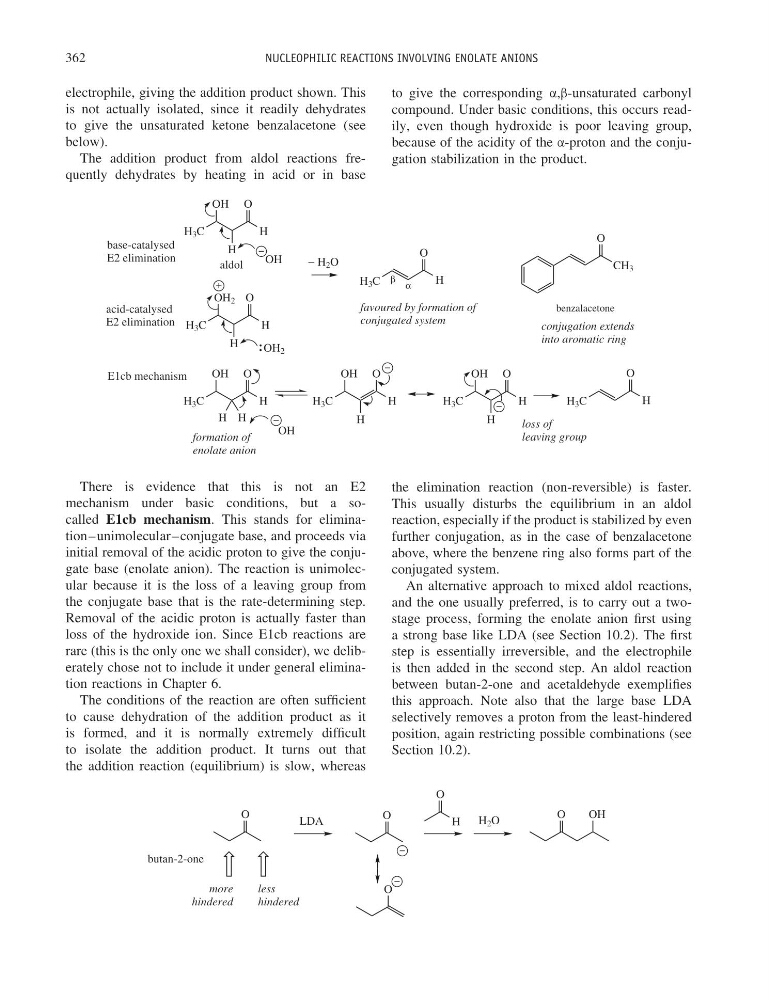
electrophile, giving the addition product shown. This
is not actually isolated, since it readily dehydrates
to give the unsaturated ketone benzalacetone (see
below).
The addition product from aldol reactions frequently dehydrates by heating in acid or in base
to give the corresponding α,β-unsaturated carbonyl
compound. Under basic conditions, this occurs readily, even though hydroxide is poor leaving group,
because of the acidity of the α-proton and the conjugation stabilization in the product.
H 3 C
H
OH O
H 3 C
H
OH O
H H
H
H 3 C
H
O
H 3 C
H
OH O
H
formation of
enolate anion
loss of
leaving group
E1cb mechanism
aldol
α
β
favoured by formation of
conjugated system
CH 3
O
benzalacetone
conjugation extends
into aromatic ring
H 3 C
H
OH O
H
H 3 C
H
O
H 3 C
H
OH 2 O
H
base-catalysed
E2 elimination
acid-catalysed
E2 elimination
− H 2 O
OH
OH 2
OH
There is evidence that this is not an E2
mechanism under basic conditions, but a socalled E1cb mechanism. This stands for elimination–unimolecular–conjugate base, and proceeds via
initial removal of the acidic proton to give the conjugate base (enolate anion). The reaction is unimolecular because it is the loss of a leaving group from
the conjugate base that is the rate-determining step.
Removal of the acidic proton is actually faster than
loss of the hydroxide ion. Since E1cb reactions are
rare (this is the only one we shall consider), we deliberately chose not to include it under general elimination reactions in Chapter 6.
The conditions of the reaction are often sufficient
to cause dehydration of the addition product as it
is formed, and it is normally extremely difficult
to isolate the addition product. It turns out that
the addition reaction (equilibrium) is slow, whereas
the elimination reaction (non-reversible) is faster.
This usually disturbs the equilibrium in an aldol
reaction, especially if the product is stabilized by even
further conjugation, as in the case of benzalacetone
above, where the benzene ring also forms part of the
conjugated system.
An alternative approach to mixed aldol reactions,
and the one usually preferred, is to carry out a twostage process, forming the enolate anion first using
a strong base like LDA (see Section 10.2). The first
step is essentially irreversible, and the electrophile
is then added in the second step. An aldol reaction
between butan-2-one and acetaldehyde exemplifies
this approach. Note also that the large base LDA
selectively removes a proton from the least-hindered
position, again restricting possible combinations (see
Section 10.2).
O
more
hindered
less
hindered
LDA
O
O
O
butan-2-one
O
H
OH
H 2 O
NUCLEOPHILIC REACTIONS INVOLVING ENOLATE ANIONS
electrophile, giving the addition product shown. This
is not actually isolated, since it readily dehydrates
to give the unsaturated ketone benzalacetone (see
below).
The addition product from aldol reactions frequently dehydrates by heating in acid or in base
to give the corresponding α,β-unsaturated carbonyl
compound. Under basic conditions, this occurs readily, even though hydroxide is poor leaving group,
because of the acidity of the α-proton and the conjugation stabilization in the product.
H 3 C
H
OH O
H 3 C
H
OH O
H H
H
H 3 C
H
O
H 3 C
H
OH O
H
formation of
enolate anion
loss of
leaving group
E1cb mechanism
aldol
α
β
favoured by formation of
conjugated system
CH 3
O
benzalacetone
conjugation extends
into aromatic ring
H 3 C
H
OH O
H
H 3 C
H
O
H 3 C
H
OH 2 O
H
base-catalysed
E2 elimination
acid-catalysed
E2 elimination
− H 2 O
OH
OH 2
OH
There is evidence that this is not an E2
mechanism under basic conditions, but a socalled E1cb mechanism. This stands for elimination–unimolecular–conjugate base, and proceeds via
initial removal of the acidic proton to give the conjugate base (enolate anion). The reaction is unimolecular because it is the loss of a leaving group from
the conjugate base that is the rate-determining step.
Removal of the acidic proton is actually faster than
loss of the hydroxide ion. Since E1cb reactions are
rare (this is the only one we shall consider), we deliberately chose not to include it under general elimination reactions in Chapter 6.
The conditions of the reaction are often sufficient
to cause dehydration of the addition product as it
is formed, and it is normally extremely difficult
to isolate the addition product. It turns out that
the addition reaction (equilibrium) is slow, whereas
the elimination reaction (non-reversible) is faster.
This usually disturbs the equilibrium in an aldol
reaction, especially if the product is stabilized by even
further conjugation, as in the case of benzalacetone
above, where the benzene ring also forms part of the
conjugated system.
An alternative approach to mixed aldol reactions,
and the one usually preferred, is to carry out a twostage process, forming the enolate anion first using
a strong base like LDA (see Section 10.2). The first
step is essentially irreversible, and the electrophile
is then added in the second step. An aldol reaction
between butan-2-one and acetaldehyde exemplifies
this approach. Note also that the large base LDA
selectively removes a proton from the least-hindered
position, again restricting possible combinations (see
Section 10.2).
O
more
hindered
less
hindered
LDA
O
O
O
butan-2-one
O
H
OH
H 2 O