

ADDITION–DEHYDRATION: THE ALDOL REACTION
361
This is easily formulated as production of an
enolate anion followed by nucleophilic attack of this
anion on to the carbonyl group of a second molecule
of acetaldehyde. Aldol is then produced when the
addition anion abstracts a proton from solvent. The
reaction is reversible, and it is usually necessary to
disturb the equilibrium by some means. Removal
of product is possible, but, as seen below, the
dehydration part of the sequence may be responsible
for pushing the reaction to completion.
In the reverse reaction, the addition anion reforms
the carbonyl group by expelling the enolate anion
as leaving group. This reverse aldol reaction is
sufficiently important in its own right, and we shall
meet examples. Note that, as we saw with simple
aldehyde and ketone addition reactions, aldehydes are
better electrophiles than ketones (see Section 7.1.1).
This arises from the extra alkyl group in ketones,
which provides a further inductive effect and extra
steric hindrance. Accordingly, the aldol reaction is
more favourable with aldehydes than with ketones.
With ketones, it is absolutely essential to disturb the
equilibrium in some way.
The aldol reaction as formulated above involves
two molecules of the starting substrate. However,
by a consideration of the mechanism, one can see
that different carbonyl compounds might be used as
nucleophile or electrophile. This would be termed
a mixed aldol reaction or crossed aldol reaction.
However, if one merely reacted, say, two aldehydes
together under basic conditions, one would get a
rather messy mixture of products containing at least
four different components. This is because both
starting materials might feature as nucleophile or as
electrophile.
mixed aldol reaction
R´CH 2 CHO
+
4 products
RCH 2 CHO
nucleophile
electrophile
RCH 2 CHO
RCH 2 CHO
R´CH 2 CHO
R´CH 2 CHO
R´CH 2 CHO
R´CH 2 CHO
RCH 2 CHO
+
+
+
+
RCH 2 CHO
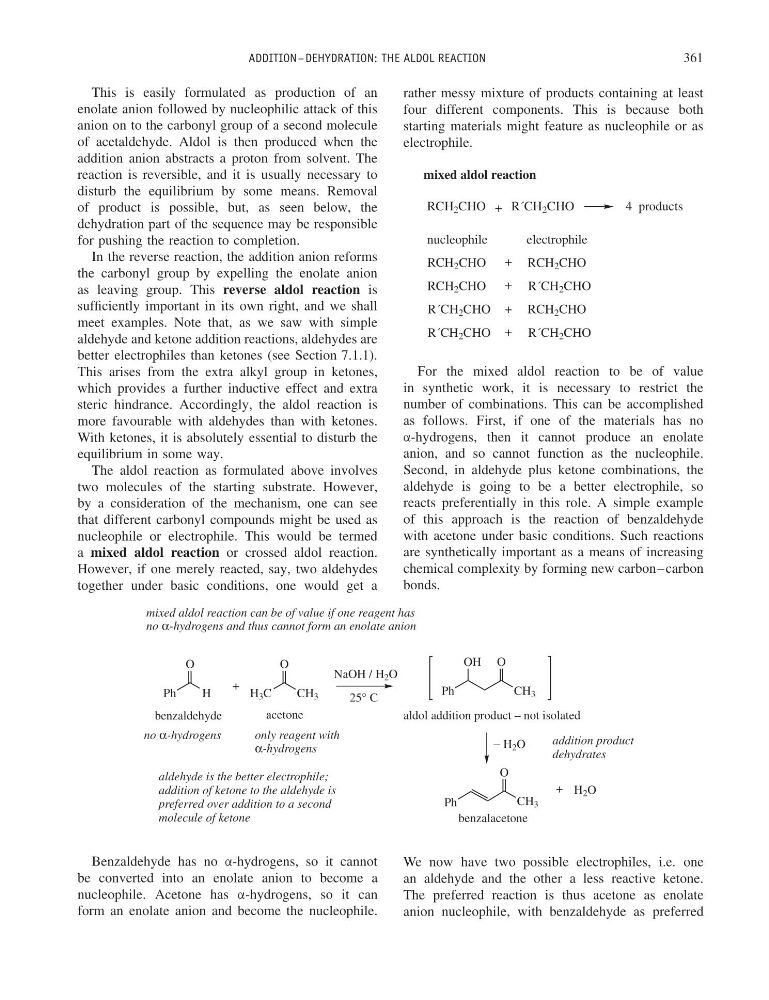
For the mixed aldol reaction to be of value
in synthetic work, it is necessary to restrict the
number of combinations. This can be accomplished
as follows. First, if one of the materials has no
α-hydrogens, then it cannot produce an enolate
anion, and so cannot function as the nucleophile.
Second, in aldehyde plus ketone combinations, the
aldehyde is going to be a better electrophile, so
reacts preferentially in this role. A simple example
of this approach is the reaction of benzaldehyde
with acetone under basic conditions. Such reactions
are synthetically important as a means of increasing
chemical complexity by forming new carbon–carbon
bonds.
+
no α-hydrogens
NaOH / H 2 O
25° C
aldol addition product – not isolated
benzalacetone
+
aldehyde is the better electrophile;
addition of ketone to the aldehyde is
preferred over addition to a second
molecule of ketone
only reagent with
α-hydrogens
mixed aldol reaction can be of value if one reagent has
no α-hydrogens and thus cannot form an enolate anion
− H 2 O
addition product
dehydrates
Ph
CH 3
O
Ph
CH 3
OH O
O
Ph
H
O
H 3 C
CH 3
benzaldehyde
acetone
H 2 O
Benzaldehyde has no α-hydrogens, so it cannot
be converted into an enolate anion to become a
nucleophile. Acetone has α-hydrogens, so it can
form an enolate anion and become the nucleophile.
We now have two possible electrophiles, i.e. one
an aldehyde and the other a less reactive ketone.
The preferred reaction is thus acetone as enolate
anion nucleophile, with benzaldehyde as preferred
361
This is easily formulated as production of an
enolate anion followed by nucleophilic attack of this
anion on to the carbonyl group of a second molecule
of acetaldehyde. Aldol is then produced when the
addition anion abstracts a proton from solvent. The
reaction is reversible, and it is usually necessary to
disturb the equilibrium by some means. Removal
of product is possible, but, as seen below, the
dehydration part of the sequence may be responsible
for pushing the reaction to completion.
In the reverse reaction, the addition anion reforms
the carbonyl group by expelling the enolate anion
as leaving group. This reverse aldol reaction is
sufficiently important in its own right, and we shall
meet examples. Note that, as we saw with simple
aldehyde and ketone addition reactions, aldehydes are
better electrophiles than ketones (see Section 7.1.1).
This arises from the extra alkyl group in ketones,
which provides a further inductive effect and extra
steric hindrance. Accordingly, the aldol reaction is
more favourable with aldehydes than with ketones.
With ketones, it is absolutely essential to disturb the
equilibrium in some way.
The aldol reaction as formulated above involves
two molecules of the starting substrate. However,
by a consideration of the mechanism, one can see
that different carbonyl compounds might be used as
nucleophile or electrophile. This would be termed
a mixed aldol reaction or crossed aldol reaction.
However, if one merely reacted, say, two aldehydes
together under basic conditions, one would get a
rather messy mixture of products containing at least
four different components. This is because both
starting materials might feature as nucleophile or as
electrophile.
mixed aldol reaction
R´CH 2 CHO
+
4 products
RCH 2 CHO
nucleophile
electrophile
RCH 2 CHO
RCH 2 CHO
R´CH 2 CHO
R´CH 2 CHO
R´CH 2 CHO
R´CH 2 CHO
RCH 2 CHO
+
+
+
+
RCH 2 CHO
For the mixed aldol reaction to be of value
in synthetic work, it is necessary to restrict the
number of combinations. This can be accomplished
as follows. First, if one of the materials has no
α-hydrogens, then it cannot produce an enolate
anion, and so cannot function as the nucleophile.
Second, in aldehyde plus ketone combinations, the
aldehyde is going to be a better electrophile, so
reacts preferentially in this role. A simple example
of this approach is the reaction of benzaldehyde
with acetone under basic conditions. Such reactions
are synthetically important as a means of increasing
chemical complexity by forming new carbon–carbon
bonds.
+
no α-hydrogens
NaOH / H 2 O
25° C
aldol addition product – not isolated
benzalacetone
+
aldehyde is the better electrophile;
addition of ketone to the aldehyde is
preferred over addition to a second
molecule of ketone
only reagent with
α-hydrogens
mixed aldol reaction can be of value if one reagent has
no α-hydrogens and thus cannot form an enolate anion
− H 2 O
addition product
dehydrates
Ph
CH 3
O
Ph
CH 3
OH O
O
Ph
H
O
H 3 C
CH 3
benzaldehyde
acetone
H 2 O
Benzaldehyde has no α-hydrogens, so it cannot
be converted into an enolate anion to become a
nucleophile. Acetone has α-hydrogens, so it can
form an enolate anion and become the nucleophile.
We now have two possible electrophiles, i.e. one
an aldehyde and the other a less reactive ketone.
The preferred reaction is thus acetone as enolate
anion nucleophile, with benzaldehyde as preferred