

360
NUCLEOPHILIC REACTIONS INVOLVING ENOLATE ANIONS
In symmetrical structures such as cyclohexanone,
ionization at α-positions occurs readily and allows
the preparation of alkylated products. In unsymmetrical structures, the sheer size of LDA as a base
may allow selectivity by preferential removal of
certain α-protons. Thus, the ketone pentan-2-one will
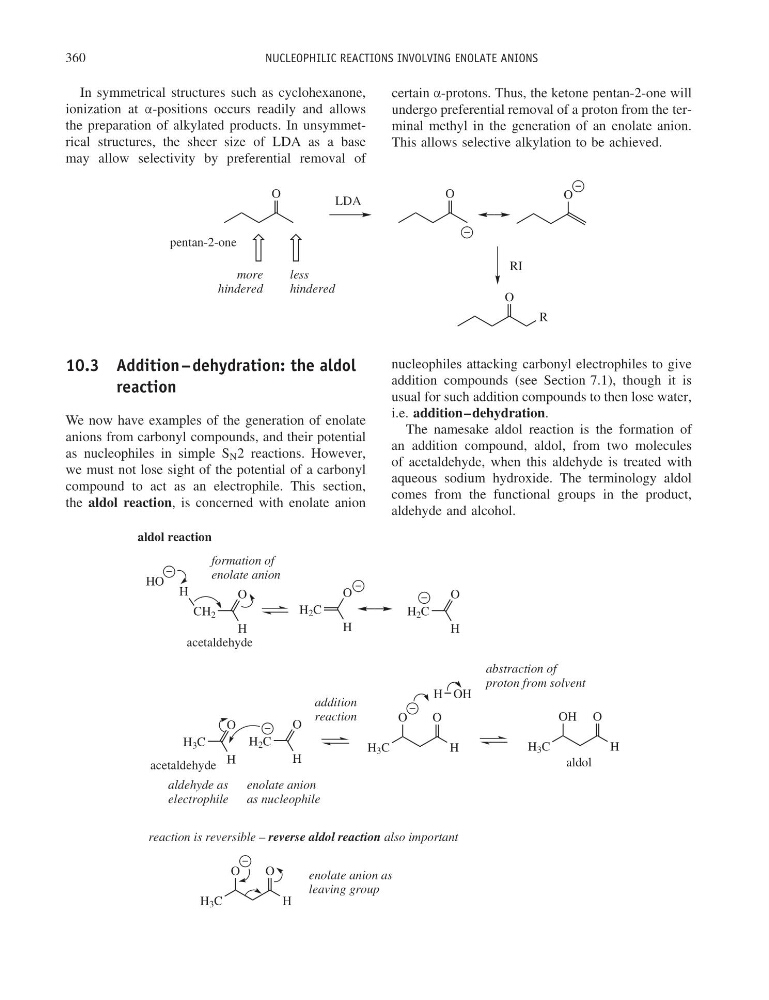
undergo preferential removal of a proton from the terminal methyl in the generation of an enolate anion.
This allows selective alkylation to be achieved.
O
more
hindered
less
hindered
LDA
O
O
RI
O
R
pentan-2-one
10.3 Addition–dehydration: the aldol
reaction
We now have examples of the generation of enolate
anions from carbonyl compounds, and their potential
as nucleophiles in simple S N 2 reactions. However,
we must not lose sight of the potential of a carbonyl
compound to act as an electrophile. This section,
the aldol reaction, is concerned with enolate anion
nucleophiles attacking carbonyl electrophiles to give
addition compounds (see Section 7.1), though it is
usual for such addition compounds to then lose water,
i.e. addition–dehydration.
The namesake aldol reaction is the formation of
an addition compound, aldol, from two molecules
of acetaldehyde, when this aldehyde is treated with
aqueous sodium hydroxide. The terminology aldol
comes from the functional groups in the product,
aldehyde and alcohol.
H 2 C
O
H
H 2 C
O
H
H 2 C
O
H
H 3 C
O
H
H OH
aldol
CH 2
H
H
HO
enolate anion
as nucleophile
aldehyde as
electrophile
addition
reaction
abstraction of
proton from solvent
formation of
enolate anion
aldol reaction
reaction is reversible – reverse aldol reaction also important
enolate anion as
leaving group
O
H 3 C
H
O
O
H 3 C
H
OH O
H 3 C
H
O
O
acetaldehyde
acetaldehyde
NUCLEOPHILIC REACTIONS INVOLVING ENOLATE ANIONS
In symmetrical structures such as cyclohexanone,
ionization at α-positions occurs readily and allows
the preparation of alkylated products. In unsymmetrical structures, the sheer size of LDA as a base
may allow selectivity by preferential removal of
certain α-protons. Thus, the ketone pentan-2-one will
undergo preferential removal of a proton from the terminal methyl in the generation of an enolate anion.
This allows selective alkylation to be achieved.
O
more
hindered
less
hindered
LDA
O
O
RI
O
R
pentan-2-one
10.3 Addition–dehydration: the aldol
reaction
We now have examples of the generation of enolate
anions from carbonyl compounds, and their potential
as nucleophiles in simple S N 2 reactions. However,
we must not lose sight of the potential of a carbonyl
compound to act as an electrophile. This section,
the aldol reaction, is concerned with enolate anion
nucleophiles attacking carbonyl electrophiles to give
addition compounds (see Section 7.1), though it is
usual for such addition compounds to then lose water,
i.e. addition–dehydration.
The namesake aldol reaction is the formation of
an addition compound, aldol, from two molecules
of acetaldehyde, when this aldehyde is treated with
aqueous sodium hydroxide. The terminology aldol
comes from the functional groups in the product,
aldehyde and alcohol.
H 2 C
O
H
H 2 C
O
H
H 2 C
O
H
H 3 C
O
H
H OH
aldol
CH 2
H
H
HO
enolate anion
as nucleophile
aldehyde as
electrophile
addition
reaction
abstraction of
proton from solvent
formation of
enolate anion
aldol reaction
reaction is reversible – reverse aldol reaction also important
enolate anion as
leaving group
O
H 3 C
H
O
O
H 3 C
H
OH O
H 3 C
H
O
O
acetaldehyde
acetaldehyde