

ALKYLATION OF ENOLATE ANIONS
359
These compounds ionize and act as sources of
hydride and amide ions respectively, which are
able to remove α-protons from carbonyl compounds.
These ions are actually the conjugate bases of
hydrogen and ammonia respectively, compounds
that are very weak acids indeed. What becomes
important here is that enolate anion formation
becomes essentially irreversible; the enolate anion
formed is insufficiently basic to be able to remove
a proton from either hydrogen or ammonia. This is
in marked contrast to the earlier examples of enolate
anion formation that were reversible. We now have
a means of preparing the enolate anion, rather than
relying upon an equilibrium reaction. Accordingly,
reactions are usually done in two stages, preparation
of the enolate anion followed by addition of the
alkylating agent electrophile.
O
O
I
no α-hydrogens
THF
(tetrahydrofuran)
NaH
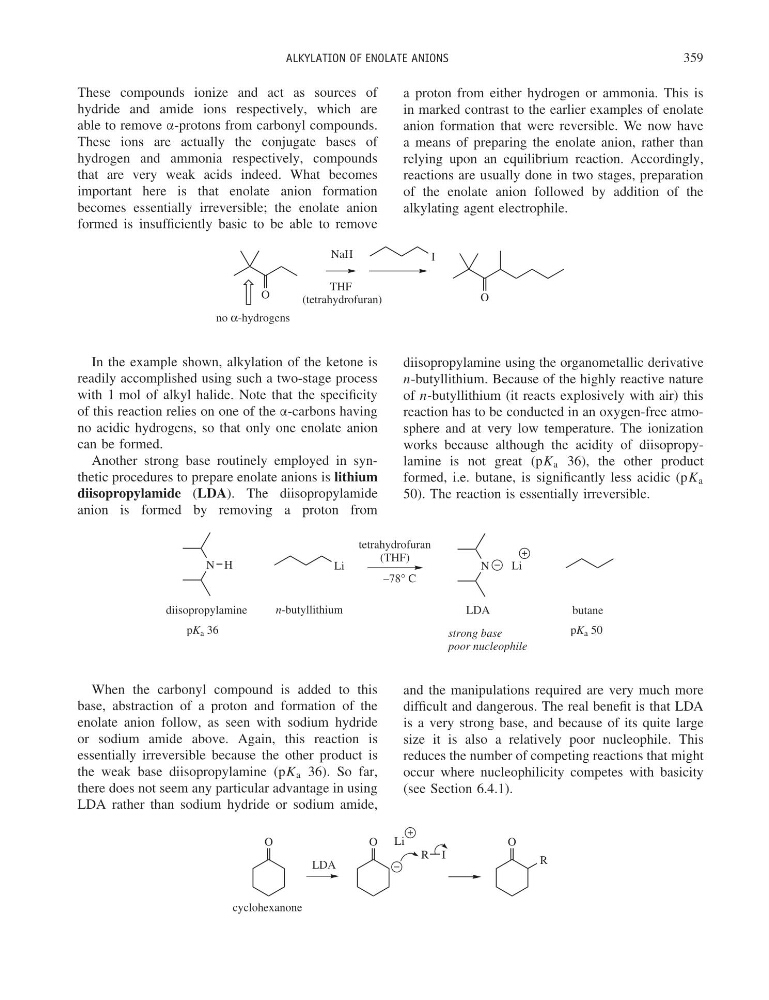
In the example shown, alkylation of the ketone is
readily accomplished using such a two-stage process
with 1 mol of alkyl halide. Note that the specificity
of this reaction relies on one of the α-carbons having
no acidic hydrogens, so that only one enolate anion
can be formed.
Another strong base routinely employed in synthetic procedures to prepare enolate anions is lithium
diisopropylamide (LDA). The diisopropylamide
anion is formed by removing a proton from
diisopropylamine using the organometallic derivative
n-butyllithium. Because of the highly reactive nature
of n-butyllithium (it reacts explosively with air) this
reaction has to be conducted in an oxygen-free atmosphere and at very low temperature. The ionization
works because although the acidity of diisopropylamine is not great (pK a 36), the other product
formed, i.e. butane, is significantly less acidic (pK a
50). The reaction is essentially irreversible.
diisopropylamine
n-butyllithium
LDA
tetrahydrofuran
(THF)
–78° C
strong base
poor nucleophile
butane
pK a 50
pK a 36
N H
Li
N
Li
When the carbonyl compound is added to this
base, abstraction of a proton and formation of the
enolate anion follow, as seen with sodium hydride
or sodium amide above. Again, this reaction is
essentially irreversible because the other product is
the weak base diisopropylamine (pK a 36). So far,
there does not seem any particular advantage in using
LDA rather than sodium hydride or sodium amide,
and the manipulations required are very much more
difficult and dangerous. The real benefit is that LDA
is a very strong base, and because of its quite large
size it is also a relatively poor nucleophile. This
reduces the number of competing reactions that might
occur where nucleophilicity competes with basicity
(see Section 6.4.1).
O
O
R
LDA
O
R I
cyclohexanone
Li
359
These compounds ionize and act as sources of
hydride and amide ions respectively, which are
able to remove α-protons from carbonyl compounds.
These ions are actually the conjugate bases of
hydrogen and ammonia respectively, compounds
that are very weak acids indeed. What becomes
important here is that enolate anion formation
becomes essentially irreversible; the enolate anion
formed is insufficiently basic to be able to remove
a proton from either hydrogen or ammonia. This is
in marked contrast to the earlier examples of enolate
anion formation that were reversible. We now have
a means of preparing the enolate anion, rather than
relying upon an equilibrium reaction. Accordingly,
reactions are usually done in two stages, preparation
of the enolate anion followed by addition of the
alkylating agent electrophile.
O
O
I
no α-hydrogens
THF
(tetrahydrofuran)
NaH
In the example shown, alkylation of the ketone is
readily accomplished using such a two-stage process
with 1 mol of alkyl halide. Note that the specificity
of this reaction relies on one of the α-carbons having
no acidic hydrogens, so that only one enolate anion
can be formed.
Another strong base routinely employed in synthetic procedures to prepare enolate anions is lithium
diisopropylamide (LDA). The diisopropylamide
anion is formed by removing a proton from
diisopropylamine using the organometallic derivative
n-butyllithium. Because of the highly reactive nature
of n-butyllithium (it reacts explosively with air) this
reaction has to be conducted in an oxygen-free atmosphere and at very low temperature. The ionization
works because although the acidity of diisopropylamine is not great (pK a 36), the other product
formed, i.e. butane, is significantly less acidic (pK a
50). The reaction is essentially irreversible.
diisopropylamine
n-butyllithium
LDA
tetrahydrofuran
(THF)
–78° C
strong base
poor nucleophile
butane
pK a 50
pK a 36
N H
Li
N
Li
When the carbonyl compound is added to this
base, abstraction of a proton and formation of the
enolate anion follow, as seen with sodium hydride
or sodium amide above. Again, this reaction is
essentially irreversible because the other product is
the weak base diisopropylamine (pK a 36). So far,
there does not seem any particular advantage in using
LDA rather than sodium hydride or sodium amide,
and the manipulations required are very much more
difficult and dangerous. The real benefit is that LDA
is a very strong base, and because of its quite large
size it is also a relatively poor nucleophile. This
reduces the number of competing reactions that might
occur where nucleophilicity competes with basicity
(see Section 6.4.1).
O
O
R
LDA
O
R I
cyclohexanone
Li