

358
NUCLEOPHILIC REACTIONS INVOLVING ENOLATE ANIONS
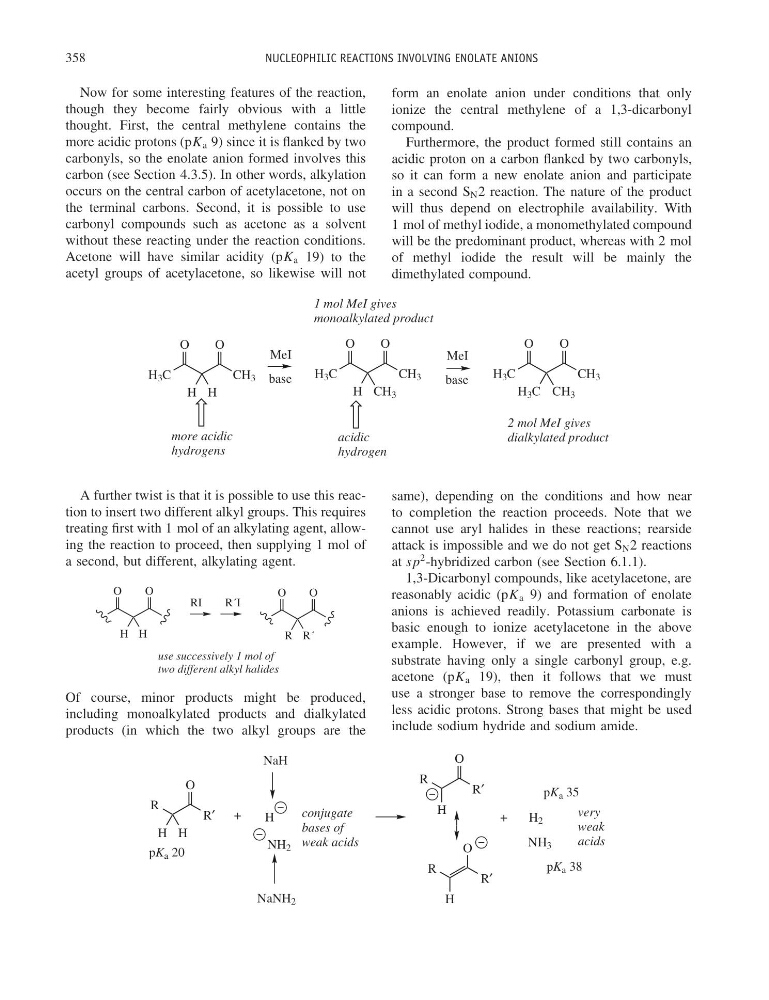
Now for some interesting features of the reaction,
though they become fairly obvious with a little
thought. First, the central methylene contains the
more acidic protons (pK a 9) since it is flanked by two
carbonyls, so the enolate anion formed involves this
carbon (see Section 4.3.5). In other words, alkylation
occurs on the central carbon of acetylacetone, not on
the terminal carbons. Second, it is possible to use
carbonyl compounds such as acetone as a solvent
without these reacting under the reaction conditions.
Acetone will have similar acidity (pK a 19) to the
acetyl groups of acetylacetone, so likewise will not
form an enolate anion under conditions that only
ionize the central methylene of a 1,3-dicarbonyl
compound.
Furthermore, the product formed still contains an
acidic proton on a carbon flanked by two carbonyls,
so it can form a new enolate anion and participate
in a second S N 2 reaction. The nature of the product
will thus depend on electrophile availability. With
1 mol of methyl iodide, a monomethylated compound
will be the predominant product, whereas with 2 mol
of methyl iodide the result will be mainly the
dimethylated compound.
1 mol MeI gives
monoalkylated product
2 mol MeI gives
dialkylated product
H 3 C
CH 3
O
O
H H
H 3 C
CH 3
O
O
H CH 3
H 3 C
CH 3
O
O
H 3 C CH 3
more acidic
hydrogens
MeI
base
MeI
base
acidic
hydrogen
A further twist is that it is possible to use this reaction to insert two different alkyl groups. This requires
treating first with 1 mol of an alkylating agent, allowing the reaction to proceed, then supplying 1 mol of
a second, but different, alkylating agent.
use successively 1 mol of
two different alkyl halides
RI
R´I
O
O
H H
O
O
R R´
Of course, minor products might be produced,
including monoalkylated products and dialkylated
products (in which the two alkyl groups are the
same), depending on the conditions and how near
to completion the reaction proceeds. Note that we
cannot use aryl halides in these reactions; rearside
attack is impossible and we do not get S N 2 reactions
at sp
2 -hybridized carbon (see Section 6.1.1).
1,3-Dicarbonyl compounds, like acetylacetone, are
reasonably acidic (pK a 9) and formation of enolate
anions is achieved readily. Potassium carbonate is
basic enough to ionize acetylacetone in the above
example. However, if we are presented with a
substrate having only a single carbonyl group, e.g.
acetone (pK a 19), then it follows that we must
use a stronger base to remove the correspondingly
less acidic protons. Strong bases that might be used
include sodium hydride and sodium amide.
very
weak
acids
conjugate
bases of
weak acids
pK a 20
pK a 38
pK a 35
R
R′
H H
O
R
R′
O
R
R′
O
H
H
+
+
NaH
NaNH 2
H 2
NH 3
H
NH 2
NUCLEOPHILIC REACTIONS INVOLVING ENOLATE ANIONS
Now for some interesting features of the reaction,
though they become fairly obvious with a little
thought. First, the central methylene contains the
more acidic protons (pK a 9) since it is flanked by two
carbonyls, so the enolate anion formed involves this
carbon (see Section 4.3.5). In other words, alkylation
occurs on the central carbon of acetylacetone, not on
the terminal carbons. Second, it is possible to use
carbonyl compounds such as acetone as a solvent
without these reacting under the reaction conditions.
Acetone will have similar acidity (pK a 19) to the
acetyl groups of acetylacetone, so likewise will not
form an enolate anion under conditions that only
ionize the central methylene of a 1,3-dicarbonyl
compound.
Furthermore, the product formed still contains an
acidic proton on a carbon flanked by two carbonyls,
so it can form a new enolate anion and participate
in a second S N 2 reaction. The nature of the product
will thus depend on electrophile availability. With
1 mol of methyl iodide, a monomethylated compound
will be the predominant product, whereas with 2 mol
of methyl iodide the result will be mainly the
dimethylated compound.
1 mol MeI gives
monoalkylated product
2 mol MeI gives
dialkylated product
H 3 C
CH 3
O
O
H H
H 3 C
CH 3
O
O
H CH 3
H 3 C
CH 3
O
O
H 3 C CH 3
more acidic
hydrogens
MeI
base
MeI
base
acidic
hydrogen
A further twist is that it is possible to use this reaction to insert two different alkyl groups. This requires
treating first with 1 mol of an alkylating agent, allowing the reaction to proceed, then supplying 1 mol of
a second, but different, alkylating agent.
use successively 1 mol of
two different alkyl halides
RI
R´I
O
O
H H
O
O
R R´
Of course, minor products might be produced,
including monoalkylated products and dialkylated
products (in which the two alkyl groups are the
same), depending on the conditions and how near
to completion the reaction proceeds. Note that we
cannot use aryl halides in these reactions; rearside
attack is impossible and we do not get S N 2 reactions
at sp
2 -hybridized carbon (see Section 6.1.1).
1,3-Dicarbonyl compounds, like acetylacetone, are
reasonably acidic (pK a 9) and formation of enolate
anions is achieved readily. Potassium carbonate is
basic enough to ionize acetylacetone in the above
example. However, if we are presented with a
substrate having only a single carbonyl group, e.g.
acetone (pK a 19), then it follows that we must
use a stronger base to remove the correspondingly
less acidic protons. Strong bases that might be used
include sodium hydride and sodium amide.
very
weak
acids
conjugate
bases of
weak acids
pK a 20
pK a 38
pK a 35
R
R′
H H
O
R
R′
O
R
R′
O
H
H
+
+
NaH
NaNH 2
H 2
NH 3
H
NH 2