

ALKYLATION OF ENOLATE ANIONS
357
O
C
H
H
Br
O
C
H
H
H
O
C
H
Br
acidity of α-protons increases
>
>
O
C
H
Br
Br
relate to increased
stability of enolate anions
O
C
Br
Br
OH
C
Br
H
H
d−
d+
halogenation destabilizes
protonated carbonyl
OH
C
Br
H
H
d−
d+
base-catalysed reaction: consider acidity
and enolate anion formation
acid-catalysed reaction: consider basicity
and conjugate acid formation
10.2 Alkylation of enolate anions
Though this topic is treated here under a separate
heading, alkylation of enolate anions is nothing
other than enolate anions acting as carbanion
nucleophiles in S N 2 reactions. We deferred this topic
from Section 6.3.4, since at that stage we had not
encountered the concept of enols and enolate anions.
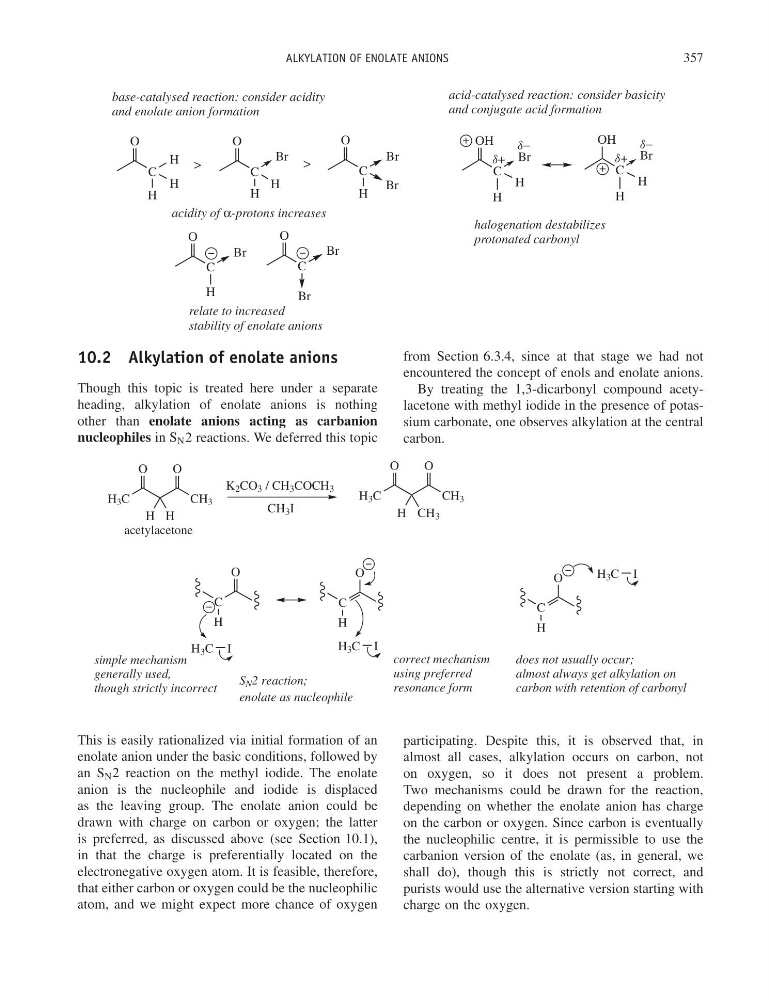
By treating the 1,3-dicarbonyl compound acetylacetone with methyl iodide in the presence of potassium carbonate, one observes alkylation at the central
carbon.
K 2 CO 3 / CH 3 COCH 3
does not usually occur;
almost always get alkylation on
carbon with retention of carbonyl
acetylacetone
O
C
H
H 3 C I
O
C
H
H 3 C I
S N 2 reaction;
enolate as nucleophile
O
C
H
H 3 C I
H 3 C
CH 3
O
O
H H
H 3 C
CH 3
O
O
H CH 3
simple mechanism
generally used,
though strictly incorrect
correct mechanism
using preferred
resonance form
CH 3 I
This is easily rationalized via initial formation of an
enolate anion under the basic conditions, followed by
an S N 2 reaction on the methyl iodide. The enolate
anion is the nucleophile and iodide is displaced
as the leaving group. The enolate anion could be
drawn with charge on carbon or oxygen; the latter
is preferred, as discussed above (see Section 10.1),
in that the charge is preferentially located on the
electronegative oxygen atom. It is feasible, therefore,
that either carbon or oxygen could be the nucleophilic
atom, and we might expect more chance of oxygen
participating. Despite this, it is observed that, in
almost all cases, alkylation occurs on carbon, not
on oxygen, so it does not present a problem.
Two mechanisms could be drawn for the reaction,
depending on whether the enolate anion has charge
on the carbon or oxygen. Since carbon is eventually
the nucleophilic centre, it is permissible to use the
carbanion version of the enolate (as, in general, we
shall do), though this is strictly not correct, and
purists would use the alternative version starting with
charge on the oxygen.
357
O
C
H
H
Br
O
C
H
H
H
O
C
H
Br
acidity of α-protons increases
>
>
O
C
H
Br
Br
relate to increased
stability of enolate anions
O
C
Br
Br
OH
C
Br
H
H
d−
d+
halogenation destabilizes
protonated carbonyl
OH
C
Br
H
H
d−
d+
base-catalysed reaction: consider acidity
and enolate anion formation
acid-catalysed reaction: consider basicity
and conjugate acid formation
10.2 Alkylation of enolate anions
Though this topic is treated here under a separate
heading, alkylation of enolate anions is nothing
other than enolate anions acting as carbanion
nucleophiles in S N 2 reactions. We deferred this topic
from Section 6.3.4, since at that stage we had not
encountered the concept of enols and enolate anions.
By treating the 1,3-dicarbonyl compound acetylacetone with methyl iodide in the presence of potassium carbonate, one observes alkylation at the central
carbon.
K 2 CO 3 / CH 3 COCH 3
does not usually occur;
almost always get alkylation on
carbon with retention of carbonyl
acetylacetone
O
C
H
H 3 C I
O
C
H
H 3 C I
S N 2 reaction;
enolate as nucleophile
O
C
H
H 3 C I
H 3 C
CH 3
O
O
H H
H 3 C
CH 3
O
O
H CH 3
simple mechanism
generally used,
though strictly incorrect
correct mechanism
using preferred
resonance form
CH 3 I
This is easily rationalized via initial formation of an
enolate anion under the basic conditions, followed by
an S N 2 reaction on the methyl iodide. The enolate
anion is the nucleophile and iodide is displaced
as the leaving group. The enolate anion could be
drawn with charge on carbon or oxygen; the latter
is preferred, as discussed above (see Section 10.1),
in that the charge is preferentially located on the
electronegative oxygen atom. It is feasible, therefore,
that either carbon or oxygen could be the nucleophilic
atom, and we might expect more chance of oxygen
participating. Despite this, it is observed that, in
almost all cases, alkylation occurs on carbon, not
on oxygen, so it does not present a problem.
Two mechanisms could be drawn for the reaction,
depending on whether the enolate anion has charge
on the carbon or oxygen. Since carbon is eventually
the nucleophilic centre, it is permissible to use the
carbanion version of the enolate (as, in general, we
shall do), though this is strictly not correct, and
purists would use the alternative version starting with
charge on the oxygen.