

356
NUCLEOPHILIC REACTIONS INVOLVING ENOLATE ANIONS
10.1.4 Halogenation
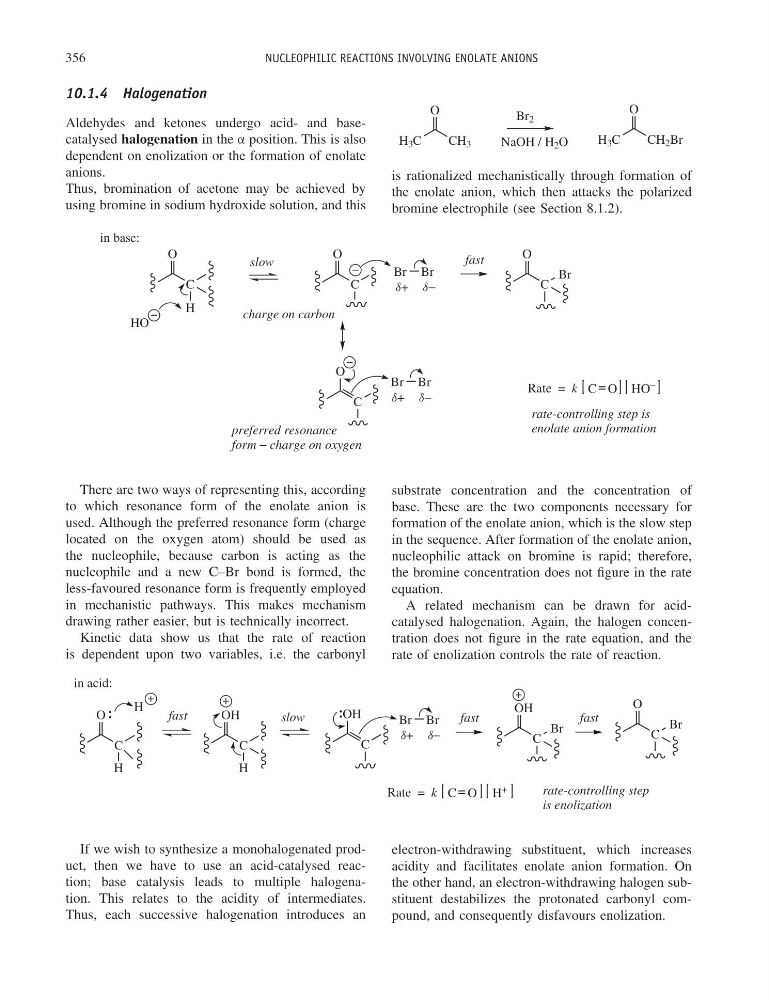
Aldehydes and ketones undergo acid- and basecatalysed halogenation in the α position. This is also
dependent on enolization or the formation of enolate
anions.
Thus, bromination of acetone may be achieved by
using bromine in sodium hydroxide solution, and this
NaOH / H 2 O
O
H 3 C
CH 3
O
H 3 C
CH 2 Br
Br 2
is rationalized mechanistically through formation of
the enolate anion, which then attacks the polarized
bromine electrophile (see Section 8.1.2).
Br Br
Br Br
in base:
fast
rate-controlling step is
enolate anion formation
Rate = k
preferred resonance
form − charge on oxygen
HO
−
charge on carbon
O
C
O
C
O
C
Br
d+ d−
O
C
H
slow
HO
d+ d−
C O
There are two ways of representing this, according
to which resonance form of the enolate anion is
used. Although the preferred resonance form (charge
located on the oxygen atom) should be used as
the nucleophile, because carbon is acting as the
nucleophile and a new C–Br bond is formed, the
less-favoured resonance form is frequently employed
in mechanistic pathways. This makes mechanism
drawing rather easier, but is technically incorrect.
Kinetic data show us that the rate of reaction
is dependent upon two variables, i.e. the carbonyl
substrate concentration and the concentration of
base. These are the two components necessary for
formation of the enolate anion, which is the slow step
in the sequence. After formation of the enolate anion,
nucleophilic attack on bromine is rapid; therefore,
the bromine concentration does not figure in the rate
equation.
A related mechanism can be drawn for acidcatalysed halogenation. Again, the halogen concentration does not figure in the rate equation, and the
rate of enolization controls the rate of reaction.
in acid:
OH
C
H
slow
OH
C
Br Br
fast
OH
C
Br
d+ d−
fast
O
C
Br
rate-controlling step
is enolization
H +
O
C
H
H
fast
Rate = k C O
If we wish to synthesize a monohalogenated product, then we have to use an acid-catalysed reaction; base catalysis leads to multiple halogenation. This relates to the acidity of intermediates.
Thus, each successive halogenation introduces an
electron-withdrawing substituent, which increases
acidity and facilitates enolate anion formation. On
the other hand, an electron-withdrawing halogen substituent destabilizes the protonated carbonyl compound, and consequently disfavours enolization.
NUCLEOPHILIC REACTIONS INVOLVING ENOLATE ANIONS
10.1.4 Halogenation
Aldehydes and ketones undergo acid- and basecatalysed halogenation in the α position. This is also
dependent on enolization or the formation of enolate
anions.
Thus, bromination of acetone may be achieved by
using bromine in sodium hydroxide solution, and this
NaOH / H 2 O
O
H 3 C
CH 3
O
H 3 C
CH 2 Br
Br 2
is rationalized mechanistically through formation of
the enolate anion, which then attacks the polarized
bromine electrophile (see Section 8.1.2).
Br Br
Br Br
in base:
fast
rate-controlling step is
enolate anion formation
Rate = k
preferred resonance
form − charge on oxygen
HO
−
charge on carbon
O
C
O
C
O
C
Br
d+ d−
O
C
H
slow
HO
d+ d−
C O
There are two ways of representing this, according
to which resonance form of the enolate anion is
used. Although the preferred resonance form (charge
located on the oxygen atom) should be used as
the nucleophile, because carbon is acting as the
nucleophile and a new C–Br bond is formed, the
less-favoured resonance form is frequently employed
in mechanistic pathways. This makes mechanism
drawing rather easier, but is technically incorrect.
Kinetic data show us that the rate of reaction
is dependent upon two variables, i.e. the carbonyl
substrate concentration and the concentration of
base. These are the two components necessary for
formation of the enolate anion, which is the slow step
in the sequence. After formation of the enolate anion,
nucleophilic attack on bromine is rapid; therefore,
the bromine concentration does not figure in the rate
equation.
A related mechanism can be drawn for acidcatalysed halogenation. Again, the halogen concentration does not figure in the rate equation, and the
rate of enolization controls the rate of reaction.
in acid:
OH
C
H
slow
OH
C
Br Br
fast
OH
C
Br
d+ d−
fast
O
C
Br
rate-controlling step
is enolization
H +
O
C
H
H
fast
Rate = k C O
If we wish to synthesize a monohalogenated product, then we have to use an acid-catalysed reaction; base catalysis leads to multiple halogenation. This relates to the acidity of intermediates.
Thus, each successive halogenation introduces an
electron-withdrawing substituent, which increases
acidity and facilitates enolate anion formation. On
the other hand, an electron-withdrawing halogen substituent destabilizes the protonated carbonyl compound, and consequently disfavours enolization.